
Solvait and Techaniat: Closing the Last Mile of HR Software Implementation
Solvait has signed a strategic partnership with Techaniat, the enterprise technology house that has run out of Damascus since 2001 and now works across six countries, including Riyadh and Doha. The aim is direct: bring Solvait's AI HR platform to more organizations across the markets Techaniat serves, with implementation, training, and support close to the customer. Both companies build on the same platform, Microsoft Dynamics 365, which makes integration cleaner and risk lower.
This isn't really a partnership slogan. It's a pattern we see in every project. The best HR system in the world changes nothing if it isn't implemented and adopted on the ground. What decides success isn't the signature. It's the months that follow it.
Key takeaways
HR software ROI is decided at implementation and adoption, not at the feature-selection stage.
Only 24% of HR functions maximize value from their current HR technology, per Gartner (2024).
A local partner changes four things: time to go live, adoption quality, support distance, and getting local compliance right the first time.
Microsoft Dynamics 365 plus a regional integration partner lowers project risk by building on a standard core and connecting to your existing systems.
The Solvait and Techaniat partnership shortens that last mile across Riyadh and the region.
Why is HR software ROI decided at rollout, not at signing?
Most HR system purchases turn on the feature list. The trouble is that features don't produce value on their own. People produce it, when they actually use the system.
The numbers are blunt. Gartner found in 2024 that only 24% of HR functions maximize the business value of their technology. In the same research, 69% of employees said they'd hit at least one barrier using HR technology in the past year. The features were there. Usage stalled.
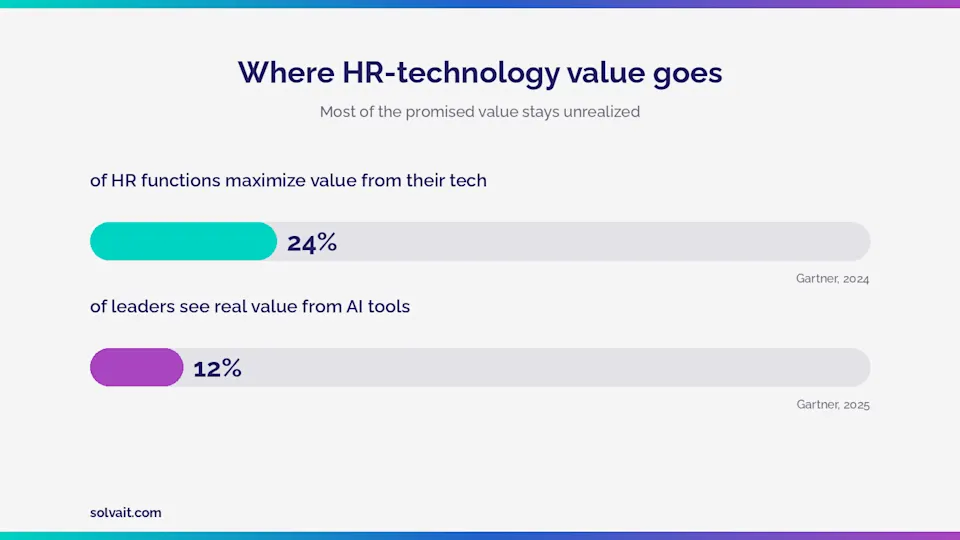
AI didn't change this equation. It exposed it. Gartner reported in 2025 that 88% of HR leaders say their organizations haven't yet realized significant business value from AI tools. The technology is ready. Adoption is the bottleneck.
And here's where projects actually break. It's rarely the product. It's weak adoption, thin training, and distant support that doesn't arrive when it's needed. On top of that, 73% of HR leaders report their employees are fatigued by change, and 74% say their managers aren't equipped to lead it (Gartner, 2024). Implementation isn't a logistics step after the purchase. It's where the project is won or lost.
What actually changes when a local partner stands behind your platform?
The difference is tangible, and it shows up in four places.
Time to go live: A team on the ground moves faster than coordination across time zones. Decisions get made in the same room.
Adoption quality: In person training in the team's own language and context lifts usage more than any generic guide. And usage, as we saw, is where value comes from.
Support distance: When something stalls two days before payroll, the gap between close local support and a ticket waiting on another time zone can be the gap between a small fix and a crisis.
Local compliance: GOSI, Qiwa, and Mudad aren't fields you fill in later. Setting them up correctly the first time saves months of correction.
Dimension | No local partner | With regional implementer |
Time to go live | Slower, remote coordination | Faster, team on the ground |
Adoption & training | Generic guides | In-person, in the team's language |
Support distance | Tickets across time zones | Local, close support |
Local compliance | Generic setup | GOSI, Qiwa, Mudad right first time |
Integration | Isolated silos | Fits your existing systems |
That's Techaniat's role in the partnership. Solvait builds the platform and the agents; Techaniat brings a quarter century in systems integration, cybersecurity, and training, with a direct presence in the market.
Why does Microsoft Dynamics 365 plus a regional integrator lower project risk?
Big system projects fail expensively. In the landmark McKinsey and University of Oxford study, large IT projects ran 45% over budget on average and delivered 56% less value than promised. A large share of that risk comes from over customization and fragile integration.
A standard core cuts that risk down. Solvait is built on Microsoft Dynamics 365, and Techaniat implements on the same platform. The result is one solid stack instead of a closed tool that's hard to connect to the rest of your business.
That also addresses the second big risk: isolated silos. An HR system that doesn't talk to your finance or existing systems creates manual work and errors. Building on a known enterprise core, with a partner who understands your environment, keeps your data connected and secure.
Let's be fair about it. Global platforms are strong and mature in large markets. But implementation depth and local compliance in fast moving regional markets tend to be thinner. That last mile is exactly what a regional partner fills, and it's the heart of this partnership.
Where Solvait fits
Solvait AI HR is a complete platform on Microsoft Dynamics 365. It runs the full HR lifecycle, from core HR to payroll that's ready for the Wage Protection System and GOSI, and it adds agents that do real work under human oversight: operations, compliance monitoring, payroll processing, and Arabic-language service over WhatsApp.
The numbers we build on are concrete: 260+ enterprise clients, 99.9% uptime, and a 30-day setup, backed by ISO 27001:2022 and Microsoft Certified Partner status. With Techaniat as a regional implementation partner, those capabilities reach more organizations, and they get deployed properly the first time.
Want to see what agentic HR automation looks like in your context? Start with Solvait AI HR.
Ready for the practical step? Book a demo and we'll show you the system applied to your team's reality.
FAQ
What did Solvait and Techaniat announce?
The two companies signed a strategic partnership to bring Solvait's AI HR platform to more organizations across the markets Techaniat serves, with local implementation, training, and support. Both work on Microsoft Dynamics 365, which makes integration cleaner.
Why does implementation matter more than the feature list?
Because value comes from usage. Gartner found in 2024 that only 24% of HR functions maximize the value of their technology. Weak adoption and thin training, not missing features, are the most common reasons projects stall.
How does a local partner reduce HR project risk?
It speeds up go live, lifts adoption through in-person training, keeps support close, and gets local compliance such as GOSI, Qiwa, and Mudad right the first time. That cuts costly post launch correction.
Does Solvait replace my finance or existing systems?
No. Building on Microsoft Dynamics 365 with an integration partner lets HR connect to your existing systems rather than sit in a silo, which reduces manual work and errors.
References
Gartner : Only 24% of HR Functions Are Maximizing the Business Value from HR Technology, 2024 (the 24% and 69% figures).
Gartner : 88% of HR Leaders Say Their Organizations Have Not Realized Significant Business Value from AI Tools, 2025 (the 88% figure).
Gartner : Leader and Manager Development Tops HR Leaders' 2025 Priorities, 2024 (change fatigue 73% and 74%).
McKinsey & University of Oxford : Delivering large-scale IT projects on time, on budget, and on value (45% over budget, 56% less value, the landmark study).
Techaniat : Official website, 2026 (founded 2001, six countries, integration and compliance services).
Ready to see Solvait in action?
Book a personalized demo and see how Solvait's AI-powered HR platform can transform the way your team works.
Tags
Related Posts

Performance Appraisal Calibration: Why Ratings Differ
Two managers, same work, different scores-how performance appraisal calibration keeps every rating fair and defensible in Saudi Arabia.
Sep 29, 2026
AI CV Screening: How It Ranks Arabic and English CVs
How AI CV screening reads Arabic and English CVs, scores each applicant with strengths and gaps, and what Saudi recruiters should still decide themselves.
Sep 17, 2026
Solvait and ZONE Partner to Expand AI Solutions
Solvait and ZONE sign a strategic partnership uniting an AI native HR platform with proven digital transformation delivery for Saudi enterprises .
Sep 8, 2026