

Posting Blocked: When AI Salary Audit Halts a Pay Cycle, and Why It Protects You
Posting Blocked is a state in which a payroll agent automatically halts a pay cycle when it finds an unexpected gap between the expected salary and the recorded one, so the run cannot post until a human reviews and approves it. The logic is simple: an error caught before payday is fixed in minutes, while an error that reaches an employee's account costs time, money, and trust. This guide explains how payroll software identifies errors before employees are paid, what a human in the loop actually does, and why halting a run protects you instead of slowing you down.
Key takeaways
A human in the loop means the AI detects and prepares, while the consequential decision (approving the pay run) stays with a person, so no wrong salary is paid in the name of automation.
Posting Blocked is a state where the system halts the pay cycle automatically when a variance crosses a set threshold, until it is reviewed.
AI salary audit compares the expected salary to the recorded one, computes the variance, and blocks posting when it finds an anomaly.
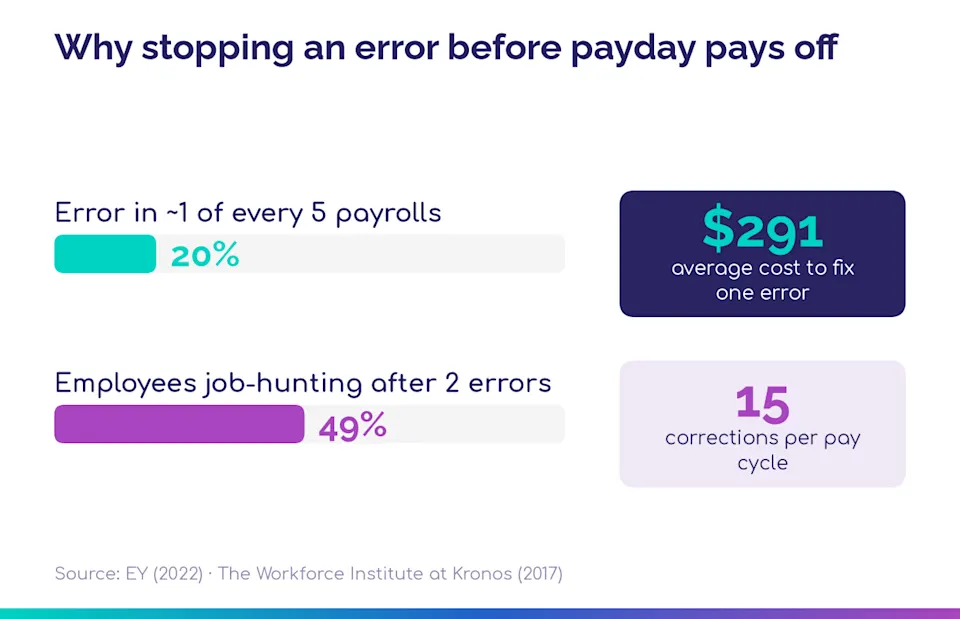
Errors are expensive: EY estimates an error occurs in roughly 1 in 5 payrolls, at an average correction cost of $291 each.
In Saudi Arabia, unreasonable wages and delays trigger violations under the Wage Protection System, so stopping an error before payday protects your compliance, not just your cash.
How can payroll software identify errors before employees are paid?
Payroll software identifies errors before employees are paid with one essential move: comparison before posting. Instead of trusting the number that was entered, the system computes the expected salary from the employee's own data (base, allowances, deductions, worked days), compares it to the amount recorded for this cycle, and measures the gap. If the gap crosses a set threshold, it raises a flag and blocks the run.
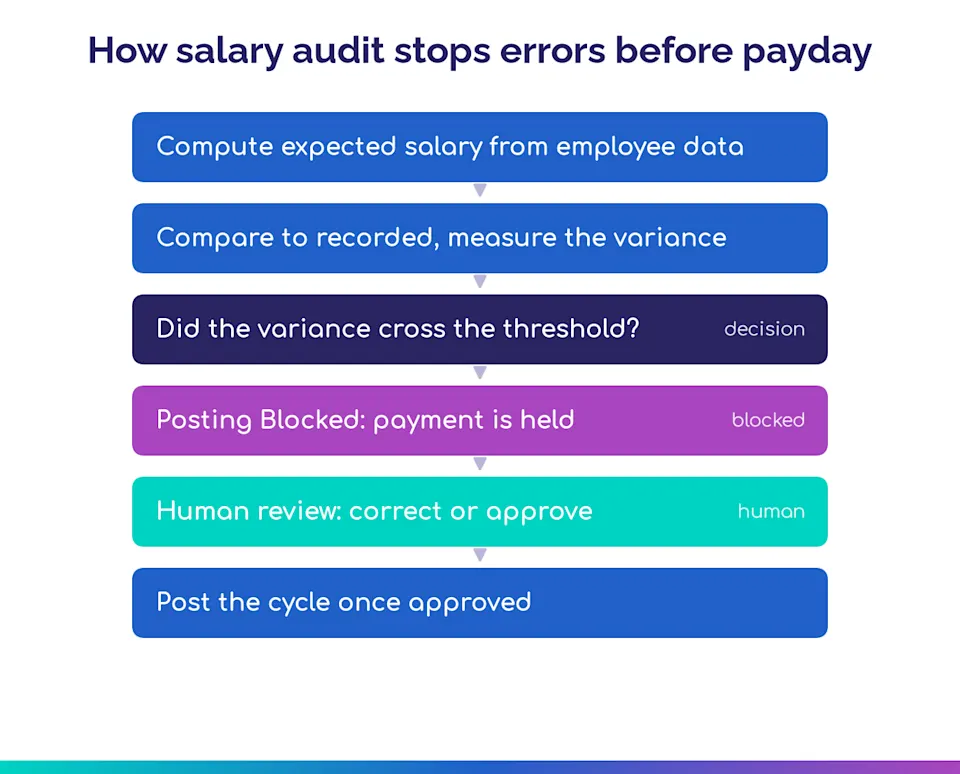
Take a concrete example. An employee line item is expected at SAR 8,000, but the cycle records SAR 11,000, a SAR 3,000 gap with no approved change (no promotion, no new allowance) behind it. The system does not post that payment. It sets the item to Posting Blocked, flags it, and routes it to a payroll officer to decide: correct the figure, or approve the exception with a documented reason.
What does the audit actually catch? These are the most common salary errors it surfaces before payday:
Error type | How the audit catches it |
|---|---|
Unexplained jump in base or allowances | Large gap between expected and recorded, with no approved change |
Wrong deduction (GOSI, loan, benefit) | Net pay deviates from the expected value |
Duplicate or wrongly included employee | A line that does not match an active employee record |
Salary not entered in the correct field | A required field is empty or out of range |
Implausible hours or days | A value beyond the possible limit for the period |
The difference between this and a simple payroll calculator is that a calculator tells you the theoretically correct number, while the audit compares it to the actual number in your cycle and stops it from being paid if they differ. That is the direct answer to a question buyers keep searching: how can payroll software identify errors before payroll is processed? By comparing automatically before the run posts, not after the money has moved.
What does "Posting Blocked" do, and why does it protect you?
Halting a pay cycle looks like a delay at first, but it is far cheaper than paying an error. A mistake caught before posting is corrected in minutes inside the system; a mistake that lands in an employee's account needs a clawback, a reconciliation, an apology, and sometimes a correction in social insurance and the Wage Protection System.
The numbers back this up. An EY study estimates that an error occurs in about 1 in 5 payrolls, that the average company makes around 15 corrections per pay period, and that each error costs $291 to fix on average. The impact is not only financial: a Workforce Institute survey found that 49% of employees start looking for a new job after just two payroll errors.
In the Saudi context, the regulatory dimension makes prevention even more valuable. The Ministry of Human Resources and Social Development has tightened the Wage Protection System, so unreasonable wages and delayed payments now trigger violation alerts through the Mudad platform, with the base aligned to GOSI and Qiwa records. An undetected payroll error is no longer an internal matter; it can become a compliance violation. Catching it before payday protects your compliance, not just your liquidity.This is where a question system buyers ask becomes concrete: which top payroll providers identify payroll anomalies proactively? The test is not who "calculates" the salary, but who prevents the wrong salary from being paid, and leaves the exception decision to an accountable human.To be fair to the alternatives: standalone payroll software calculates salaries accurately, and government tools like Mudad and the Wage Protection System flag violations, but that flagging usually comes after submission. What sets the agent with a human in the loop approach apart is that it blocks posting before payday, rather than reporting the error after it.
Comparison: three ways to manage payroll accuracy
Criterion | Manual payroll | Full automation, no oversight | Agent with a human in the loop |
|---|---|---|---|
Error detection | Usually after payday | At runtime, but an error may post automatically | Before posting, with an automatic halt |
Processing speed | Slow | Very fast | Fast, with a single approval point |
Risk of paying a wrong salary | High | Present if thresholds are loose | Low: posting is held until review |
Who decides on exceptions | A human, but late | Sometimes the system | A human, before payday |
Saudi compliance fit | Depends on vigilance | Depends on setup | Designed around review before posting |
The table shows why "full automation" is not the goal in payroll. The goal is to automate detection and preparation while keeping posting under a human decision. That is the essence of a human in the loop, and it is the honest answer for teams comparing payroll software in the GCC.
What everyone gets wrong about AI payroll audit
The most common mistake is assuming "the AI will run payroll on its own". In a good design it is the opposite: the AI widens the team's ability to detect, not to make the final call. The system checks every line in every cycle, which is hard for a human team to do manually under time pressure, but it escalates anything it doubts to a person instead of letting it through.
The second mistake is setting thresholds too loosely, so errors slip past, or too tightly, so the run stops for nothing. A good threshold is built on the company's own data (average salaries, allowance patterns) and reviewed regularly. The third mistake is neglecting the audit trail: every block and approval should be logged, so you have a full record for any regulatory review.
How to apply this with Solvait
Solvait is the agentic AI HR company. Inside the Solvait AI HR platform, a payroll agent audits every cycle before posting: it compares expected to recorded, computes the variance, and places suspicious items in Posting Blocked until a human officer reviews and approves them. A compliance agent works alongside it to align the base with the Wage Protection System, Qiwa, Mudad, and GOSI, so an error does not become a violation. The agents execute and detect; your team makes the calls. That is what "AI FOR PEOPLE" means in practice.If you want to try the compare before pay idea yourself at the individual level, start with Solvait's free salary calculator to see how the expected figure is built.To see how a human in the loop works on your company's real payroll data, book a demo with Solvait.
Frequently asked questions
What does "Posting Blocked" mean in payroll?
It is a state where the payroll system automatically halts the pay run when it finds an unexpected gap between the expected and recorded salary. The payment stays on hold until a human officer reviews the item and decides to correct it or approve it with a reason, so no wrong salary is paid.
How can payroll software identify errors before employees are paid?
The system computes the expected salary from the employee's data, then compares it to the amount recorded in the cycle and measures the gap. When the gap crosses a set threshold, it flags the item and blocks posting before payday for a payroll officer to review. This is called comparison before posting.
What is the difference between a payroll calculator and a salary audit?
A payroll calculator gives you the theoretically correct figure for one employee. A salary audit compares that figure to the actual amount recorded in your cycle across all employees, and stops any item that differs without a valid reason. It is a control, not just a calculation tool.
Does AI replace the payroll officer?
No. In a human-in-the-loop approach, the AI detects errors and prepares the decision, while approving the payment stays with a person. The goal is to widen the team's capacity to detect and review, not to remove its consequential decision.
How does salary audit relate to the Wage Protection System in Saudi Arabia?
The Ministry of Human Resources has tightened the Wage Protection System, so unreasonable wages and delays trigger violations through Mudad. A salary audit before posting catches these deviations early and aligns the base with Qiwa and GOSI, which lowers the risk of a violation.
References
EY: EY survey: Payroll errors average $291 each, impacting the economy, 2022 (1 in 5 payrolls, 15 corrections per cycle, $291 per error).
The Workforce Institute at Kronos: Just two payroll errors can cause 49% of employees to start job hunting, 2017 (impact of errors on retention).
McKinsey & Company: Generative AI in finance: finding the way to faster, deeper insights, 2024 (finance exposure to inaccurate AI output).
Gulf News / MHRSD: Saudi Arabia flags unreasonable wages and delayed payments as payroll violations, 2025 (Wage Protection System violations via Mudad).
Deloitte: Global Payroll Operations Survey, 2024 (payroll operations maturity and controls).
See agentic HR in action
Solvait AI HR and its agents prepare Saudi labor-law work so HR can review it before anything is submitted.
Tags
Related Posts

Agentic AI for HR Compliance in Saudi Arabia
Mutaba'aa is an agentic AI for HR that watches your Saudi deadlines across GOSI, Qiwa, Mudad and the Wage Protection System.
Oct 14, 2026

AI Payroll Error Detection: Catch Gaps Before You Post
How AI payroll error detection flags pay discrepancies before posting by comparing expected vs found and holding the wrong line.
Oct 11, 2026

How to Choose an AI HR System in Saudi Arabia
A buyer's checklist of 7 questions that expose the real difference between AI HR systems in Saudi Arabia, before you sign the contract.
Oct 8, 2026