
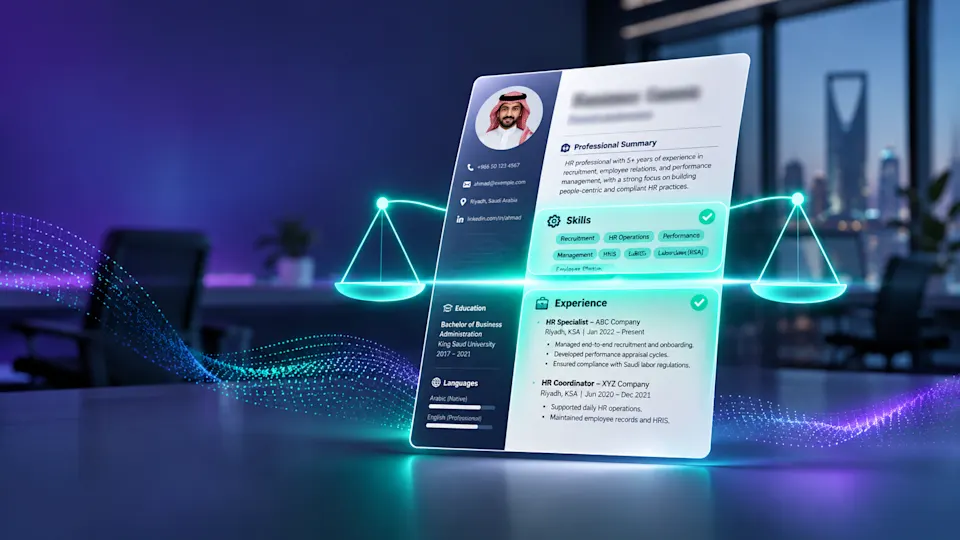
Arabic CV Screening Bias in ATS: What a Fair System Must Do, and Must Not
ATS CV screening is when software reads your CV automatically, pulls out your experience and skills, and ranks you against other applicants before any human sees you. The trouble is that many of these systems were trained on Western data and English CVs, so they stumble on an Arabic CV: a name written several ways, a Hijri date, a right-to-left layout. A capable candidate gets filtered out for a reason that has nothing to do with capability. This guide explains where bias enters Arabic CV screening, what a fair ATS must do, and what it must never do no matter how "smart" it looks.
Key takeaways
A biased ATS rejects a sound CV for cosmetic reasons: a name format, a Hijri date, an Arabic layout, not weak qualifications.
A University of Washington study (2024) found AI resume screeners favored white associated names 85% of the time and female associated names only 11%.
A fair ATS ranks by skills not by name, reads Arabic and English with equal accuracy, and explains the match score instead of hiding it.
No system may auto reject a candidate without human review, and none may be a black box that cannot explain its decision.
Saudi Arabia's Personal Data Protection Law (PDPL) gives the applicant the right to be informed about, and challenge, a solely automated decision.
In Saudi Arabia this has grown past a technical footnote. Saudi women are entering the workforce at record rates: their labour force participation reached 36.3% in the first quarter of 2025, per the General Authority for Statistics. A screening system that quietly penalises female-associated names works against a national priority, and drops exactly the talent companies are trying to hire.
What is ATS CV screening, and where does bias start?
An ATS (Applicant Tracking System) is the software that receives applications, parses every CV automatically, and turns it into structured data: name, years of experience, skills, past titles. It then computes a "match score" between you and the role and ranks applicants on it. That means one simple, decisive thing: if the system misreads your CV, you lose before anyone meets you. Bias here rarely comes from bad intent. It comes from training data and from weak handling of Arabic. Here are the four places it actually enters.
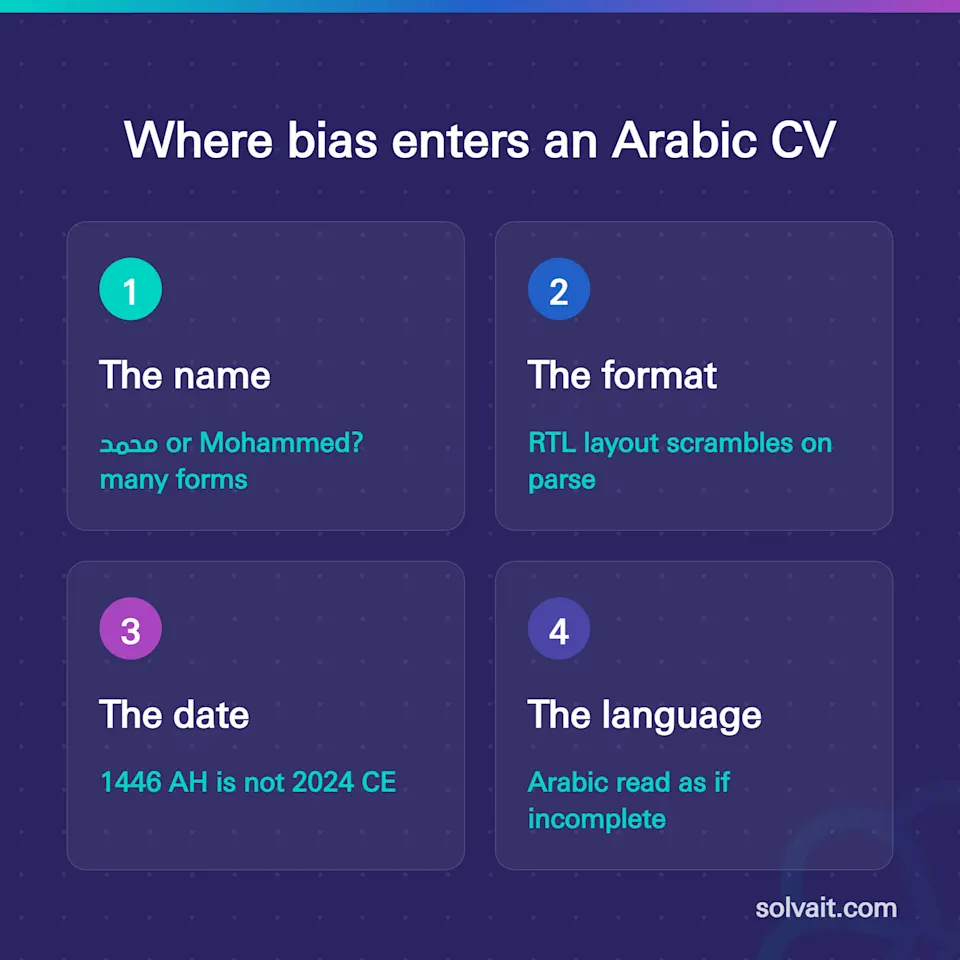
The name. An Arabic name is written in more than one form: محمد and محمّد, and its English transliteration varies (Mohammed, Muhammad, Mohamed). A system trained on Western names may read the Arabic name as "unusual" data and rank it lower. Worse, some models infer gender or ethnicity from a name and act on that inference.
The format. An Arabic CV runs right to left, and many parsers were built left to right. A two-column table, or a nicely designed layout, can collapse into scrambled text on extraction, and your experience disappears with it.
The date. 1446 AH is not 2024 CE. A system that counts experience only in the Gregorian calendar may read Hijri dates as meaningless numbers and shortchange your years of work.
The language. A CV written in Arabic, or mixing Arabic and English, can be treated by a weak parser as "incomplete". That is not a gap in the candidate. It is a gap in the tool.
The early conclusion: most of the rejections we see are not rejections of merit. They are failures of reading. That is why running an ATS resume check before applying is smart for a job seeker, and why choosing a fair system is a responsibility for the employer.
What must a fair ATS do with Arabic CVs?
A fair system is not an "AI-free" system. It uses AI where it helps and constrains it where it harms. Five things it must do.
Rank by skills, not by name. Matching rests on real experience, skills, and titles, not on a name, a photo, or where someone graduated. Some systems offer "blind screening" that hides the name and gender in the first stage. That is a good practice worth switching on.
Read Arabic and English with equal accuracy. A real bilingual parser recognises the many forms of a name, understands right-to-left Arabic, and converts a Hijri date to its accurate equivalent. The real test is simple: upload an Arabic CV and an English CV for the same candidate, and confirm the result is the same.
Explain the match score. A number alone is not enough. A fair system shows why a candidate got that score: which skills matched, which were missing. That is what lets a recruiter review rather than trust blindly.
Keep the human deciding. The system ranks and suggests; a person decides. No final rejection comes from the machine alone. This is not only an ethical preference. In Saudi Arabia it is a regulatory requirement, as we will see.
Audit it regularly. Review the system from time to time: does it reject one group more than others with no job-related reason? Auditing catches bias before it hardens into a pattern.
Criterion | Biased ATS | Fair ATS |
|---|---|---|
Basis of ranking | Name, photo, school | Real skills and experience |
Arabic | Reads it broken or scrambled | Reads it as accurately as English |
Hijri dates | Ignored or miscounted | Converted accurately to years |
Match score | A closed number, no reason | A score with a clear reason |
Final decision | Automatic rejection, no review | System suggests, human decides |
Look at the last row. The difference between the two systems is not "how smart" each is. It is who holds the decision. And the more autonomous a system becomes, the more that safeguard matters, not less.
What must an ATS never do, and where does the human stay in charge?
The closer a system gets to acting on its own, the higher the stakes. These practices no screening system should perform, however advanced it looks. Never fully auto-reject. Letting the machine close the door on a candidate with no human in the loop is a professional and a legal error at once. Saudi Arabia's Personal Data Protection Law (PDPL), whose Implementing Regulation became fully enforceable on 14 September 2024, gives the individual the right to be informed about, and to object to, decisions based solely on automated processing. Any screening pipeline that rejects without human involvement puts the company on the wrong side of that right. Never be a black box. A system that gives a score and cannot explain it cannot be reviewed or defended. If a recruiter cannot explain why a candidate was rejected, the reason usually does not hold up. Never learn from past bias unchecked. The best-known case here is Amazon, which scrapped an AI recruiting tool after it learned from past CVs that were mostly men's and began downgrading any CV containing the word "women's", per Reuters (2018). A system that learns from biased decisions reproduces the bias with more confidence. Never use attributes unrelated to the job. Gender, origin, age, home city: none of these should move a match score. Yet inferring gender or ethnicity from a name does exactly that implicitly. The University of Washington study (2024), which had three large language models rank real CVs, found the models favored white-associated names 85% of the time, and never once preferred Black-male-associated names over white-male ones.
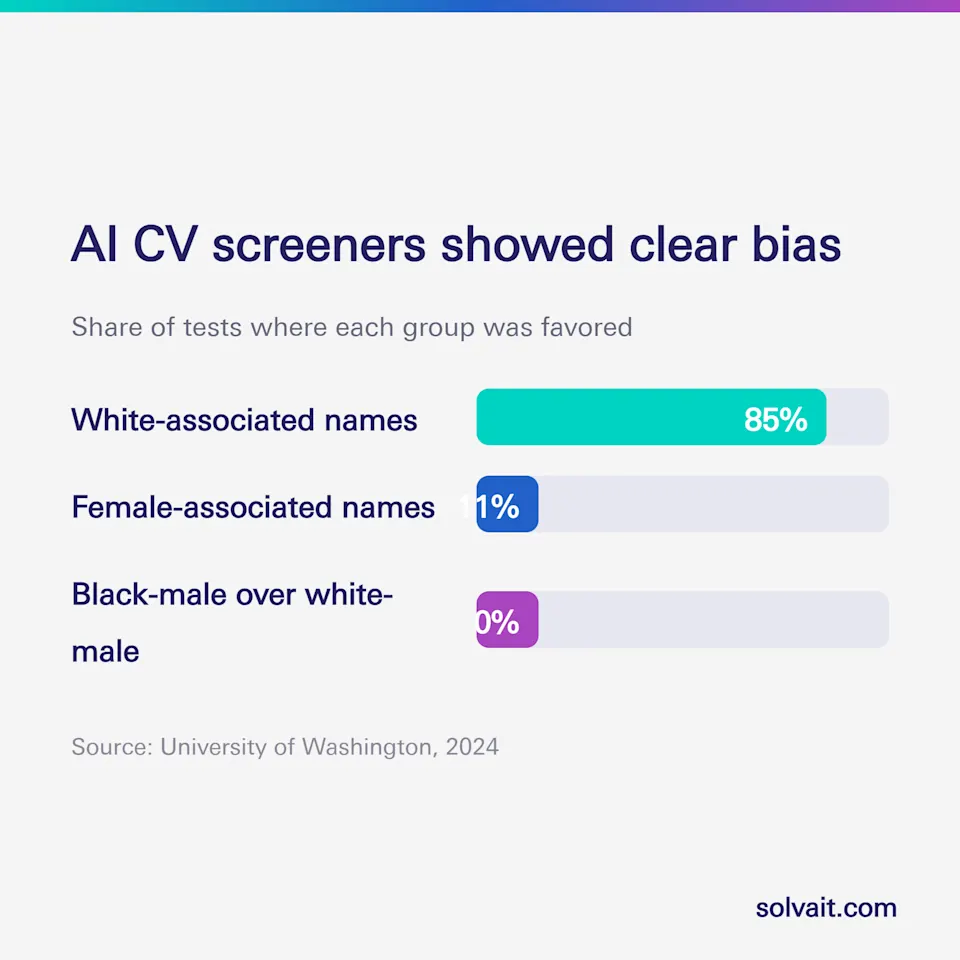
That number is the whole point. When a smart system drifts this far in a controlled research setting, picture its effect on a live hiring pipeline running quietly every day. Intelligence alone is not fairness. Fairness is a design decision backed by continuous human oversight.
Quick checklist: is your screening system fair?
Run these six checks before you trust any ATS:
Does it read an Arabic CV as accurately as an English one? (Try the same name in two forms.)
Does it convert Hijri dates into correct years of experience?
Does it show the match score with a reason, not a closed number?
Does it always keep the final rejection with a human?
Does it allow hiding the name and gender in the first screening stage?
Have you reviewed its results recently for an unjustified rejection pattern against one group?
If any answer is "no", you are risking more than fairness. You are losing real talent that leaves your funnel without your ever knowing.
Where do Solvait's tools stand on this?
Solvait, the agentic AI HR company, built its tools on this principle: the AI assists, the human decides. In its recruitment product, Solvait Attract, the parser reads CVs in Arabic and English, extracts skills and experience, and gives a match score with its reason, then leaves the final call to the recruiter. It is AI-assisted recruitment, not a machine that rejects on its own.
For job seekers who want to be sure before they apply, Solvait offers a free ATS CV checker: upload your CV and see whether a system reads it properly before you send it. It is as close as it gets to a "test cv ats free" in the words people actually search.
At the platform level, Solvait Agentic AI HR is Solvait's agentic HR platform that runs the HR lifecycle with human oversight at every step, keeping that same balance: the machine executes, your team makes the calls.
If you want to see how a fair system screens Arabic CVs without dropping talent over a name or a format, book a Solvait demo and we will show you the difference on a real CV.
FAQ
What does ATS mean in recruitment?
ATS stands for Applicant Tracking System. It is software that receives job applications, parses each CV automatically, extracts skills and experience, then ranks applicants with a match score against the role before a human reviews them.
Why does an ATS reject my CV even though I am qualified?
Usually because the system failed to read your CV, not because you are unqualified. Common causes: a complex Arabic layout that scrambles on extraction, a Hijri date the system cannot count, a name format unfamiliar to it, or two mixed languages. Run an ATS CV check before you apply.
Is AI screening biased against Arabic names?
It can be, if the system was trained on Western data and English CVs. Studies such as the University of Washington 2024 work found a clear preference for some names over others. A fair system ranks by skills, not by name, and is audited regularly to catch any bias pattern.
Does Saudi law allow fully automatic rejection of a candidate?
The Personal Data Protection Law (PDPL) gives the individual the right to be informed about, and object to, decisions based solely on automated processing. So the final decision must stay with a human, not be issued by the system alone.
References
University of Washington (iSchool): AI tools show biases in ranking job applicants' names according to perceived race and gender, 2024 (supports the 85% figure and name preference).
PwC Middle East: Workforce Hopes and Fears Survey 2025, 2025 (AI adoption across the region).
SDAIA / Saudi Personal Data Protection Law (PDPL) and its Implementing Regulation, fully enforceable since 14 September 2024 (right to object to automated decisions).
Reuters: Amazon scraps secret AI recruiting tool that showed bias against women, 2018 (learning from biased data).
General Authority for Statistics (GASTAT): Labour Market Statistics, Q1 2025, 2025 (Saudi female participation 36.3%).
See agentic HR in action
Solvait AI HR and its agents prepare Saudi labor-law work so HR can review it before anything is submitted.
Tags
Related Posts
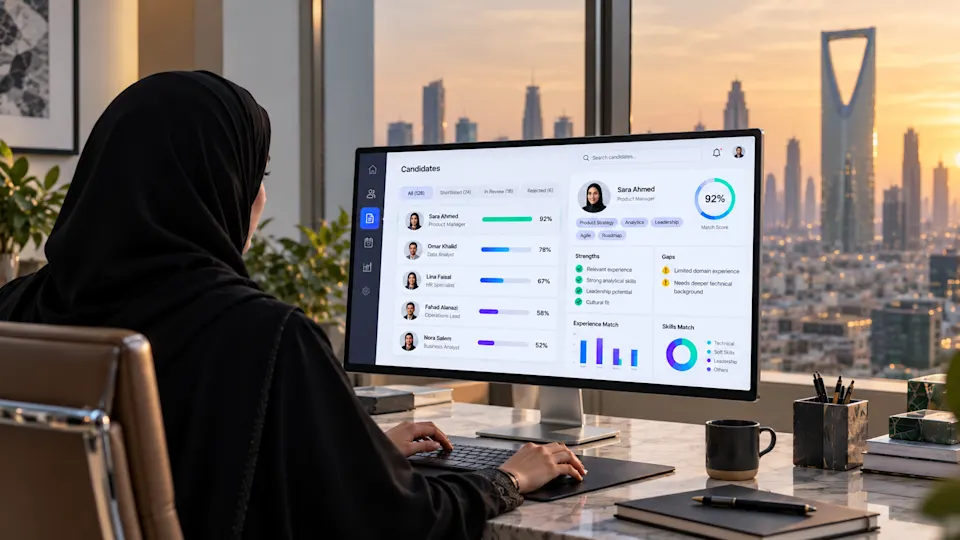
AI CV Screening: How It Ranks Arabic and English CVs
How AI CV screening reads Arabic and English CVs, scores each applicant with strengths and gaps, and what Saudi recruiters should still decide themselves.
Sep 17, 2026
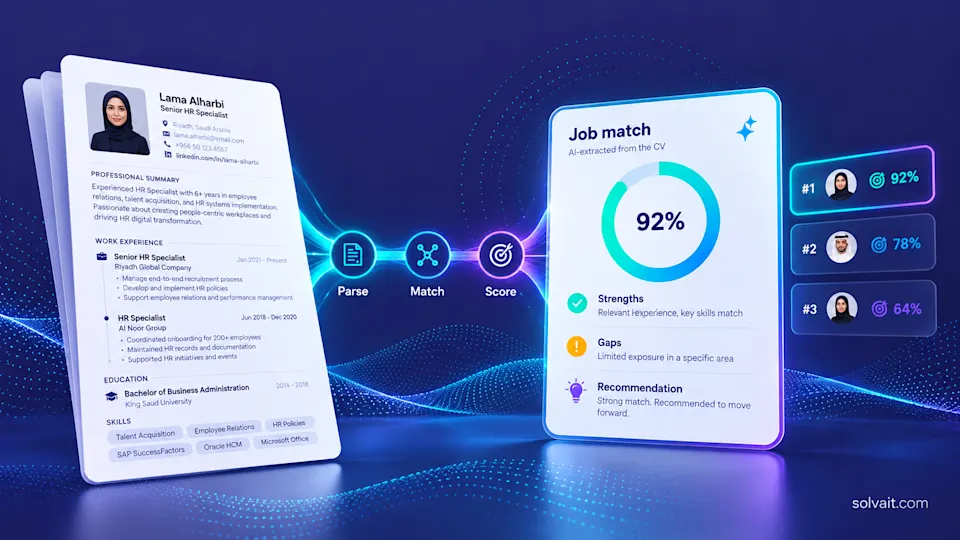
CV ATS Score: Why the AI Ranked This Candidate
A CV ATS score gives every candidate a match number plus the reason behind it, so you walk into the selection meeting with a ranking you can defend.
Oct 27, 2026

Applicant Tracking System (ATS): Employer's Guide
An applicant tracking system reads and ranks CVs before a recruiter sees them. Here's how an ATS works from the employer's side .
Oct 21, 2026