
You Ask, It Works Out the Form: The AI HR Assistant Inside PeopleHub (Ask Solvait AI)
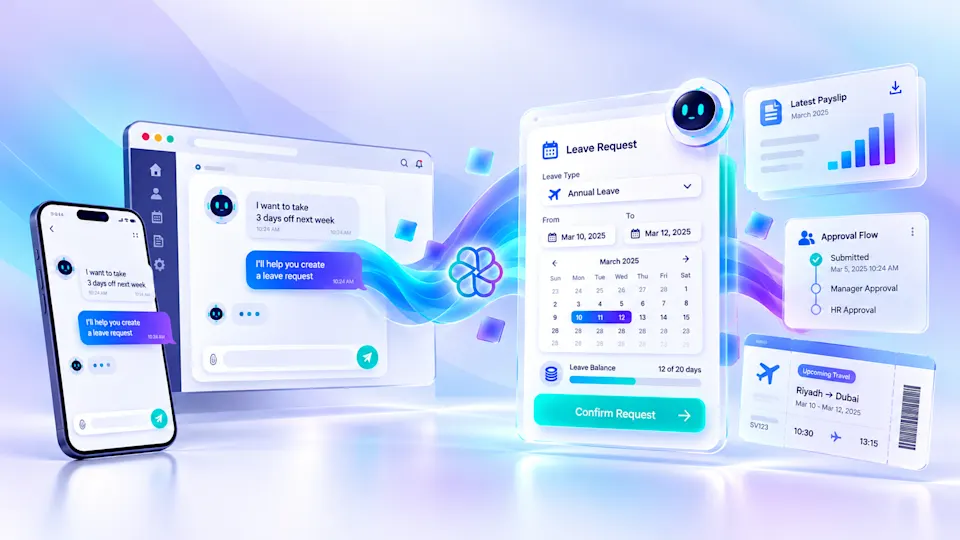
Ask Solvait AI is the AI HR assistant built into PeopleHub: an employee asks in plain language, the assistant works out what the request needs, drops a short ready made form into the chat, and completes it under the employee's own login and permissions. It works in Arabic and English, switching automatically, on web and mobile, and covers HR tasks from a single conversation. The idea is simple. Instead of hunting for the right screen, the employee says what they want and the form comes to them. The assistant does not act on its own. It completes what the employee asks, after the employee confirms the form.
Key takeaways
The AI HR assistant Ask Solvait AI turns a plain language request into a ready made form inside the chat.
It executes under the employee's own login and permissions only, and sees just their data (managers see their team), so it stays safe and scoped.
It is built into 40+ screens across web and mobile, works in Arabic and English with automatic switching, and you confirm every request before it is sent.
It covers leave, attendance, approvals, pay, travel, and documents from one conversation, and can open any screen on request.
It is a feature within Solvait's AI HR platform and part of employee self service, never a replacement for the user's decision.
What is Ask Solvait AI, and how is it different from a normal chatbot?
An AI HR assistant is not a chatbot that answers and leaves you to it. A traditional HR chatbot replies with information or a link, and the work of doing the task stays with you. Ask Solvait AI goes one step further: it understands the request, builds the form, and completes it after you confirm.
The important word here is execute. The assistant does not stop at answering. It finishes the request on the employee's behalf, within their permissions. And the decision still belongs to the employee, who confirms the form before it is sent.
Many companies in Saudi Arabia look for HR software that eases the load on the HR team. An assistant that completes routine requests means less time answering repeat questions, and faster service for the employee.
What does "you ask, it works out the form" mean?
This is the assistant's signature behavior. The employee types what they want in their own words, even when there is no ready shortcut for it. The assistant works out which fields the request needs and drops a short, ready made form straight into the chat.
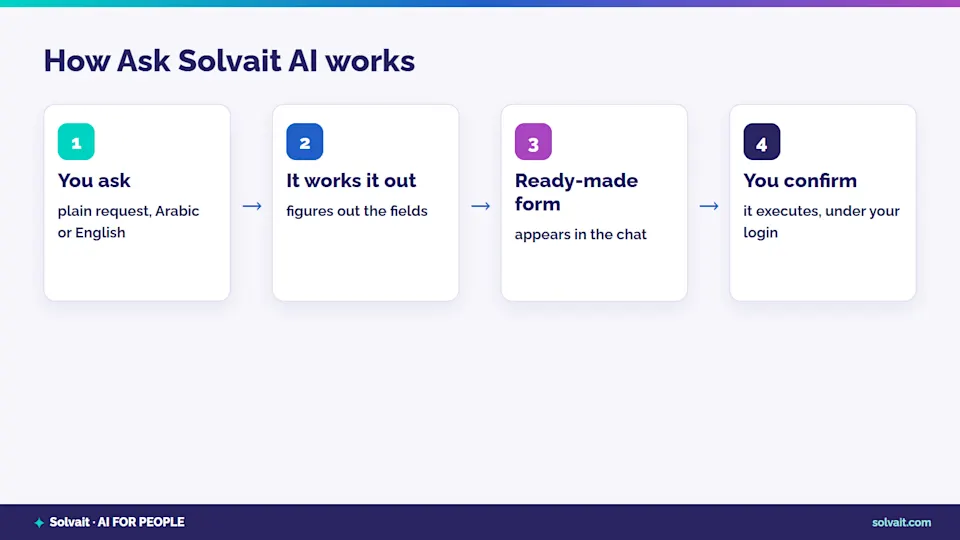
The result is that the employee does not move from screen to screen hunting for the right place. A quick example: instead of opening a menu, then the leave screen, then the leave type, then the dates, the employee writes one sentence like "I need three days off starting Sunday," and the form arrives pre-filled, ready to confirm. That is what employee self-service looks like when it is genuinely easy.
What can it do from a single conversation?
Ask Solvait AI is not built for one task. One assistant covers most of what an employee needs day to day:
Leave and attendance: leave balance and who is away, submit leave or an excuse or overtime or remote work, clock in and out, and fix a missed clock-in.
Approvals: what is waiting for you, and approve, decline, or send back with a comment.
Pay: payslips, expense claims, loan requests, education allowances.
Travel and learning: travel options and fares and air-ticket requests, browse and enroll in courses, and request certificates.
Documents and navigation: HR letters and documents with file attachments in the chat, find a colleague or see a manager's team view, and open any screen just by asking.
This breadth is what makes HR automation something the employee actually feels, not just a slogan.
Does it take action automatically? And is it safe?
Yes it executes, but not on its own. The assistant acts on the employee's request and after they confirm the form, within their permissions only. This is a real distinction: it is an assistant that completes what it is asked to do, not an autonomous agent that decides for itself. The "agentic" label at Solvait is reserved for the Solvait Agentic AI HR platform and its agents, not for this assistant.
Safety rests on three rules:
It signs in as the employee: it sees only the employee's data, and a manager sees only their team's.
It stays on topic: it politely steers non-work questions back to HR tasks.
You confirm before it acts: no request is sent until you confirm the form, so the decision stays with you.
So the answer to a question people ask a lot is this: yes, an AI service desk can answer employee questions and take action, as long as the action is on the employee's request and within their permissions. That is exactly how Ask Solvait AI works.
Where do I find it inside PeopleHub?
The assistant is always within reach, not on a separate page. It is built into 40+ screens across web and mobile:
a card on the home dashboard.
a top bar icon on desktop.
a floating button on every mobile screen.
When opened, it appears as a panel beside the current page with no reload, so the employee keeps working with the conversation open. That answers another common question: yes, mobile HR apps can offer intelligent in app help and instant answers to employee questions, as PeopleHub does.
Why now? AI in HR
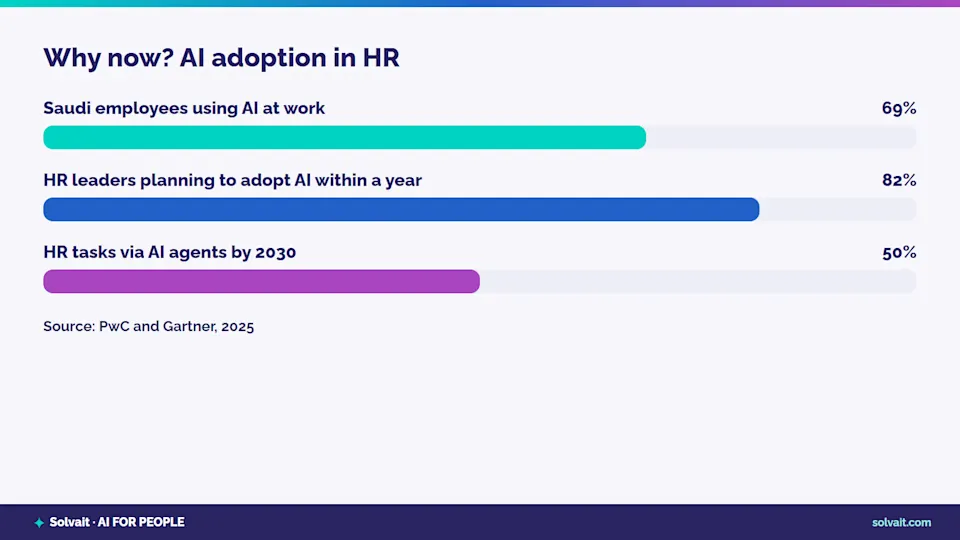
The trend is clear, regionally and globally. Employees are ready, and leaders are moving:
Metric | Figure | Source |
|---|---|---|
Saudi employees using AI at work | 69% | PwC, 2025 |
HR leaders planning to adopt AI within 12 months | 82% | Gartner, 2025 |
HR tasks managed by AI agents by 2030 | 50% | Gartner, 2025 |
The Saudi number stands out: 69% versus 54% globally, per PwC. In other words, the Saudi employee is more ready for AI tools than the global average, and that is an opening to deliver smarter employee self service.
A chatbot that replies, or an assistant that executes?
The difference is clear in one table:
Aspect | Traditional HR chatbot | Ask Solvait AI |
|---|---|---|
What it does | Replies with info or a link | Builds the form and executes the request |
Reaching the request | Screen after screen | You type the request in plain language |
Language | Usually one | Arabic and English, switches automatically |
Permissions | General | The employee's login, their data only |
Confirmation | Not applicable | You confirm the form before it is sent |
Where does Solvait fit in?
Ask Solvait AI is the daily face of a wider system. Solvait AI HR is Solvait's complete HR platform, built on Microsoft Dynamics 365, running the full HR lifecycle with four agents that work under your team's oversight. Inside this platform, PeopleHub is the self service app, and Ask Solvait AI is its assistant that handles employee requests from one conversation.
More than 260 enterprises across Saudi Arabia and the Gulf trust Solvait, with 99.9% uptime, up to 50% time savings, a 30 day go live, and ISO 27001:2022 certification.
To go deeper, see Solvait HR Assistant and Solvait AI HR, and try the free HR tools.
Want to see it on your own data? Book a demo with Solvait and we will show you how Ask Solvait AI works out the form and completes the request inside PeopleHub.
Frequently asked questions
What is Ask Solvait AI?
It is the AI HR assistant built into PeopleHub. An employee asks in plain language, the assistant works out what the request needs, drops a short form into the chat, and completes it under the employee's login after they confirm. It works in Arabic and English, on web and mobile.
Can an AI service desk answer employee questions and take action automatically?
Yes, but on the employee's request and after they confirm, within their permissions only. Ask Solvait AI completes what it is asked to do and does not act on its own. The "agentic" label is reserved for the Solvait Agentic AI HR platform, not for this assistant.
What is the difference between an HR chatbot and an AI HR assistant?
An HR chatbot replies with information or a link only. An AI HR assistant like Ask Solvait AI understands the request, builds the form, and completes it under the employee's permissions. The first answers, the second gets it done.
Do mobile HR apps offer intelligent in app help or instant answers to employee questions?
Yes. In PeopleHub, Ask Solvait AI appears as a floating button on every mobile screen and a card on the home dashboard, and opens as a panel beside the page with no reload, giving instant answers and actions.
What language does the assistant work in?
Arabic and English, switching automatically to the language the employee uses. That matters for mixed teams across Saudi Arabia and the Gulf.
Does the assistant see only my data?
Yes. It signs in as the employee and sees only their data, while a manager sees only their team's. It stays within HR tasks.
References
Gartner: Top Trends Shaping HR Priorities (50% of HR tasks managed by AI agents by 2030), 2025. (Why now)
Gartner: HR leaders and AI (82% plan to adopt within 12 months), 2025. (Why now)
PwC Middle East: Employees and AI, 2025 (69% in Saudi Arabia vs 54% globally), 2025. (AI adoption)
ServiceNow: Mondelēz self-service case study (deflection of 30% to 60% of queries), 2025. (Value of smart self-service)
Solvait: documented operating data on the official site (260+ clients across Saudi Arabia and the Gulf, 99.9% uptime, up to 50% time savings, 30-day go-live, ISO 27001:2022), 2026. (Solvait section)
Ready to see Solvait in action?
Book a personalized demo and see how Solvait's AI-powered HR platform can transform the way your team works.
Tags
Related Posts
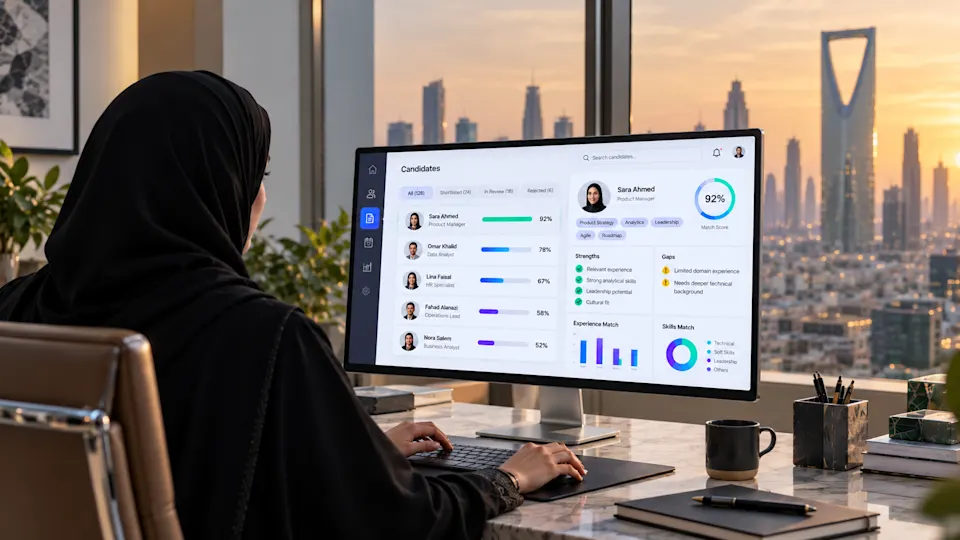
AI CV Screening: How It Ranks Arabic and English CVs
How AI CV screening reads Arabic and English CVs, scores each applicant with strengths and gaps, and what Saudi recruiters should still decide themselves.
Sep 17, 2026

Solvait PeopleHub: One Unified Employee Platform
A tour of Solvait PeopleHub: employee dashboard, attendance, requests, talent management, the Wellbeing Hub, and the newest feature, Home Screen Widgets, in one app.
Aug 16, 2026

HR AI Trends GCC 2026: State of Market Report
State of Market report: what GCC HR leaders say about AI in 2026, with sourced numbers on adoption, impact, and the gap between them across the Gulf.
Aug 4, 2026