

How to Build a Growth Path for Every Employee Without Guesswork
An employee development plan is a written path that ties one person to their next career step: where their skills stand today, where they want to go, and the courses and experiences that close the gap between the two. You build it without guesswork in four steps. Identify the skill gap from data rather than impression, suggest a path that fits the role, connect it to courses and hands-on projects, then have the manager approve it. AI suggests and orders the steps. The manager makes the call.
The trouble is that most development plans get built from ready templates copied across every employee, or from a manager's estimate in one yearly meeting. The result is a plan nobody opens a week later. And when an employee can't see where they go after two years, they go somewhere else.
Why has a growth path become a retention issue, not a perk?
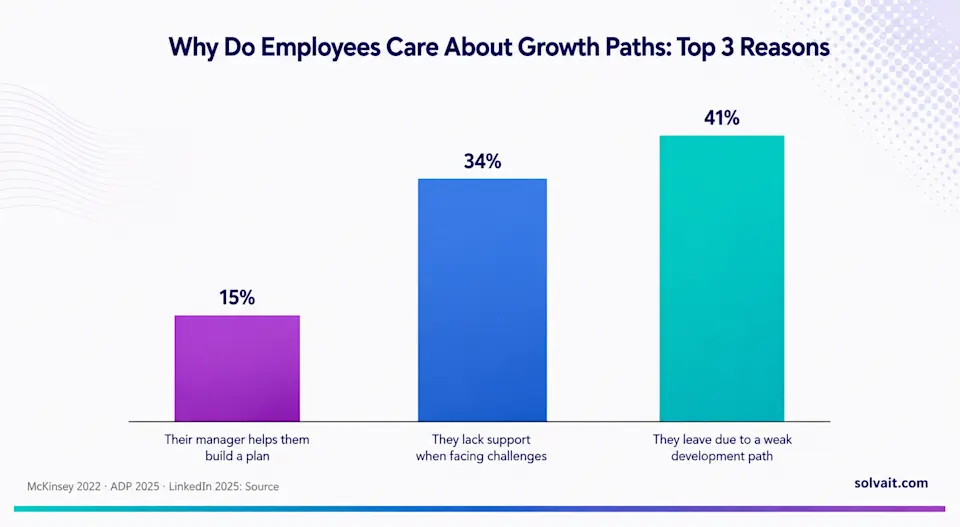
The numbers here are blunt. McKinsey found the top reason employees gave for quitting their previous jobs was a lack of career development and advancement, at 41%. This isn't a passing trend. ADP's People at Work 2025 report, built on nearly 38,000 workers across 34 markets, found that more than a third of workers who can't find advancement with their current employer are actively looking or interviewing elsewhere.
Meanwhile the person meant to build the path, the direct manager, is pulling back. LinkedIn's 2025 Workplace Learning Report notes that only 15% of employees said their manager helped them build a career plan in the past six months, down five points on the year before. Managers aren't slacking. They're carrying more than the role can hold.
In Saudi Arabia the pressure doubles. Vision 2030 turned skills development from an internal initiative into a national priority, and with rising Saudization targets, building and keeping local talent has become a measure companies are judged on. Anyone who leaves because they saw no path is hard to replace with a qualified Saudi hire at the same speed.
How do I find my team's skill gaps?
Before any plan, you need an accurate picture of what each person actually does well against what their role demands. The manual way is for a manager to sit with each employee and estimate it from memory. The more accurate way is for the system to read performance data, competencies, and the job role, and show exactly where the gap sits.
This is where AI plays a specific, bounded role. It doesn't invent the gap. It calculates it from data you already have: appraisal results, the competencies a role requires, the output of past performance cycles. What comes back isn't an opinion. It's a list you can argue with: this skill is short for this role, and here is a suggested development opportunity.
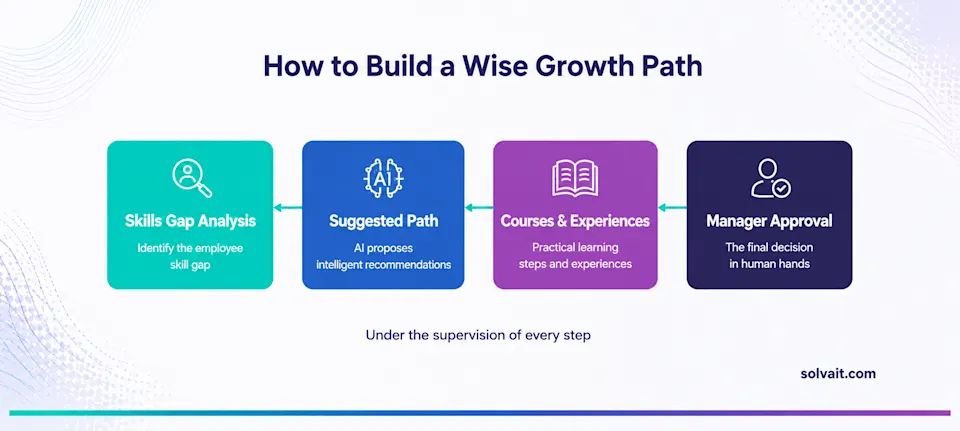
The four steps in order: skill-gap analysis, then a recommended path that fits the role, then linking it to courses and hands on projects, then manager approval. Every step sits under human oversight, and the last one is an explicit human decision.
Who decides the path, the AI or the manager?
This is the question that worries HR teams, and the answer settles how the whole thing works. AI suggests, ranks, and prepares the option. The manager reviews and approves or adjusts. No development plan goes live before a human has seen it.
That split isn't cosmetic. The manager knows their employee's circumstances, their next project, their personal ambition, things the system never sees. AI knows the data and gives back the time that used to disappear into gathering and formatting it. When the two meet, the employee gets a path built on real data and signed off by someone who knows them. That is the core of agentic HR: the system does the preparatory work, and the human owns the decision.
Generic plan vs a data-built path
The difference between a plan filled in from a template and a path built from skills data isn't a difference in formatting. It's a difference in whether the plan ever gets used.
Criterion | Generic development plan | Data built path |
Built from | A template copied to everyone | Each employee's real skill gap |
Updated | Usually once a year | Continuously, with the performance cycle |
AI role | None | Suggests the path, orders the steps |
Decision | Undocumented individual guess | Manager approves explicitly |
Measurable | Weak | Tied to competencies and performance |
The practical difference is that a generic plan gets written and forgotten, while a data built path stays alive because it's tied to the performance cycle itself. And look at that last row. When the path is tied to competencies, it becomes measurable, and what gets measured gets followed up.
Where Solvait Wise fits
Everything above is native to Solvait Wise, the AI-driven performance and talent management platform. Wise reads competency and performance data, surfaces the skill gap for each employee, then suggests a development path that links the gap to courses and hands on experiences. Suggestions appear clearly marked as "suggested, human approved," so the manager stays the decision maker.
Wise doesn't replace your existing HR system. It works on top of it and feeds it an intelligence layer for performance and talent. If you want to see how a skill gap analysis turns into a path ready for approval, explore Solvait Wise in detail.
The result that matters to an HR leader isn't how many plans got written. It's how many employees see a clear path ahead and stay. Start with one employee and one path built on real data, and you'll feel the difference in the first performance cycle.
Ready to see a growth path built on your team's real data? Book a demo with Solvait.
FAQ
What's the difference between a development plan and a growth path?
A development plan is usually a short horizon document tied to one performance cycle and its goals. A growth path is longer: it links a series of career steps across years, from the current role to target roles, and names the skills and experiences each transition needs. A path contains several development plans in sequence.
Does the AI decide the employee's path instead of the manager?
No. In the agentic HR model, AI suggests the path and orders its steps from skills and performance data, but the final decision stays with the manager, who approves or adjusts the plan. The system does the preparatory work, and the human has the last word.
How is a skill gap analysis calculated?
The system compares the competencies a role requires against the employee's actual competencies as they show up in performance and appraisal data. The gap is the difference between the two: the skills the role demands that the employee doesn't yet hold at the required level. That gap is where the path starts.
Why do employees leave when there's no development path?
Because no path means the employee sees no future inside the company. McKinsey found that a lack of career development is the top reason for leaving at 41%, and ADP's 2025 report found that more than a third of workers who lack advancement opportunities are actively looking elsewhere. A clear path addresses the cause directly.
References
McKinsey & Company - The Great Attrition is making hiring harder, 2022 (41% quit over lack of career development)
ADP Research - People at Work 2025: lack of career growth is the top barrier, 2025 (over a third of stalled workers are job-hunting)
LinkedIn Learning - Workplace Learning Report 2025, 2025 (only 15% had a manager help build a career plan)
PwC Middle East - How Saudi Arabia's workforce can keep growing beyond Vision 2030, 2025 (lifelong learning as Vision 2030 infrastructure)
Saudi Ministry of Human Resources and Social Development - Skills and Training, 2025 (national skills initiatives under Vision 2030)
Ready to see Solvait in action?
Book a personalized demo and see how Solvait's AI-powered HR platform can transform the way your team works.
Tags
Related Posts

Vision 2030 Is Forcing Saudi CHROs to Rebuild HR
Why Saudi CHROs are rebuilding their entire HR stack for Vision 2030: automation, compliance, and agentic AI, with the numbers that explain it.
Aug 23, 2026

Are Your Job Roles Actually Designed for the Work? Solvait
Most job roles accreted over time; they were never designed. A guide to the difference between a designed role and an accreted one, and how AI detects the mismatch between tasks and competencies.
Aug 20, 2026

Future of HR in the GCC: 5 Predictions for 2027
Five practical predictions for the future of HR in the GCC by 2027, backed by Gartner, PwC , and what agentic AI means for Saudi and Gulf teams.
Aug 11, 2026