

End of Service on Termination (Article 84): Worked Saudi Examples
When the employer ends the contract, the worker gets the full end-of-service award under Article 84 of the Saudi Labor Law: half a month's wage for each of the first five years, then a full month's wage for each year after five, calculated on the last wage including allowances, with partial years counted pro rata. That is the key difference from resignation. Resignation reduces the award under Article 85, while employer termination pays it in full. This guide shows the formula for end of service on termination in the Saudi private sector, gives worked numeric examples, and puts termination next to resignation in one table so the gap is clear.
Key takeaways
On employer termination, the worker receives the full end-of-service award under Article 84, with no resignation reduction.
The formula: half a month per year for the first five years, then a full month per year after five, on the last wage.
The wage used in end of service calculation is the last wage including fixed allowances, not basic pay alone.
Resignation cuts the award (one third from 2 to 5 years, two thirds from 5 to 10, full after 10).
On exit, add payment for unused annual leave under Article 111, and possibly unfair-dismissal compensation under Article 77.
How is end of service calculated on termination? (Article 84)
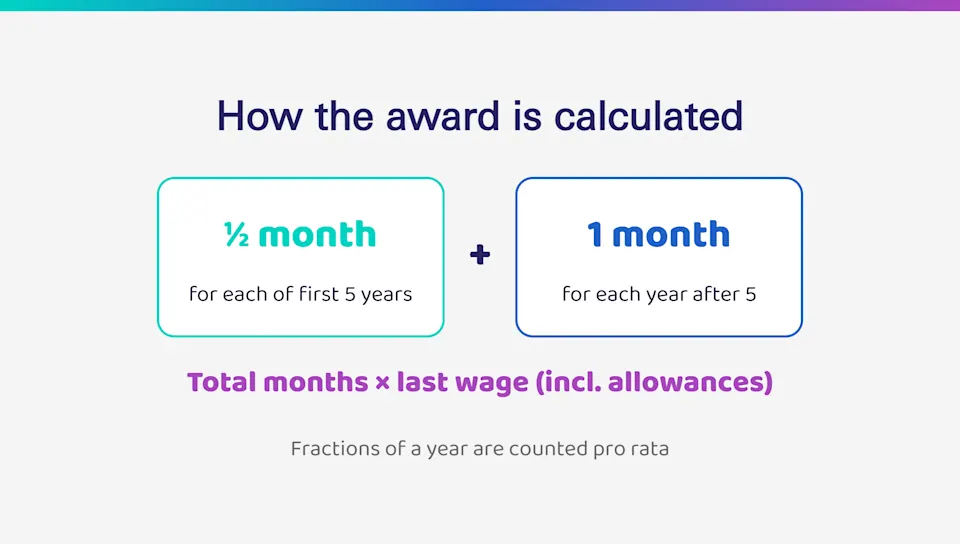
Article 84 states a rule that is simple at its core. When the work relationship ends, the employer pays an award of:
Half a month's wage for each of the first five years.
A full month's wage for each of the following years.
The award is calculated on the last wage, and the worker is entitled to a share for fractions of a year in proportion to the time served. So an extra six months counts as half a year. It is neither dropped nor rounded up to a full year.
Which "wage" is the calculation based on?
This is where most mistakes happen. "Wage" in the Labor Law is not basic salary alone. It is the last wage including fixed allowances paid on a regular basis, such as housing and transport. If basic pay is SAR 6,000 and housing allowance is SAR 2,000, the wage used in the end of service calculation is SAR 8,000, not SAR 6,000. Leaving allowances out means a lower figure than the worker is owed, and that is a common source of disputes at settlement.
Practical tip: check the definition of "wage" in the worker's contract before any calculation. Variable allowances (like fluctuating commissions) are treated differently, so don't assume they all count automatically.
What is the difference between termination and resignation? (Article 85)
The question HR teams get most: how do I calculate the award if the worker resigned rather than being terminated? The difference is large.
On employer termination, the worker takes the full award as in Article 84. On resignation, Article 85 applies and the award is reduced by length of service:
Service at resignation | Worker's share of the Article 84 award |
|---|---|
Less than 2 years | No award |
2 to less than 5 years | One third (⅓) |
5 to less than 10 years | Two thirds (⅔) |
10 years or more | Full award |
So the gap between the two figures is widest in mid career, and it disappears after ten years, where resignation and termination pay the same. This scale applies to indefinite-term contracts. Check the contract type before applying it, because fixed term contracts may be treated differently.
How much is end of service for the private sector? Worked examples
Here are four real private-sector cases, all employer termination (full award), on a wage that includes allowances. Next to each one, we show what the worker would have received on resignation, so the difference is clear.
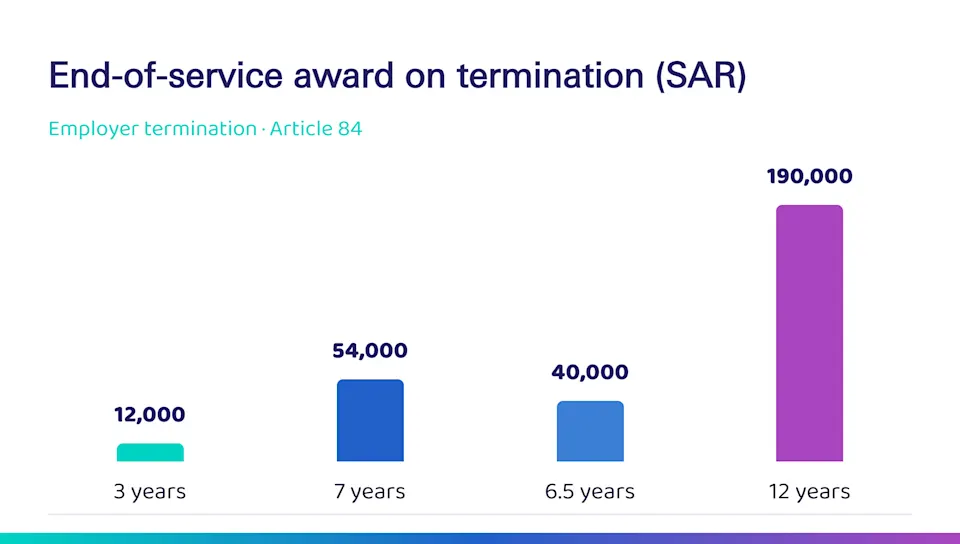
Example 1: 3 years, wage SAR 8,000 The 3 years fall within the first five: 3 × half a month = 1.5 months. 1.5 × 8,000 = SAR 12,000 on termination.
Example 2: 7 years, wage SAR 12,000 First 5 years: 5 × half a month = 2.5 months. Next 2 years: 2 × one month = 2 months. Total 4.5 months × 12,000 = SAR 54,000 on termination.
Example 3: 6 years and 6 months, wage SAR 10,000 First 5 years: 2.5 months. The next 1.5 years: 1.5 × one month = 1.5 months. Total 4 months × 10,000 = SAR 40,000 on termination. (Notice how the six months were counted pro rata.)
Example 4: 12 years, wage SAR 20,000 First 5 years: 2.5 months. Next 7 years: 7 × one month = 7 months. Total 9.5 months × 20,000 = SAR 190,000 on termination.
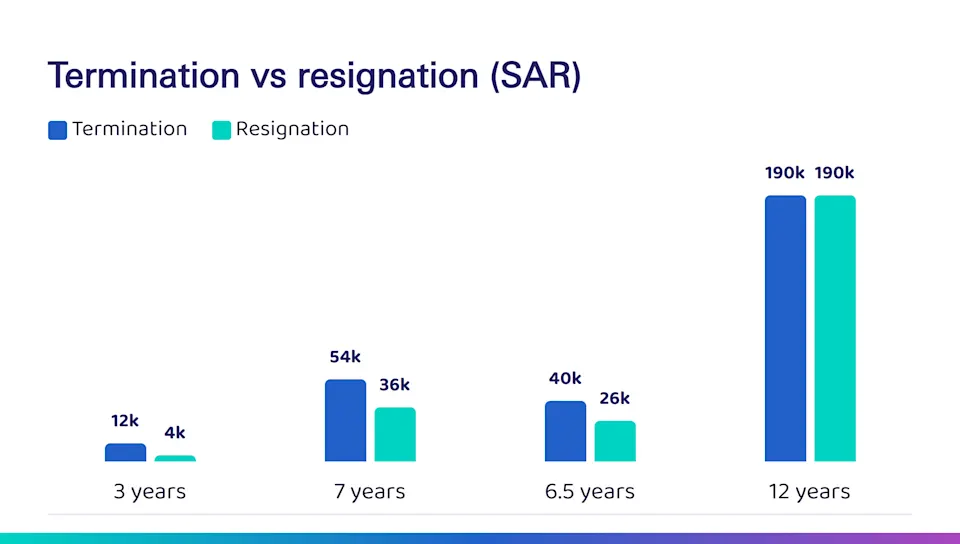
And this table shows the termination vs resignation difference for the same cases:
Case | Service | Wage (incl. allowances) | Award on termination (Art. 84) | Award if resigned (Art. 85) |
|---|---|---|---|---|
1 | 3 years | 8,000 | 12,000 | 4,000 (one third) |
2 | 7 years | 12,000 | 54,000 | 36,000 (two thirds) |
3 | 6.5 years | 10,000 | 40,000 | 26,667 (two thirds) |
4 | 12 years | 20,000 | 190,000 | 190,000 (full) |
Don't forget leave balance and other dues
The award is not the whole settlement. On exit, the worker is owed payment for unused annual leave under Article 111. The math is simple: divide the monthly wage by 30 to get a day's wage, then multiply by the remaining leave days. The worker in Example 2 (wage 12,000) with 15 leave days left gets (12,000 ÷ 30) × 15 = SAR 6,000 added to the award.
What are the common mistakes in calculating end-of-service dues?
These are the mistakes we see most in settlements, and each one means a wrong figure or a labor dispute:
Calculating the award on basic pay alone. The correct base is the last wage including fixed allowances.
Dropping fractions of a year. Six months is half a year in the calculation, not zero.
Applying the resignation reduction to a termination case. Termination pays the full award.
Forgetting leave pay. Unused balance is owed in cash on exit.
Confusing award with compensation. If the termination is without a valid reason, the worker may be owed separate compensation for unfair dismissal under Article 77, which is on top of the end-of-service award.
The cost of these mistakes is not theoretical. EY found the average cost of fixing a single payroll error rose to about USD 339, with an error showing up in roughly one in five payroll runs (EY, 2026). And exits are rising in Saudi Arabia. The World Bank reports the average number of employers a Saudi worker has had rose from 1.2 to 1.7 between 2015 and 2025, meaning higher job mobility (World Bank, 2026). With Saudi private-sector employment up 5% to 2.4 million in 2024 (Jadwa/GASTAT, 2025), the number of settlements each year is larger, and every error scales with it.
How to verify the end of service before you pay, with Solvait
Most settlement errors are purely technical: a forgotten allowance, a dropped fraction of a year, or the resignation rule applied to a termination. That is exactly what automation is good at. McKinsey estimates that about 80% of HR processes are at least partly automatable, with payroll administration at the top of the list (McKinsey).This is where Solvait's agentic AI HR comes in. The Solvait Agentic AI HR platform calculates the end-of-service award from the worker's real data: exact service length, the correct wage including allowances, how the relationship ended (termination or resignation), and the remaining leave balance. Then the Rawatib payroll agent reviews the settlement before payment and flags any difference, so a wrong amount never leaves the system. Solvait reports time savings of up to around 50% on HR operations.Run the numbers yourself first with the free Solvait end of service calculator, and compare your result against the examples here. For the resignation side in detail, read our guide on end of service on resignation with worked examples.
Want to see how Solvait calculates and verifies the settlement before payment on your own company data? Book a Solvait demo.
Frequently asked questions
How do I calculate end of service on termination in the private sector?
Count half a month for each of the first five years, and a full month for each year after, on the last wage including fixed allowances. Add the months, multiply by the monthly wage, then add payment for unused leave. On employer termination the award is paid in full, with no reduction.
What is the difference between termination and resignation for end of service?
Employer termination pays the full award under Article 84. Resignation reduces it under Article 85: nothing under two years, one third from two to five, two thirds from five to ten, and full after ten years of service.
Is the award based on basic salary or on the wage with allowances?
On the last wage including regular fixed allowances such as housing and transport, not basic pay alone. Leaving allowances out gives a lower figure than owed, a common mistake that causes disputes.
How do I calculate end of service with the leave balance?
Divide the monthly wage by 30 to get a day's wage, then multiply by the number of unused annual-leave days. This payment is due under Article 111 and is added to the end-of-service award in the final settlement.
Is the worker owed extra compensation if dismissed without cause?
Yes. If the employer terminates without a valid reason, the worker may be owed compensation for unfair dismissal under Article 77. It is a separate amount added to the end-of-service award. Check the article text and the contract to confirm what is due.
References
Ministry of Human Resources and Social Development: Saudi Labor Law: Articles 84, 85, 88, 111 and 77, (the legal basis for the award, compensation and leave pay).
EY: EY Survey: Cost Per Payroll Error Climbs to $339 Average, 2026 (cost and frequency of payroll errors).
World Bank: A Decade of Progress: Inside Saudi Arabia's Labor Market Transformation, 2026 (rising job mobility among Saudi workers).
Jadwa Investment / GASTAT: Saudi Labor Market Update 2024, 2025 (growth in Saudi private-sector employment).
McKinsey & Company: Human Resources in the Age of Automation (automatability of HR processes and payroll administration).
See agentic HR in action
Solvait AI HR and its agents prepare Saudi labor-law work so HR can review it before anything is submitted.
Tags
Related Posts

End of Service on Resignation in Saudi: Worked Examples
EOS if you resign in Saudi Arabia, with worked examples. What you get after 4 or 8 years, the Article 85 ladder, the Article 84 base, and exceptions.
Oct 4, 2026

Free Saudi End of Service Calculator
Calculate any Saudi employee's end of service in 60 seconds, free and no signup, under Articles 84 and 85 of the Labor Law, with a worked example, every exit scenario, and the settlement deadlines.
Jun 14, 2026

Saudi Labour Law Automation: 9 Clauses to Enforce
Nine Saudi labour law clauses your HR system should enforce automatically after the 2025 reforms, from probation caps to WPS files.
Aug 30, 2026