

GOSI Deduction From Salary in Saudi Arabia: How It's Calculated, and Why Yours Differs From Your Colleague's
The GOSI deduction from salary in Saudi Arabia is calculated on the contributory wage (basic salary + housing allowance), multiplied by the employee rate. For a Saudi, there are now two rates by first-registration date: 9.75% if you registered before 3 July 2024, and 10.75% if you registered after it. A non-Saudi employee has nothing deducted for social insurance; the employer alone pays 2% for occupational hazards.
So on a contributory wage of SAR 12,500, the monthly deduction is either SAR 1,218.75 or SAR 1,343.75. The gap is SAR 125 a month, and the only reason for it is your registration date, not your pay and not your job. That is exactly the question HR teams hear most: "why is my deduction different from my colleague's?" This guide walks through the calculation step by step, shows the mismatches that slip into the payroll file, and explains how they get caught before filing.
Key takeaways
The base: GOSI is deducted on basic salary + housing allowance only, capped at SAR 45,000 a month. Transport and bonuses are excluded.
Legacy track (registered before 3 July 2024): the Saudi employee deduction is 9.75%, and the employer share is 11.75%.
New track (registered from 3 July 2024): 10.75% for the employee and 12.75% for the employer since July 2026, rising 0.5% a year to 11.75% by 2028.
Non-Saudis: no deduction from pay; the employer pays only 2% for occupational hazards.
Most "wrong deduction" complaints are not a calculator fault. They are a gap in the wage base, the rate, or nationality, and each one is catchable before filing.
How is the GOSI deduction from salary calculated?
The math is three clear steps. Anyone who understands them can check their own payslip.
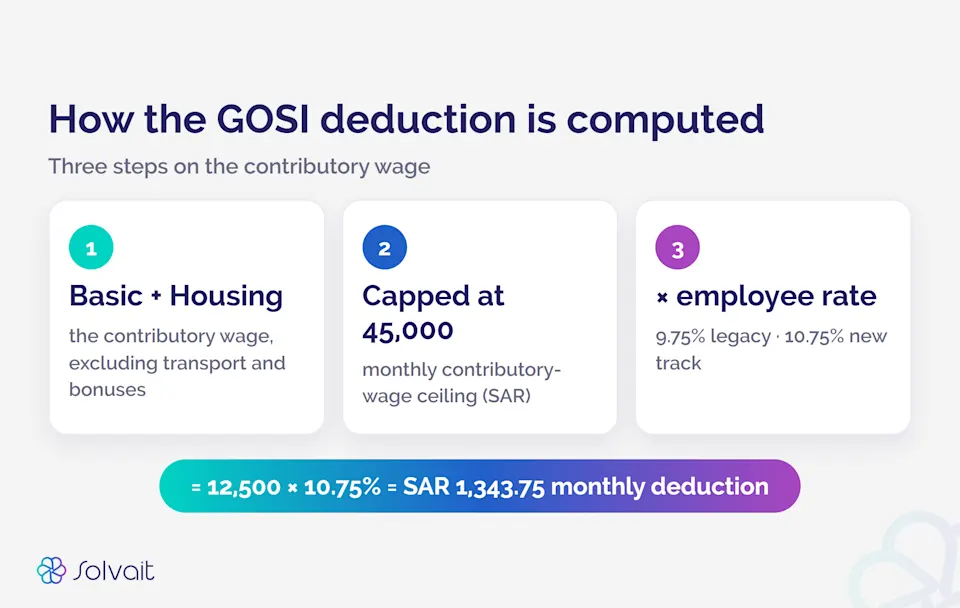
Step one: find the contributory wage. It is the basic salary plus the housing allowance (cash or in kind). Transport allowance, bonuses, and commissions stay out of the base. An employee on a SAR 10,000 basic with a SAR 2,500 housing allowance has a contributory wage of SAR 12,500, even if the gross pay is higher because of transport.
Step two: apply the cap. The ceiling for the contributory wage is SAR 45,000 a month. Anyone earning above that has the deduction computed on 45,000, not on the actual wage. There is no minimum inside the social insurance system itself. The SAR 4,000 Nitaqat minimum wage is a separate requirement with no bearing on the GOSI base.
Step three: multiply by the employee rate. Here is where the difference comes in. The rate follows your track, not your pay. On our example wage of SAR 12,500:
Legacy track: 12,500 × 9.75% = SAR 1,218.75 a month.
New track: 12,500 × 10.75% = SAR 1,343.75 a month.
That makes "net salary after GOSI" simple: subtract the deduction from your gross. If you want the number without the manual math, the Solvait salary calculator returns net pay after GOSI from the contributory wage.
Cap example: an employee with a SAR 42,000 basic and SAR 8,000 housing has an actual wage of SAR 50,000. The contribution is computed on 45,000 only. If a system wrongly runs it on 50,000, the deduction rises by SAR 537.50 a month with no basis.
Why does your colleague's deduction differ from yours? The two track system
Since 3 July 2024, social insurance has had two tracks. Anyone registered before that date stayed on the old rates. Anyone first registered after it joined a new track where the pension rate rises each year. The result is that two employees in the same role on the same salary can have different amounts deducted, simply because one entered the workforce before the other.
This table sums up the difference as applied since July 2026:
Item | Legacy track | New track |
|---|---|---|
Saudi employee deduction | 9.75% | 10.75% |
Employer share | 11.75% | 12.75% |
Pension per party | 9% | 10% |
Applies to | Registered before 3 Jul 2024 | Registered from 3 Jul 2024 |
The new track rate does not stop here. The pension branch rises half a point per party every July: it began at 9.5% per party in July 2025, reached 10% in July 2026, and lands at 11% per party by July 2028. So the newلاtrack employee deduction will reach 11.75% in 2028, while the legacy track stays fixed at 9.75%. The gap between two colleagues widens year after year, and any calculator that lumps all employees onto one rate gives wrong numbers for the half on the other track.
A non-Saudi is a different story. No pension or unemployment contribution comes off the salary. The employer pays only 2% for the occupational hazards branch, on the same base (basic + housing, capped at 45,000). The non-Saudi employee's deduction is zero. That is why a misclassified nationality is one of the largest sources of mismatch, as we will see.
What are the common GOSI mismatches, and how are they caught before filing?
A "wrong deduction" is rarely a fault in the social insurance calculator. It is usually a gap between what should be computed and what was computed in the payroll file. These gaps repeat, which makes them predictable and catchable. Here are the most common:
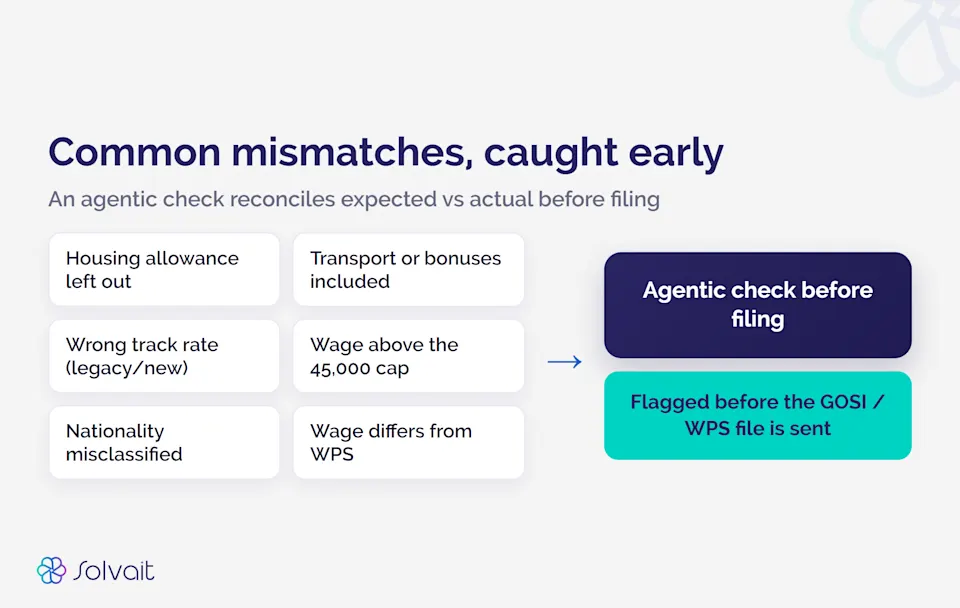
Mismatch | What happens | Impact |
|---|---|---|
Housing allowance left out | Contribution runs on basic only | Under-deduction |
Transport or bonuses included | Items outside the base enter the math | Over-deduction |
Wrong track rate | New joiner on the old rate, or the reverse | Up to SAR 125 a month per employee |
Cap not applied | Contribution on a wage above 45,000 | Over-deduction with no basis |
Nationality misclassified | A non-Saudi treated as Saudi, or the reverse | Huge gap between 0% and 10.75% |
Wage differs from WPS | GOSI wage does not match the declared pay | Compliance flag and a possible fine |
The last row deserves a pause. The Wage Protection System checks that what the employee is actually paid each month through banks and the Mudad platform matches the declared wage. When the wage registered with GOSI differs from the wage paid, that gap becomes a compliance signal that can cost the company a fine. Reconciling the GOSI file against the wage file is not a nicety. It is protection against a direct risk.
Catch it before filing, not after
The trouble is that finding these gaps after the file is submitted means a late correction, back-and-forth, and sometimes a penalty. The global numbers confirm the cost. A survey by EY in 2022 found that about one in five payrolls contains an error, at an average correction cost of $291 per error, and that a payroll employee spends close to 29 weeks a year fixing common mistakes. The cheaper logic is always to catch the gap before filing, not after.
This is where agentic AI earns its place. In Solvait Agentic AI HR, the payroll agent recomputes the expected contribution for each employee from their own data (nationality, registration date and track, contributory wage, the cap), then reconciles it against what sits in the file before submission. Any gap goes to the monitoring agent, which routes it to a specialist to approve or correct. The agent flags and proposes; the decision stays with a human. Mismatches are caught while they are still free to fix, not after they become a violation. And the trend is widening: a 2026 survey by KPMG found that 47% of organizations now use AI, automation, or digital agents in payroll.
Because the system connects to your existing HR and payroll stack, the reconciliation runs on your real data without changing your technical setup.
Where does Solvait fit in?
Solvait is an agentic AI HR company, with offices in Riyadh, Amman, and Cairo, serving more than 300 clients. The agents in Solvait Agentic AI HR do not only "calculate GOSI." They watch the gap between expected and actual in every payroll run, reconcile it against the Wage Protection System, and raise any difference for human approval before filing. The goal is simple: keep a predictable error out of a file you actually pay.
To see how the agent flags contribution mismatches on your own data before submission, book a Solvait demo.
FAQ
How do I calculate salary after GOSI?
First find the contributory wage (basic + housing, capped at SAR 45,000), multiply it by your rate (9.75% legacy track or 10.75% new track), then subtract the result from your gross. On a SAR 12,500 contributory wage, the deduction is SAR 1,343.75 on the new track.
What is the GOSI deduction rate for a Saudi employee?
9.75% for anyone registered before 3 July 2024, and 10.75% for anyone registered after it (as applied since July 2026). The new-track rate rises gradually to 11.75% by 2028.
Is GOSI deducted from a non-Saudi's salary?
No. A non-Saudi employee has nothing deducted for social insurance. The employer alone pays 2% for the occupational hazards branch on the contributory wage.
Which wage is GOSI calculated on?
On basic salary plus housing allowance only, capped at SAR 45,000 a month. Transport allowance, bonuses, and commissions are outside the base.
How does GOSI relate to the Wage Protection System?
The Wage Protection System checks that the wage actually paid matches the declared wage. A difference between the wage registered with GOSI and the wage paid creates a gap that can become a violation, so the two are reconciled before payroll is closed.
References
General Organization for Social Insurance (GOSI), official site: https://www.gosi.gov.sa/
Mudad platform and the Wage Protection System (official source): https://mudad.com.sa/
CalcMENA, GOSI two-track contribution rates (2026): https://calcmena.com/blog/ksa-gosi-two-track-rates-july-2026
Mercans, Statutory Alert: GOSI contribution rates and the Saned Unemployment Fund 2026:https://mercans.com/resources/statutory-alerts/saudi-arabia-gosi-contribution-rates-saned-unemployment-fund-2026/
GASTAT via Saudi Gazette: private sector accounts for 95% of social insurance subscribers (2026):https://saudigazette.com.sa/article/665200/saudi-arabia/private-sector-accounts-for-95-of-saudi-social-insurance-subscribers-riyadh-tops-with-52
EY payroll survey: average payroll error costs $291 (2022):https://www.businesswire.com/news/home/20221222005093/en/EY-survey-Payroll-errors-average-291-each-impacting-the-economy
KPMG, Global Payroll Survey 2026 (AI and automation in payroll): https://kpmg.com/kpmg-us/content/dam/kpmg/pdf/gated/2026/global-payroll-survey-whitepaper-final.pdf
See agentic HR in action
Solvait AI HR and its agents prepare Saudi labor-law work so HR can review it before anything is submitted.
Tags
Related Posts

AI Payroll Error Detection: Catch Gaps Before You Post
How AI payroll error detection flags pay discrepancies before posting by comparing expected vs found and holding the wrong line.
Oct 11, 2026

GOSI Automation Saudi Arabia: Calculate, File & Audit
Calculate, submit and audit GOSI contributions in Saudi Arabia accurately, without a dedicated compliance specialist, using agentic payroll automation.
Aug 24, 2026

GOSI Mistakes in Saudi Arabia
How small GOSI mistakes snowball into large fines in Saudi Arabia, and how to catch them before they become violations.
Jul 1, 2026