
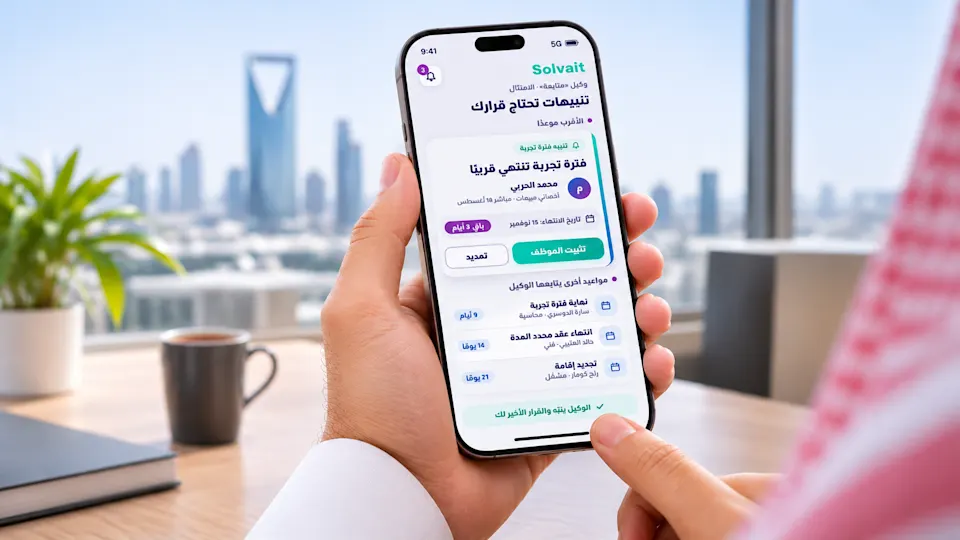
Probation Period in Saudi Labor Law: How to Never Miss the End Deadline (Automated Compliance Alerts)
The probation period in Saudi labor law is a fixed window during which both the employer and the employee test whether the job is a fit, and during which either side can end the contract with no end-of-service benefit and no notice. The standard length is 90 days, extendable to a maximum of 180 days by written agreement, and it excludes Eid al-Fitr, Eid al-Adha, and sick leave. Here is the point most teams miss: that right to terminate ends when the period ends. If the probation end date passes without a decision, the employee becomes permanent, and any termination after that falls under dismissal and compensation rules. So tracking that date is not routine admin. It is a compliance obligation, and automated alerts are what keep the deadline from slipping by unnoticed.
Key takeaways
The probation period is 90 days, extendable to a maximum of 180 days by written agreement between both parties.
It must be stated explicitly in the contract. If it isn't, the contract counts as permanent with no probation.
Eid holidays and sick leave don't count toward the period, so the real end date can fall later than it looks.
Once the period lapses, the employee becomes permanent and any termination follows dismissal and compensation rules.
Automated alerts and the Mutaba'aa compliance agent in Solvait track the date and warn before the window closes.
What does Saudi labor law say about the probation period? (Articles 53 and 54)
Article 53 of the Labor Law governs the probation period and sets clear rules every HR lead should know:
Maximum length: 90 days, unless a written agreement extends it.
Extension: the parties may extend the probation period by written agreement, provided the total does not exceed 180 days.
In writing: the probation period must be stated explicitly in the contract. If it isn't, the contract is treated as permanent with no probation at all.
The real length: Eid al-Fitr, Eid al-Adha, and sick leave do not count toward the period, so the actual end date can fall later than the date written in the contract.
Termination during it: either party may terminate the contract during probation with no end-of-service benefit and no notice, unless the contract says otherwise.
Article 54 then prevents putting the same worker on probation more than once with the same employer, except in a different occupation or after six months from the end of their previous service, by written agreement. The takeaway: the probation period length is capped and conditional, and breaching any of those conditions flips the legal position entirely.
Rule | Detail |
|---|---|
Standard length | 90 days |
Maximum with extension | 180 days by written agreement |
Not counted | Eid holidays and sick leave |
Termination during it | No benefit, no notice |
After it lapses | Employee is permanent, dismissal rules apply |
Why do probation-end deadlines get missed? And what is the risk?
The core risk is simple. The end of probation without a decision means the employee is now permanent by force of law. If it later turns out they aren't a fit, you can no longer end the contract on probation grounds. You need a lawful cause for dismissal, and compensation may follow. Put plainly, one day past the date turns a cost free decision into a potential dispute.
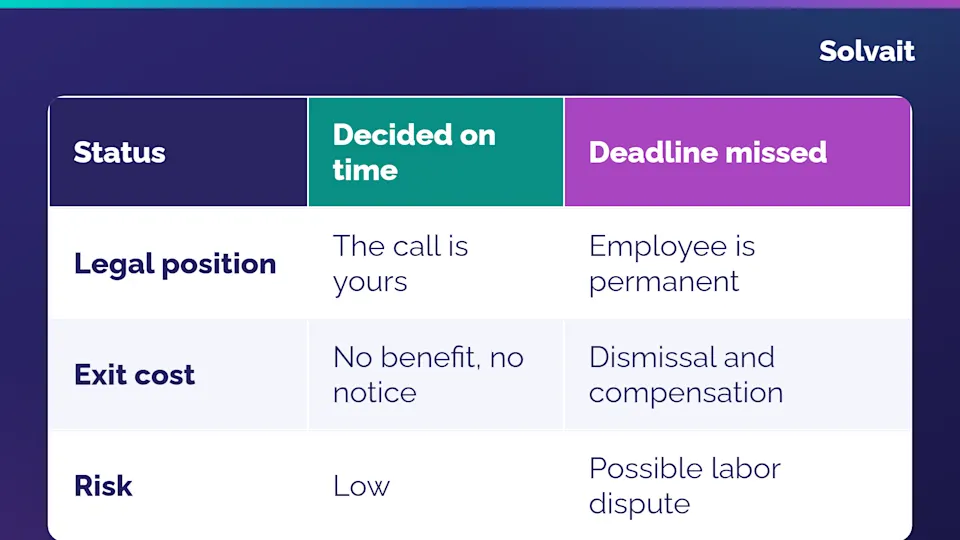
So why do these dates get missed in the first place? The reasons are purely operational:
Manual tracking. Confirmation dates sit in spreadsheets or in managers' heads, not in a system that alerts.
Volume. In a company hiring dozens a month, dozens of end dates overlap, and one slips easily.
A moving target. Excluding Eid and sick leave shifts the real date, so the manual math gets it wrong.
No owner. When nobody owns the reminder, the deadline becomes everyone's job, which means no one's.
The cost of getting this wrong is not theoretical. The US Department of Labor estimates a bad hire costs at least 30% of the employee's first year earnings, and SHRM puts replacement cost anywhere from half a salary to several times it, depending on seniority. When an unsuitable employee becomes permanent because of a missed date, you pay that cost twice: the cost of keeping them, then the cost of a lawful exit you could have avoided.
How do automated alerts prevent a missed deadline?
The fix is not more spreadsheets. It is moving the tracking out of human memory and into a system that watches the dates for you. This is where HR automation and compliance alerts come in.
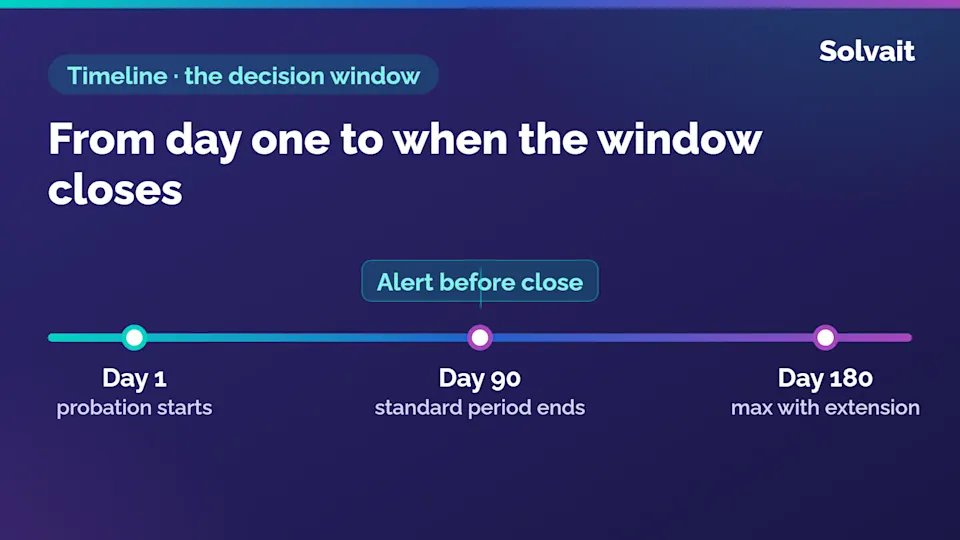
Inside Solvait Agentic AI HR, the Mutaba'aa compliance agent owns this job:
It tracks each employee's probation-end date, calculated correctly after excluding Eid holidays and sick leave.
It alerts the owner well before the window closes, not on the last day, with the options laid out: confirm, extend by written agreement, or terminate within the period.
It escalates the alert automatically if no decision is made, so the date never lapses because someone forgot it.
It puts the action to the owner for approval. The agent alerts and prepares; the final call stays with management.
That is exactly what makes agentic AI different: it doesn't wait to be asked. It watches and acts within limits you set. Across the data of the 300+ organizations Solvait serves as the agentic AI HR company since 2010, this kind of monitoring turns compliance from a reaction into a safeguard.Want your team to raise their own daily requests through a chat instead? The Solvait HR Assistant executes requests and answers policy questions with their sources.Probation is not the only statutory deadline worth tracking. Try Solvait's end of service calculator to work out an employee's dues accurately when the relationship ends..Ready to see compliance alerts run on your own company's data? Book a short demo with Solvait.
Frequently asked questions
How long is the probation period in Saudi labor law?
The standard length is 90 days. It can be extended by written agreement between the employee and employer, as long as the total probation period does not exceed 180 days. Eid al-Fitr, Eid al-Adha, and sick leave are not counted, so the real end date can fall later than the one written in the contract.
Can a contract be terminated during probation without compensation?
Yes. Either party may terminate the contract during probation with no end of service benefit and no notice, unless the contract says otherwise. That right ends when the period ends, and after that any termination follows dismissal and compensation rules.
What happens if the probation period ends without a decision?
The employee becomes permanent by force of law. You can no longer end the contract on probation grounds, and any later termination needs a lawful cause for dismissal, with compensation possible. That is why tracking the end date is an obligation, not just admin.
Does the probation period have to be in the contract?
Yes. Article 53 requires the probation period to be stated explicitly in the employment contract. If the contract omits it, the contract is treated as permanent with no probation, and the employer cannot invoke it later.
How does HR automation help you not miss the deadline?
The system calculates the end date accurately after excluding Eid holidays and sick leave, then sends compliance alerts before the window closes and escalates them if no decision is made. This moves tracking out of error prone human memory into a disciplined process that puts the action to the owner for approval.
References
Saudi Labor Law: Article 53 and the probation period, 2024 (length, extension, termination rules).
US Department of Labor (DOL): a bad hire costs at least about 30% of first-year earnings, 2024 (cost floor).
SHRM: replacement cost ranges from half a salary to several times it by seniority, 2024 (cost range).
GASTAT: Labour Market Statistics, Q1 2025 (scale of the Saudi workforce).
See agentic HR in action
Solvait AI HR and its agents prepare Saudi labor-law work so HR can review it before anything is submitted.
Tags
Related Posts

Payroll Error Detection: AI Flags, Your Team Decides
AI powered payroll error detection flags salary gaps before you post, while your team makes the call. A practical Saudi pre-payroll guide.
Oct 25, 2026

Four Agents, One HR Department | Agentic HR
How agentic HR works: four agents (Compliance, Operations, Payroll, Concierge) over a deterministic engine, on Saudi Labor Law rules, from Solvait.
Aug 13, 2026

Agentic HR vs Automation vs Chatbots: A Plain Guide
Agentic HR is not automation and not a chatbot. A plain language guide to the difference, the four AI HR agents in Solvait AI HR, and when you need each.
Oct 20, 2026