

End of Service in Saudi Arabia
End of service benefit is a statutory right for private sector employees in Saudi Arabia, governed by Articles 84 and 85 of the Labor Law, and paid as a lump sum when employment ends, based on the last wage and length of service. The final figure varies a lot with the reason the contract ended: did the employee resign or was the contract terminated? And how many years did they serve? In this article we take five scenarios with the same wage and the same tenure and calculate the gratuity for each in front of you, so you see why the numbers diverge.
The base rule in Article 84 is the same across all cases: half a month for each of the first five years, and a full month for each subsequent year, calculated on the last wage including basic and fixed allowances such as housing and transport. What changes the result is Article 85: how the law treats resignation versus termination.
The base: how the full award is built
Before the scenarios, we calculate the full award once, because it is the starting point for every case.
Take an employee whose last wage is SAR 10,000, with 10 full years of service. The full award under Article 84 is calculated like this: for the first five years, half a month per year, so 5 × 0.5 = 2.5 months. For the next five years, a full month per year, so 5 × 1 = 5 months. Total 7.5 months. Multiply by the wage: 7.5 × 10,000 = SAR 75,000.
That is the full award. Now we see how the law treats each reason for the contract ending.
The five scenarios: same wage, same tenure, different awards
All the cases below are for an employee whose last wage is SAR 10,000 with 10 years of service. The only variable is the reason the relationship ended.
# | Scenario | Legal basis | Entitlement | Award |
1 | Terminated by employer | Article 84 | Full | 75,000 |
2 | Terminated under Article 80 | Article 84 | Full | 75,000 |
3 | Fixed-term contract ended | Article 84 | Full | 75,000 |
4 | Resignation (5 to 10 years) | Article 85 | Two thirds | 50,000 |
5 | Resignation (2 to 5 years) | Article 85 | One third | 25,000 |
Scenarios four and five assume different tenures to illustrate the resignation tiers, with the wage held constant for comparison.
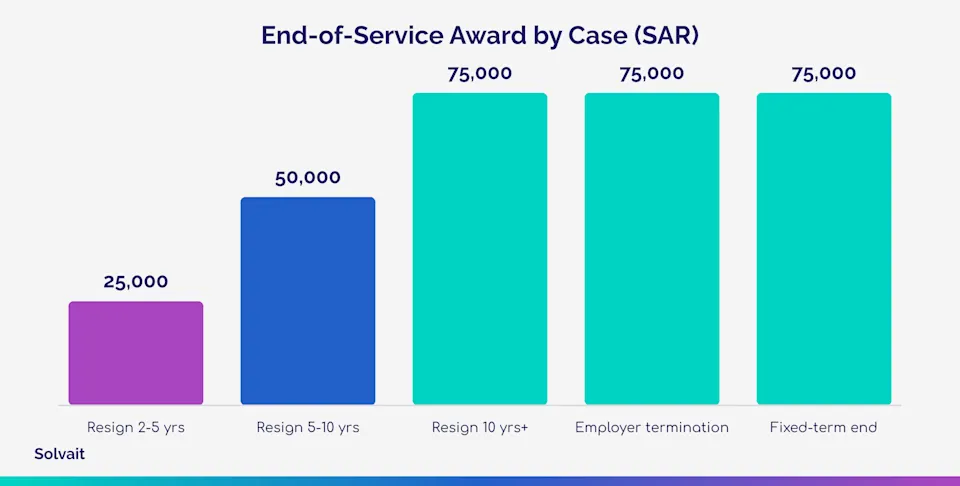
The gap is striking at first glance: the same employee, the same wage, but the award ranges from SAR 25,000 to SAR 75,000. The reason is not managerial mood. It is clear statute. When the employer ends the contract, the employee receives the full award. When the employee resigns, it is reduced according to their length of service.
The resignation tiers: this is where most errors happen
Article 85 sets resignation entitlement in clear tiers. This part specifically trips people up, because mixing the termination rule with the resignation rule produces a completely wrong figure.
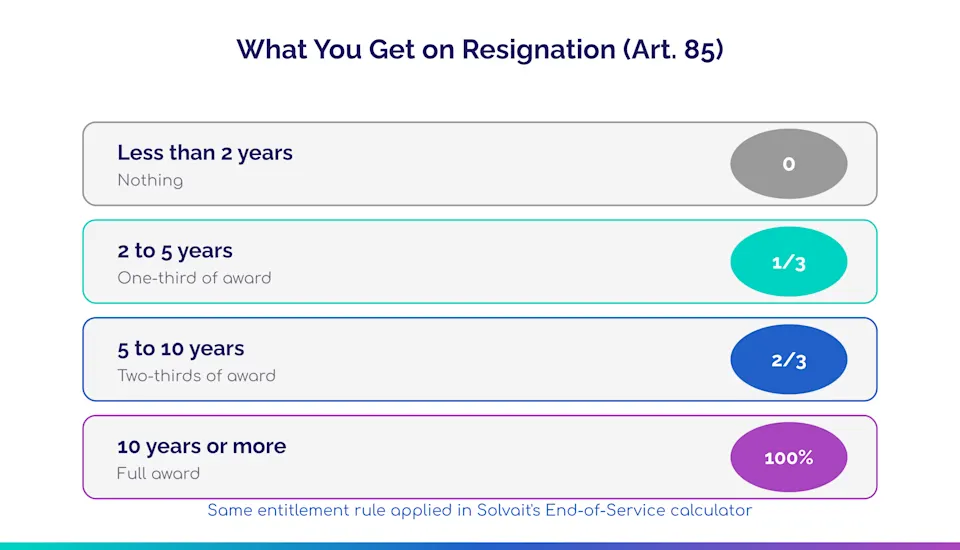
An employee who resigns before completing two years is entitled to nothing. From two to five years, one third of the award. From five to ten years, two thirds. At ten years or more, the full award, equal to an employee whose contract was terminated.
There are important exceptions the specialist knows: some separations pay the full award regardless of tenure, such as service ending due to force majeure, or a female worker who resigns within six months of marriage or three months of childbirth, per Article 87. These details are exactly what a rushed manual calculation forgets.
Three mistakes that cost a dispute
From real end of service settlements, three mistakes repeat.
First: applying the resignation tier to someone whose contract was terminated. This cuts the employee's right with no legal basis and directly violates Article 84.
Second: calculating the award on full years only and ignoring fractions of a year. The law guarantees a proportional right for every part of a year, and neglecting it shortchanges the employee.
Third: calculating on basic salary alone when the last wage includes fixed allowances like housing and transport.
Each of these can look like a detail, but on an award worth tens of thousands it means a likely dispute before the relevant authorities. Accuracy here protects the employer as much as the employee.
How the calculator gives you the right figure instantly
The whole logic, from Article 84 to the Article 85 tiers to the Article 87 exceptions, is programmed into the free EOS calculator from Solvait. You enter the last wage, the length of service, and the reason for separation. The tool automatically distinguishes resignation from termination, calculates fractions of a year, applies the correct tier, and returns the award in seconds.
Try it now on your own case with the free EOS calculator.
From the calculator to a full end of service settlement
The calculator gives you the award figure. But the actual end of service settlement is bigger: clearance, remaining leave, final dues, linking them to payroll, all within the statutory window. The manual clearance process between HR, finance, and IT is often the reason payment is delayed.
This is where Solvait's HCM platform, built on Microsoft Dynamics 365, comes in. It calculates the award under Articles 84, 85, and 87 automatically, and links clearance and final dues into a single flow that closes on time. The calculator shows you the figure. The platform runs the whole settlement.
And if you want to automate the end-of-service settlement with no confusion and no delay, book a demo with Solvait.
FAQ
How is end of service benefit calculated in Saudi Arabia?
Under Article 84: half a month for each of the first five years and a full month for each subsequent year, on the last wage including basic and fixed allowances, with a proportional right for fractions of a year. On resignation, it is reduced under the Article 85 tiers.
What is the difference between termination and resignation for the award?
On termination by the employer, the employee receives the full award under Article 84. On resignation, it is reduced under Article 85: nothing before two years, one third from two to five, two thirds from five to ten, and the full award at ten years or more.
Do allowances count in the award calculation?
Yes, the award is calculated on the actual last wage, which includes basic and fixed allowances such as housing and transport. Calculating on basic alone is a common mistake that shortchanges the employee.
When must end of service benefit be paid?
The employer must settle the award and other dues within the statutory window when the contract ends. Payment delays are usually caused by slow manual clearance, which settlement automation addresses.
References
- Saudi Labor Law (Royal Decree No. M/51): Articles 84, 85, and 87, end-of-service calculation, statutory reference (supports the calculation rules and tiers).
- General Organization for Social Insurance (GOSI): Contributable wage and allowances, 2025 (supports the wage definition).
- McKinsey & Company: Generative AI and the future of HR, 2024 (supports the process automation context).
Ready to see Solvait in action?
Book a personalized demo and see how Solvait's AI-powered HR platform can transform the way your team works.
Tags
Related Posts

AI Workload Analysis: Spot the Imbalance Before Burnout
Practical guide to detecting workload imbalance in Saudi departments with AI before burnout and turnover hits, backed by recent figures and sources.
Sep 2, 2026

Arabic First Employee Self Service Portal Guide
How to build an Arabic first employee self service portal your staff actually use in Saudi Arabia: the 5 layers, adoption benchmarks, and where AI fits.
Sep 1, 2026

Recruitment Automation in KSA: Hire a Full Batch, Small Team
Hire a large batch of Saudi employees with a small HR team via one record that feeds Qiwa, GOSI, and wage protection automatically.
Aug 31, 2026