
Saudi Payroll Calculator
Calculate employee salaries accurately with social insurance contributions, allowances, and deductions in compliance with Saudi Arabia's laws and regulations.
Employee Information & Salary Details
Enter employee information and salary details
* Required fields

Saudi Salary Calculator
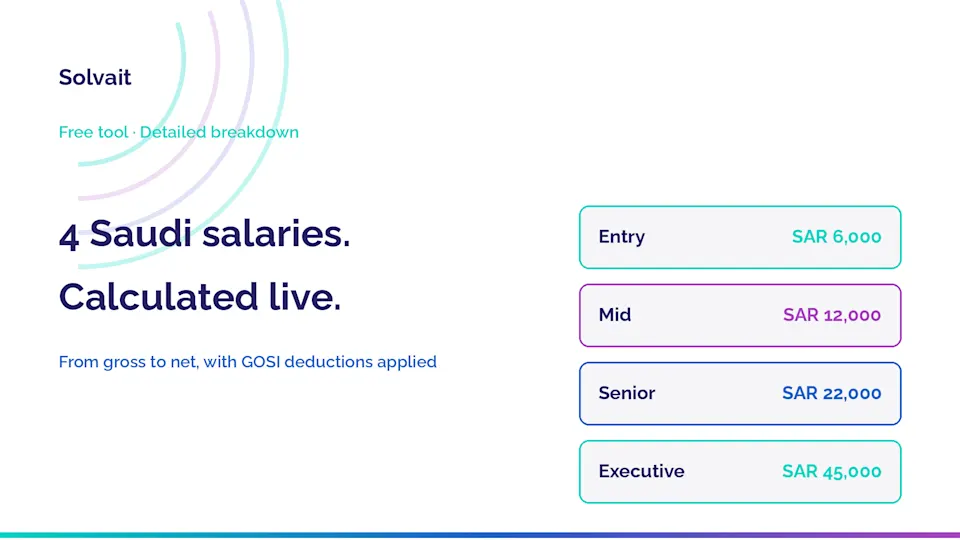
Gross salary is not what lands in the employee's account. The gap between the two numbers is the social insurance deduction, and knowing that gap precisely matters to three people at once: the employee planning their commitments, the payroll manager building the run, and finance closing the month. In this article we take four Saudi salary levels, realistic in how they are built, from entry to executive, and calculate the net for each one in front of you. Then we show how the free Saudi salary calculator from Solvait reaches the same figure in seconds.
The rule behind every calculation is simple at its core. The contributable wage is basic salary plus housing allowance, capped at SAR 45,000 per month. The employee's GOSI share applies to that wage, and the rest are allowances that sit outside the contribution base. There is no personal income tax on salaries in Saudi Arabia, so the only statutory deduction on a Saudi employee's pay is social insurance.
First: the GOSI rate changed, which is why many get it wrong
Before we calculate, one point trips up a lot of payroll teams. The Saudi employee's GOSI share is no longer a single fixed number.
The old scheme, still applied to subscribers registered before 3 July 2024, deducts 9.75% for pensions plus 0.75% for the SANED unemployment system, so 10.5% in total. New subscribers with no prior contribution history before that date fall under a graduated scale that started in July 2025: the pension share rises half a point each year until it reaches 11% in July 2028, per the General Organization for Social Insurance (GOSI) and the official schedule reported by specialist payroll sources. A non-Saudi employee has nothing deducted for this purpose; the employer alone carries a 2% occupational hazards contribution.
Across our four scenarios we apply 10.5% to the contributable wage, the most common reference for a previously registered Saudi employee. But note the trap: a good payroll system does not assume the rate. It reads each employee's subscription date and applies the correct tier automatically. That is exactly where manual calculation slips.
The four scenarios: from gross to net
We picked four levels that cover most salary structures in Saudi companies. In each case basic and housing enter the contribution base, and transport is an allowance that stays out of it.
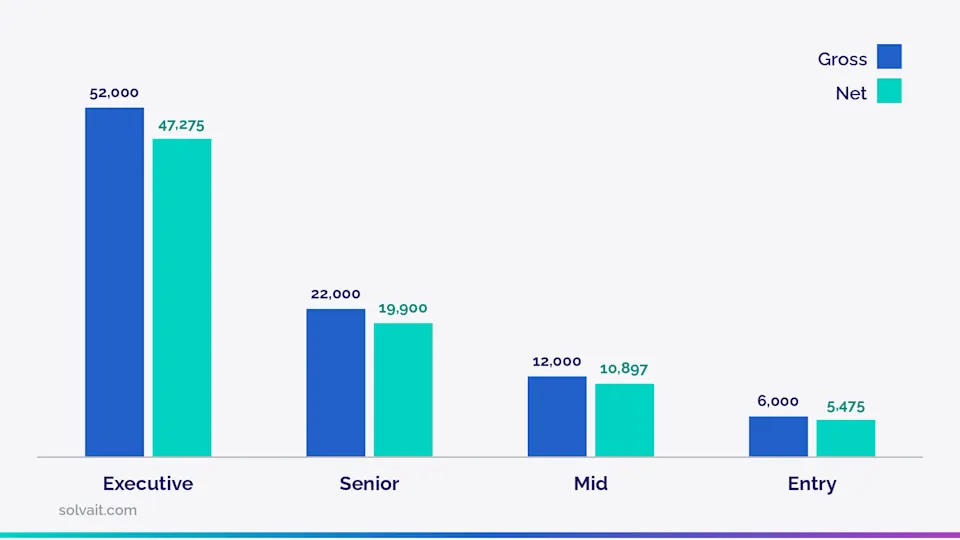
Level | Basic | Housing | Transport | Gross | Contributable wage | GOSI (10.5%) | Net |
Entry | 4,000 | 1,000 | 500 | 6,000 | 5,000 | 525 | 5,475 |
Mid | 8,000 | 2,500 | 1,000 | 12,000 | 10,500 | 1,102.5 | 10,897.5 |
Senior | 15,000 | 5,000 | 1,500 | 22,000 | 20,000 | 2,100 | 19,900 |
Executive | 40,000 | 10,000 | 2,000 | 52,000 | 45,000 (cap) | 4,725 | 47,275 |
Three quick reads from the table are worth pausing on:
Transport lifts the gross without lifting the deduction: In the mid case, the SAR 1,000 transport reached the employee in full because it sits outside the contribution base. Anyone deducting on the whole gross over deducts, and shortchanges the employee without meaning to.
The cap stops the deduction growing at the executive level: Gross salary of SAR 52,000, but the contributable wage stopped at 45,000. Any increase in basic or housing above that ceiling adds nothing to GOSI. This is the kind of detail an Excel sheet forgets, and it surfaces suddenly in a year end reconciliation.
The net percentage differs by level for different reasons: The entry employee kept 91% of their gross, and the executive kept roughly 91% too, but for a completely different reason: the first because the deduction is small, the second because the cap protected them. Similar numbers hide different causes, which is exactly why the explanation matters.
How the calculator reaches the figure in seconds
The logic we walked through by hand is the same one the salary calculator runs in a handful of steps, minus the chance of human error and returned instantly.
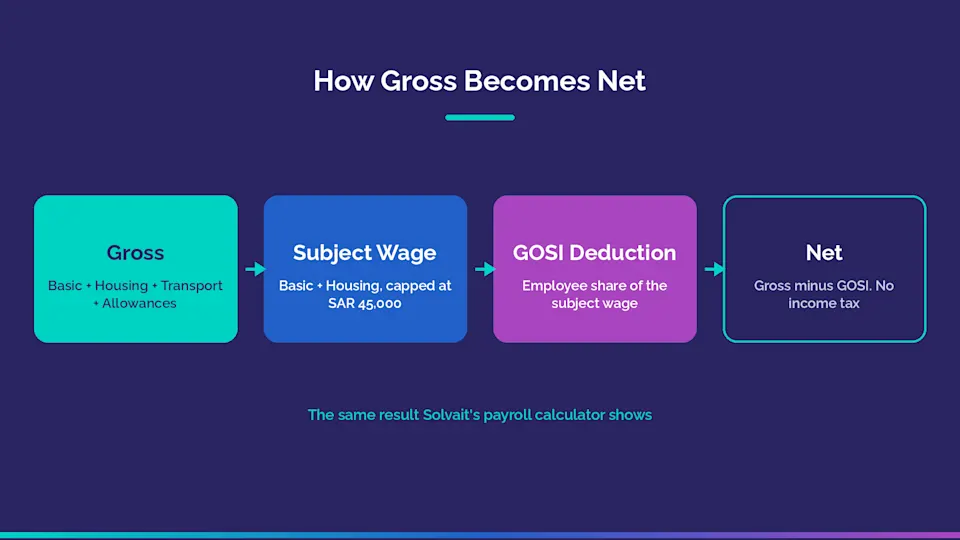
You enter basic, housing, transport, and allowances. The tool sums the contributable wage, applies the SAR 45,000 cap, deducts the correct employee share, and returns the monthly net. Time taken: under a minute. The difference between this and a spreadsheet is not only speed. The calculator does not forget the cap, and it does not confuse which allowances belong in the base.
The wider value shows up here. McKinsey research indicates that generative AI can handle up to 85% of routine HR queries with accuracy above 92%, and that organizations deploying these solutions reported a 65% cut in HR service desk costs and a 50% drop in response times (McKinsey, 2024). Salary calculation is a small instance of the same principle: a repetitive task, fully automatable, where the saved time returns to work that actually needs a human.
Where manual calculation usually goes wrong
From real payroll runs, five mistakes repeat.
The first is putting every allowance into the contribution base, which inflates the deduction unfairly. The second is ignoring the SAR 45,000 cap on higher salaries. The third is applying one rate to all employees without distinguishing old subscribers from new ones. The fourth is forgetting that a non Saudi employee has nothing deducted for this item. The fifth is leaning on an old Excel file copied from a previous year with rates that no longer apply.
Each of these looks small on one salary. Multiply it by a hundred employees and twelve months, and you see why payroll errors turn into disputes and claims. Accuracy here is not a luxury. It protects both sides.
From a free calculator to a full payroll system
The calculator answers one question: what is the net for this salary? But a monthly payroll run for hundreds of employees is a bigger question. The Wage Protection System (WPS) file, GOSI contributions per category, variable allowances, deductions, all on time and error free.
This is where Solvait's HCM platform, built on Microsoft Dynamics 365, comes in. It reads each employee's subscription date and applies the right tier, generates the WPS file, and links GOSI and allowances into a single run that closes on schedule. The calculator shows you the principle on one salary. The platform executes it for every employee, every month.
Try the difference yourself. Start with the free salary calculator on a single salary and watch it reach the net in seconds.
And if you want the full run automated with no errors and no delay, book a demo with Solvait to see how payroll for hundreds of employees runs inside one platform.
FAQ
What is the difference between gross and net salary in Saudi Arabia?
Gross salary is basic plus all allowances before any deduction. Net is what actually reaches the employee after their GOSI share is deducted. There is no personal income tax on salaries in Saudi Arabia, so the only statutory deduction on a Saudi employee is social insurance.
How is the GOSI deduction on salary calculated?
It applies to the contributable wage, which is basic plus housing capped at SAR 45,000 per month. The employee share is applied: 10.5% for an old Saudi subscriber, or a graduated rate for a new subscriber registered after 3 July 2024. Transport and other allowances stay out of the base.
Is GOSI deducted from a non-Saudi employee?
No. A non Saudi employee has nothing deducted for pensions or unemployment. The employer alone carries a 2% occupational hazards contribution, so a non Saudi employee's net usually equals their gross.
Is the Solvait salary calculator free?
Yes, it is a completely free tool with no subscription. You enter the salary components and get the net instantly. It is built for quick estimates, while a full payroll system handles the monthly run and the WPS file for all employees.
References
- General Organization for Social Insurance (GOSI): Contribution rates and 2025 to 2028 graduated schedule, 2025 (supports the GOSI rates and graduated schedule).
- McKinsey & Company: Generative AI and the future of HR, 2023 to 2024 (supports the HR automation figures).
Ready to see Solvait in action?
Book a personalized demo and see how Solvait's AI-powered HR platform can transform the way your team works.
Tags
Related Posts

AI Employee Data Validation: A Pre-Payroll Readiness Scan
Solvait's AI Employee Data Validation scans employee data before payroll . Built into Solvait HCM.
Sep 15, 2026

End of Service on Resignation in Saudi: Worked Examples
EOS if you resign in Saudi Arabia, with worked examples. What you get after 4 or 8 years, the Article 85 ladder, the Article 84 base, and exceptions.
Oct 4, 2026

Saudi Labour Law Automation: 9 Clauses to Enforce
Nine Saudi labour law clauses your HR system should enforce automatically after the 2025 reforms, from probation caps to WPS files.
Aug 30, 2026