How to Build a Bilingual Arabic English HR Knowledge Base That Employees Actually Use
Build it around the questions employees actually ask, load only your approved HR policies as the source, and put an AI agent in front of it that answers in whichever language the employee typed. A bilingual HR knowledge base is a single searchable store of your company's HR policies and answers, served in both Arabic and English, that staff can query in their own words and get a sourced answer back in seconds.
Most HR knowledge bases fail for one reason: nobody uses them. The policy PDF sits on a shared drive, the Arabic version is a rushed translation of the English, and by month three everyone is back to messaging the HR coordinator. This guide shows the build that avoids that, from content model to the agentic layer that answers on top of it.
Why do employees ignore the HR knowledge base you already built?
Because finding the answer costs more effort than asking a colleague. That is not a motivation problem. It is a findability problem, and the numbers behind it are large.
Knowledge workers spend close to 20% of the workweek looking for internal information or tracking down the person who has it, according to the McKinsey Global Institute. That is one day in five spent locating things that already exist somewhere in the organization. Atlassian's 2025 State of Teams research, which surveyed 12,000 knowledge workers, put the figure higher still, at roughly 25% of working time spent searching for answers.
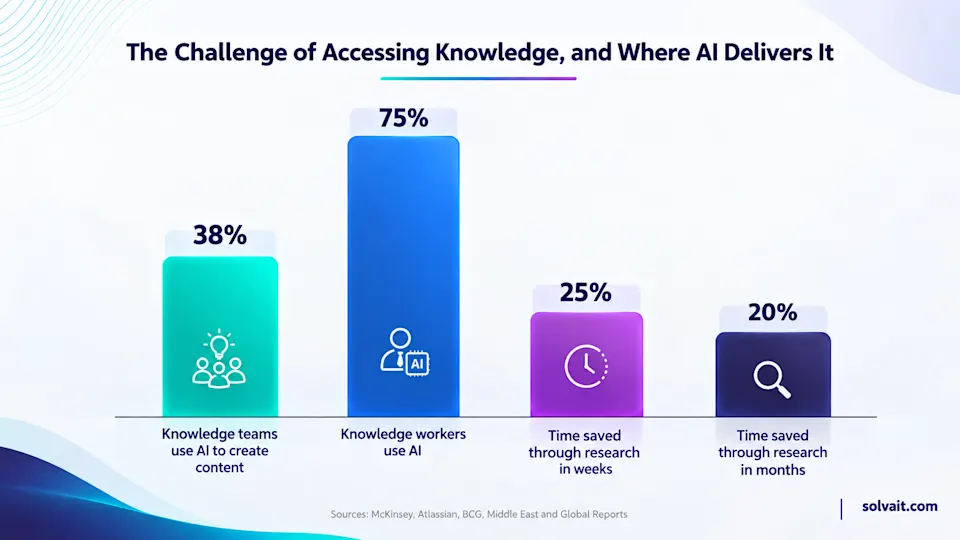
A knowledge base is supposed to reclaim that time. McKinsey's own estimate is that a searchable internal record can cut the time employees spend hunting for company information by as much as 35%. The gap between that promise and the ignored PDF on the shared drive comes down to four failures, and each one has a fix.
The knowledge is scattered. Policies live in emails, a SharePoint site, a couple of Word files, and three people's heads. An employee has to know where to look before they can look.
The search is keyword matching, not answering. Staff phrase a question the way they speak. A folder full of documents matches the words, not the intent.
The Arabic is an afterthought. If the Arabic content is a literal translation done in a hurry, Arabic-first employees can tell, and they route around it.
And nobody owns it. Without a named owner, review dates, and version control, the content drifts out of date. Once an employee gets one wrong answer, they stop trusting all of them.
What content goes into a bilingual HR knowledge base?
Start with the questions, not the documents. Pull the last two or three months of tickets, emails, and chat messages your HR team answered, and cluster them. In most Saudi organizations the top clusters are predictable: leave balances and how to apply, end of service benefit questions, GOSI and salary deductions, Iqama and visa renewals, working hours and overtime, and policy specifics around probation and notice periods.
Each cluster becomes an entry written as a direct answer to the question, in both languages. The structure that works:
Element | What it holds | Why it matters |
Question title | The question in the employee's own words | Matches how people actually search |
Short answer | Two or three sentences, self contained | This is what the AI agent lifts and reads back |
Detail | The full policy, steps, or table | For the employee who needs the whole rule |
Source link | The exact clause in your HR policy or the primary regulation | Lets the answer be trusted and audited |
Owner and review date | Who maintains it, when it was last checked | Keeps the content from rotting |
The source link matters more than it looks. When an answer about GOSI or end of service points to the primary authority, an employee can verify it and your HR team can defend it. Link to primary sources directly: the General Organization for Social Insurance for contributions, Qiwa for contracts and labor services, Mudad for wage protection, and the Ministry of Human Resources and Social Development for labor law provisions.
How do you make the Arabic version genuinely native, not a translation?
Write the Arabic entry from the Arabic question, not from the finished English one. A leave policy answer that reads naturally to an employee in Riyadh uses the terms that employee would type, follows the phrasing of Saudi labor law as it is actually written, and does not carry the sentence rhythm of an English original run through a translation tool.
This is where a lot of Gulf HR tech quietly falls short. Bolting an Arabic interface onto an English first product gives you right to left layouts and translated buttons, but the content underneath still thinks in English. Employees notice. Software localized for the Saudi market, with proper RTL handling and Arabic native content, drives broader adoption precisely among the staff who are not comfortable working in English, and that is often the majority of the frontline workforce.
There is a productivity dividend too. One analysis of Arabic native enterprise software found average onboarding time dropped by 28% when the interface matched the user's language and reading direction. The lesson holds for a knowledge base: an Arabic first employee who gets a clear Arabic answer stops needing a human to translate the policy for them.
Where does agentic AI change the knowledge base?
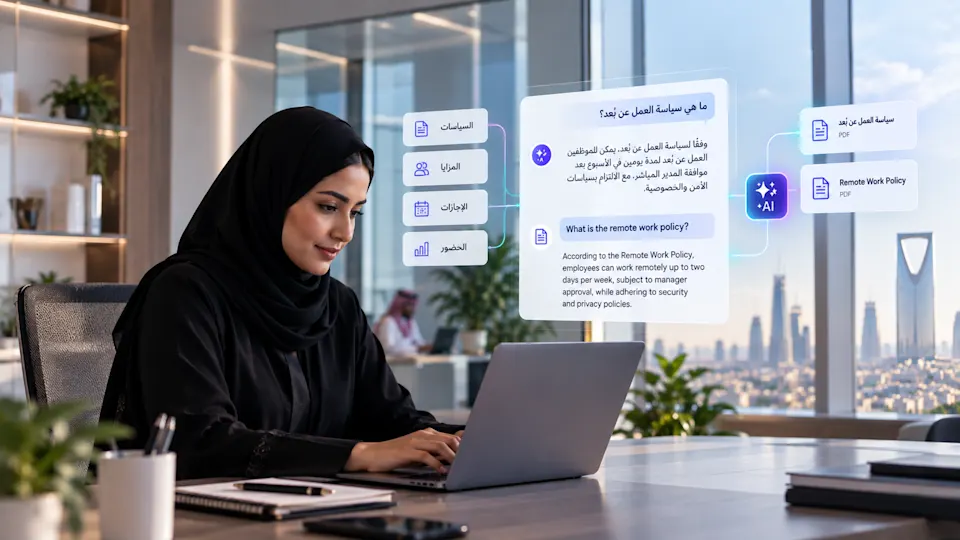
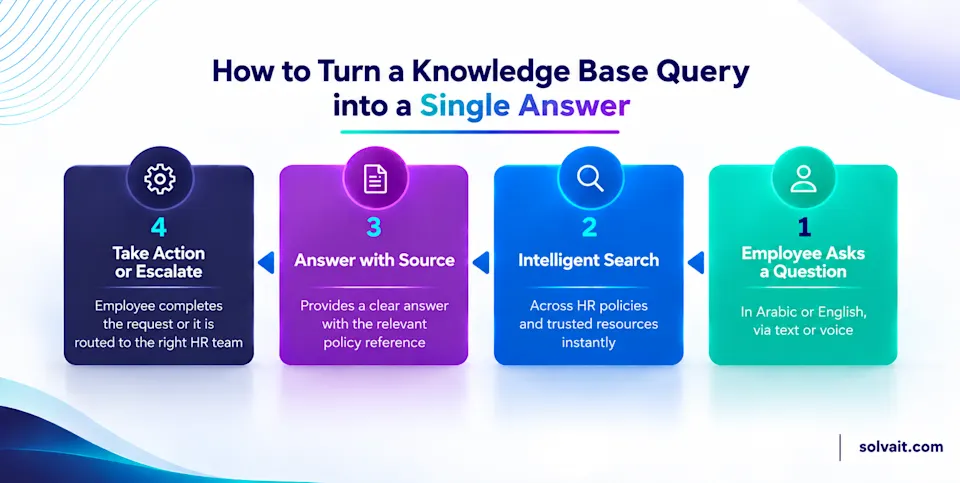
An agentic HR knowledge base does not wait for the employee to search. An AI agent reads the question, retrieves the answer from your approved content, replies in the employee's language with the source attached, and where it can, completes the next step or routes the request to a human.
Agentic AI in HR is an approach where AI agents independently carry out HR tasks, from answering a policy question to filing a leave request, under human oversight and drawing only on the organization's approved knowledge. The distinction from a chatbot matters. A chatbot returns text. An agent retrieves from your policies, cites the clause, and can take the next action.
The regional timing is good. PwC's Middle East Workforce Hopes and Fears Survey 2025 found that 75% of employees in the region had used AI tools in their roles over the past year, ahead of the 69% global figure. Staff are not resisting AI at work. They are already reaching for it, which means an HR agent meets an audience that expects it to work.
Two design rules keep an agentic knowledge base trustworthy. First, the agent answers only from your approved content, never the open web, so a policy question never gets a generic internet answer. Second, every answer carries its source, so the employee sees which clause it came from and your HR team can audit any response. An agent that cites its source is one an HR director can actually sign off on.
Manual HR portal vs. agentic bilingual knowledge base
The difference shows up in the moments that used to eat an HR coordinator's afternoon.
Scenario | Document portal | Agentic bilingual knowledge base |
Employee asks a leave question in Arabic | Searches a folder, opens a PDF, reads to find the clause | Types the question, gets a two sentence answer with the policy clause linked |
Same question at 9pm | Waits for HR to reply next morning | Answered instantly, in Arabic, from approved policy |
Answer needs an action (file the leave) | Employee emails HR, who file it manually | Agent files the request or routes it to the right approver |
Policy changes | Someone remembers to re-upload the file, or does not | Owner updates one entry, every future answer reflects it |
HR team's day | Repeating the same five answers | Handling the exceptions that need judgment |
The portal is not useless. For a stable, rarely questioned policy, a well organized document library is fine. The agentic layer earns its place on the high volume, repetitive questions that make up most of an HR inbox, and on giving Arabic first staff an answer without a human in the loop.
Solvait's HR Assistant is built for this: Arabic native, RTL from the ground up, answering from your own HR policies with the source attached, in Arabic and English, by chat or voice. It runs on Solvait's HCM platform, so an answer about a leave balance reads from the same system that holds the balance. If you want to see how staff would query their own policies, book a demo and bring three real questions from your HR inbox.
Frequently asked questions
What is a bilingual HR knowledge base?
It is a single searchable store of a company's HR policies and answers, maintained in both Arabic and English, that employees can query in their own words. Instead of hunting through documents, staff ask a question and get a direct, sourced answer in the language they used. An agentic version adds an AI agent that retrieves the answer and can complete the next step.
How is an agentic HR knowledge base different from a chatbot?
A chatbot returns scripted or generated text. An agentic knowledge base retrieves the answer from the company's approved HR policies, attaches the source clause, and can take the next action, such as filing a leave request or routing it to an approver, under human oversight. The source attribution is what makes an agent's answer auditable.
Do we need separate content for Arabic and English?
Yes. A literal translation of English content reads as translated to Arabic first employees, who then stop using it. Each language should be written from its own question, using the terms staff actually search and the phrasing of Saudi labor law as written, so both versions read as native originals rather than a translation pair.
How long does it take to build one?
The content model is the work, not the technology. Most teams can cluster their top 30 to 50 recurring questions from a few months of HR tickets in a couple of weeks, write both language versions, and load them. Assigning an owner and review date to each entry is what keeps it useful past the first quarter.
Will employees actually use it?
They use it when the answer is faster to get than asking a colleague. That means answering in their language, matching how they phrase questions, and attaching a source they can trust. PwC found 75% of Middle East employees already used AI tools at work in 2025, so the appetite is there when the tool works.
References
McKinsey Global Institute: The Social Economy: Unlocking Value and Productivity Through Social Technologies, 2012 (the ~20% workweek-searching and up-to-35% search-reduction figures)
Atlassian:State of Teams 2025, 2025 (teams spend roughly 25% of time searching for answers)
PwC Middle East: Workforce Hopes and Fears Survey 2025, 2025 (75% of regional employees used AI tools at work)
APQC: 2025 Knowledge Management Priorities and Trends, 2025 (38% of KM teams use AI to recommend content)
General Organization for Social Insurance (GOSI): gosi.gov.sa (contributions, primary source)
Ministry of Human Resources and Social Development: hrsd.gov.sa (Saudi labor-law provisions)
Ready to see Solvait in action?
Book a personalized demo and see how Solvait's AI-powered HR platform can transform the way your team works.
Tags
Related Posts
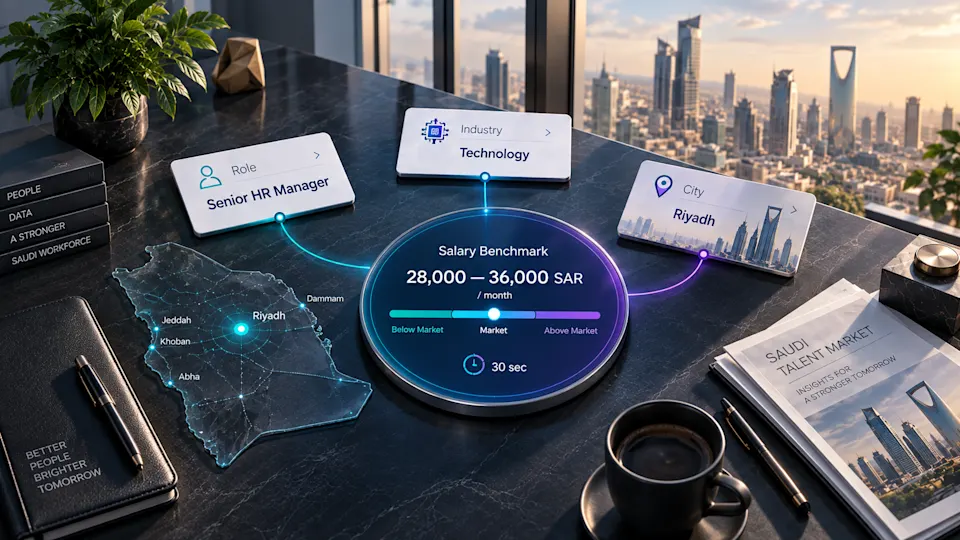
Benchmark Any Saudi Salary in 30 Seconds (Free Tool)
Solvait's free salary calculator gives you the Saudi market range by role, sector and city in 30 seconds. Benchmark any offer before you hire or raise pay.
Sep 13, 2026
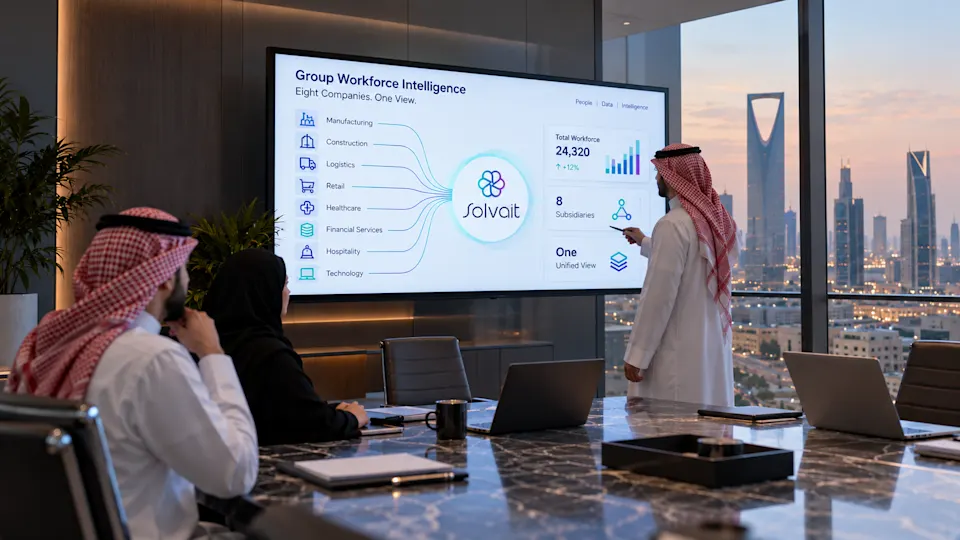
Holding Company Workforce Intelligence in Saudi Arabia
How a Saudi holding company unifies eight subsidiaries into one workforce intelligence view. A practical four layer guide for multi entity groups.
Sep 9, 2026
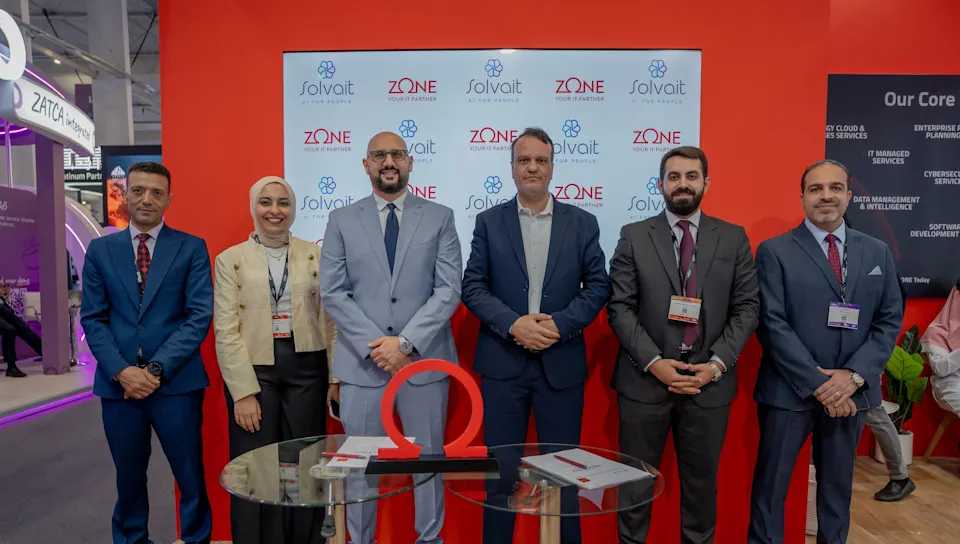
Solvait and ZONE Partner to Expand AI Solutions
Solvait and ZONE sign a strategic partnership uniting an AI native HR platform with proven digital transformation delivery for Saudi enterprises .
Sep 8, 2026