

End of Service on Termination in Saudi Arabia (Not Resignation): Worked Examples
End of service on termination is the award an employee receives in full when the employer ends the contract or a fixed term contract expires, calculated on the last full wage: half a month's wage for each of the first five years, and a full month's wage for each year after that. The point most people miss: the reduction scale (one third, two thirds) in Article 85 applies only to resignation. When the employer ends the contract, or a fixed term contract runs out, the employee receives the full award with no reduction, whatever the length of service.
This article explains the difference with numbers, gives worked examples from the Saudi private sector, and shows when the award is paid and when it is forfeited, citing the official articles of the Labor Law as published by the Ministry of Human Resources and Social Development.
Key takeaways
On termination by the employer, or expiry of a fixed term contract, the end of service award is paid in full under Article 84, with no reduction.
The reduction scale (nothing under 2 years, one third from 2 to 5, two thirds from 5 to 10, full at 10 or more) applies to resignation only (Article 85).
End of service is calculated on the last full wage (basic plus fixed allowances), not basic salary alone.
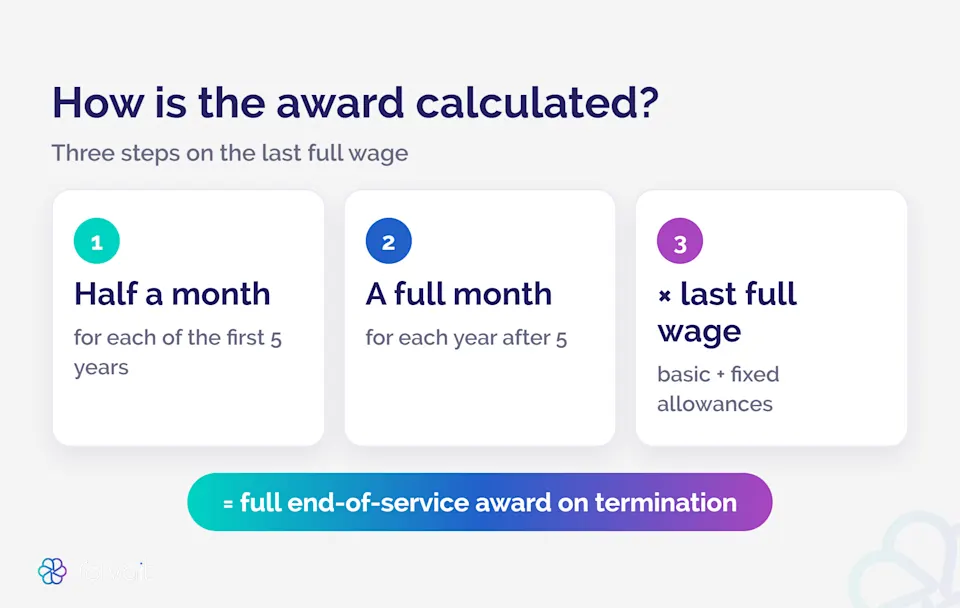
The formula: half a month's wage per year for the first five years, a full month per year after that, with partial years pro-rated.
Dues must be settled within one week of the contract ending on termination, and within two weeks on resignation (Article 88).
What is the difference between termination and resignation for end of service?
The question HR teams get every month: "The employee served three years, what are they owed?" The answer starts with a counter question: who ended the contract?
What decides the amount is not the number of years alone, but the reason the relationship ended:
Termination by the employer (or expiry of a fixed term contract): full award under Article 84, with no reduction scale applied.
Resignation: Article 85 applies, and the amount is reduced by length of continuous service.
The Article 85 resignation scale is clear: under two years, nothing; from two to under five years, one third; from five to under ten years, two thirds; at ten years or more, the full award. The table below puts both cases side by side.
Years of service | On termination (by employer) | On resignation |
|---|---|---|
Under 2 years | Full award (Article 84) | Nothing |
2 to under 5 | Full award | One third |
5 to under 10 | Full award | Two thirds |
10 years or more | Full award | Full award |
The simple takeaway: on termination, years of service never reduce your right. The award stays full whether you served one year or twelve. In end of service on resignation, the number of years is exactly what sets your share.
How do you calculate end of service on termination in the private sector? (worked examples)
Before the examples, two rules that manual calculations often get wrong:
The base is the last full wage. End of service is calculated on the employee's last actual wage, which is the basic salary plus fixed allowances (such as housing and transport), not basic salary alone. This answers the common "basic or total" question: the fixed total is the base.
The formula has two tiers. Half a month's wage for each of the first five years, and a full month's wage for each year after five. Partial years are counted pro-rata.
Example 1: 3 years of service, last wage SAR 9,000
All years fall within the first five, so the share is half a month per year:
0.5 month × 3 years = 1.5 months.
1.5 × 9,000 = SAR 13,500 on termination (full).
If it were a resignation (2-to-5 band = one third): 13,500 × 1/3 = SAR 4,500.
The gap between the two cases: SAR 9,000 for the same employee and the same tenure.
Example 2: 7 years of service, last wage SAR 12,000
Split the tenure into two tiers:
First 5 years: 0.5 month × 5 = 2.5 months.
Next 2 years: 1 month × 2 = 2 months.
Total: 4.5 months × 12,000 = SAR 54,000 on termination.
If it were a resignation (5-to-10 band = two thirds): 54,000 × 2/3 = SAR 36,000.
Example 3: 12 years and 6 months, last wage SAR 15,000
First 5 years: 0.5 month × 5 = 2.5 months.
Remaining 7.5 years after five: 1 month × 7.5 = 7.5 months.
Total: 10 months × 15,000 = SAR 150,000 on termination.
On resignation after 10 years or more, the full award is paid too, so the amount here does not change between the two cases.
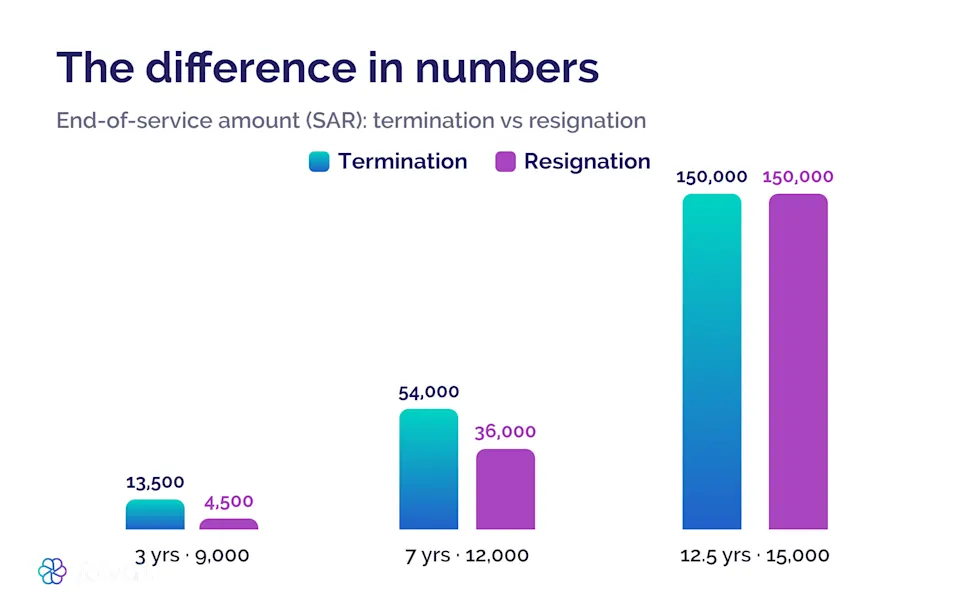
The three examples in one chart show where the reason for leaving makes a large difference, and where it does not:
Example | Tenure | Last wage | On termination | On resignation |
|---|---|---|---|---|
1 | 3 years | 9,000 | 13,500 | 4,500 |
2 | 7 years | 12,000 | 54,000 | 36,000 |
3 | 12.5 years | 15,000 | 150,000 | 150,000 |
These examples are for illustration only. Your real figures depend on your contract, your fixed allowances, and your start date. To compute your exact number, use Solvait's free end-of-service calculator.
When is the award not paid, or changed? (common mistakes)
The following cases cause the most disputes over end of service dues in the private sector:
Dismissal for a lawful reason (Article 80): if the employer ends the contract for one of the Article 80 grounds (such as proven assault or serious misconduct), the award may be forfeited. Not every termination pays the full award automatically; a lawful cause is a stated exception.
A fixed-term contract expiring counts as termination, not resignation. When a non-renewed term contract ends, the employee is treated as terminated and receives the full award, not treated as a resignation. This covers the "indefinite vs fixed term contract" question that trips up many settlements.
Resignation cases that still pay in full (Article 87): the reduction scale is waived in cases such as leaving for force majeure beyond the employee's control, or a female employee ending her contract within six months of marriage or three months of childbirth, who is then entitled to the full award.
Wrong base: calculating the award on basic salary alone instead of the last full wage. This is one of the costliest mistakes, cutting the amount sharply when fixed allowances are high.
Missing the payment deadline (Article 88): the employer must settle wages and dues within one week at most of the contract ending on termination, and within no more than two weeks on resignation. Delay exposes the organization to liability.
The cost of these errors is not theoretical. EY put the average cost of a single payroll error at about USD 291 per error, and PwC's "Making payroll pay" study (193 global organizations) found that payroll errors cost large companies between USD 15 million and USD 45 million a year. In an economy with more than 12 million private sector workers, per Saudi Arabia's General Authority for Statistics (Q2 2026), one small error in the calculation base compounds across every settlement.
How does Solvait's payroll agent ensure a correct settlement?
A final settlement is not one calculation, it is a chain of decisions: is this a termination or a resignation? What is the last full wage? How large is the final partial year? Is the contract fixed term? Each step is a place an error can hide.
Solvait AI HR is Solvait's agentic HR platform . It runs the full HR lifecycle and adds autonomous agents that work under human oversight. Among them is the Rawatib (Payroll) agent, paired with AI Salary Audit, which compares expected against found and surfaces variances before pay runs, so every employee receives the correct settlement. The AI detects and prepares; the final call always stays with your team. Solvait's own figures point to up to 50% time savings and a 100% compliance rate across its clients.
Before you build a settlement by hand, try Solvait's free end-of-service calculator to verify the figure in seconds. For the matching resignation guide, see End-of-service worked examples on resignation.
Want to see how the payroll agent surfaces settlement variances before pay day in your own system? Book a Solvait demo.
Frequently asked questions
When is an employee entitled to the end of service award?
An employee is entitled when the employment relationship ends after completing qualifying service. On termination by the employer or expiry of a fixed-term contract, the full award is paid under Article 84, whatever the tenure. On resignation, nothing is paid under two years, then the amount is reduced per the Article 85 scale.
Is end of service calculated on basic salary or total?
It is calculated on the last full wage, meaning basic salary plus fixed allowances such as housing and transport, not basic salary alone. Calculating on basic only is a common mistake that lowers the amount due when allowances are high.
How do I calculate end of service in the private sector on termination?
Take the last full wage, count half a month for each of the first five years and a full month for each year after, pro-rating partial years. Example: 7 years at 12,000 = (2.5 + 2) months × 12,000 = SAR 54,000, paid in full on termination.
What is the difference between termination and resignation for the award?
On termination the award is paid in full with no reduction. On resignation the Article 85 scale applies: nothing under two years, one third from two to five, two thirds from five to ten, and full at ten years or more.
When must dues be settled after the contract ends?
Under Article 88, the employer must settle wages and remaining dues within one week at most of the contract ending on termination, and within no more than two weeks on resignation.
References
Ministry of Human Resources and Social Development: Labor Law: Labor Relations (Articles 84, 85, 87, 88), 2026 (formula, reduction scale, settlement deadline).
EY: Is your payroll strategy fit for the future?, 2022 (average cost of a single payroll error).
PwC: Making payroll pay: Managing risk and compliance, 2023 (cost of payroll errors to large companies).
ADP Research: Global Payroll Accuracy, 2023 (global payroll accuracy rate).
Deloitte: Global Payroll Benchmarking Survey, 2023 (continued reliance on manual, fragmented processes).
General Authority for Statistics (GASTAT): Labor Market Statistics, Q2 2026, 2026 (private-sector workforce size).
See agentic HR in action
Solvait AI HR and its agents prepare Saudi labor-law work so HR can review it before anything is submitted.
Tags
Related Posts

End of Service on Termination KSA (Article 84)
Calculate end of service on termination in KSA under Article 84: formula, vs resignation, and worked private sector examples.
Nov 12, 2026

End of Service on Resignation in Saudi: Worked Examples
EOS if you resign in Saudi Arabia, with worked examples. What you get after 4 or 8 years, the Article 85 ladder, the Article 84 base, and exceptions.
Oct 4, 2026

Posting Blocked: Why a Halted Pay Run Protects Payroll
Posting Blocked halts a pay run when an AI salary audit finds an unexplained variance, holding it until a human approves. What triggers it and why
Nov 5, 2026