
Employee Onboarding Metrics: How to Measure Whether the First 90 Days Actually Worked
Employee onboarding is won or lost in the first 90 days, and the only way to know which one happened is to measure it. Measuring does not mean counting how many checklist items a new hire ticked on day one. It means four numbers: when they reached full productivity, whether they stayed past 90 days and past a year, how engaged they are, and how satisfied their direct manager is. Without those, you are running onboarding on a feeling, not on evidence. And the gap is wide: only 12% of employees say their company does a good job of onboarding, according to Gallup. This article covers the metrics that actually prove onboarding works, why most teams miss them, and how to measure them across the first 90 days, which in Saudi Arabia is also the statutory probation window.
Key takeaways
The first 90 days are the decisive window. It is when a new hire decides to stay or leave, and when the probation period legally ends.
Vanity metrics (checklist completion, sessions attended) prove nothing. The four real metrics are time to productivity, retention at 90 days and one year, new-hire engagement, and direct-manager satisfaction.
Only 12% of employees say their company onboards well, and only 29% feel fully prepared to excel in their role afterward (Gallup).
Applicant data from your ATS is the natural starting point for onboarding metrics, because it links the quality of the hire to its outcome.
Automated alerts turn measurement from a late monthly report into live tracking that warns before deadlines are missed.
Why measure the first 90 days specifically, and what does ignoring it cost?
Because the decision happens early. The SHRM Foundation report notes that a new hire needs roughly 90 days to prove themselves, and that the most common exit point sits inside that same window. Put plainly, the people who leave tend to leave early, before they have returned your investment in hiring them.
In Saudi Arabia that window carries an extra legal weight. The first 90 days are the probation period under the Labor Law (Article 53), the stretch during which either party can end the contract with no end-of-service benefit and no notice. If the window closes on an unsuitable hire you never measured, they become permanent, and exiting them gets expensive. We covered that point in detail in our guide to probation deadlines and automated compliance alerts.
The cost is not theoretical. The US Department of Labor (DOL) estimates a bad hire costs at least 30% of the employee's first-year earnings. When an unsuitable hire becomes permanent because of onboarding you never measured, you pay that cost twice: the cost of keeping them, then the cost of a lawful exit you could have avoided.
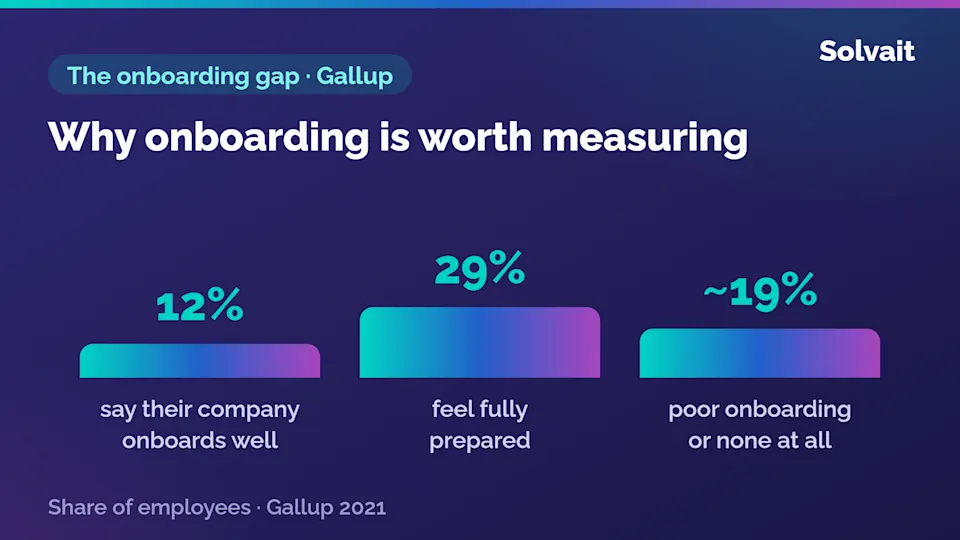
The size of the gap is why this is worth measuring. Per Gallup, only 12% of employees say their company onboards well, only 29% feel fully prepared to excel in their role afterward, and nearly one in five describe their most recent onboarding as poor or say they got none at all. The gap is large, and the teams that measure it hold an edge over the ones that look away.
Which metrics actually prove onboarding works?
The problem is that most teams measure activity, not outcome. Finishing the checklist and attending the orientation session show that something happened, not that it worked. Four metrics show whether it worked.
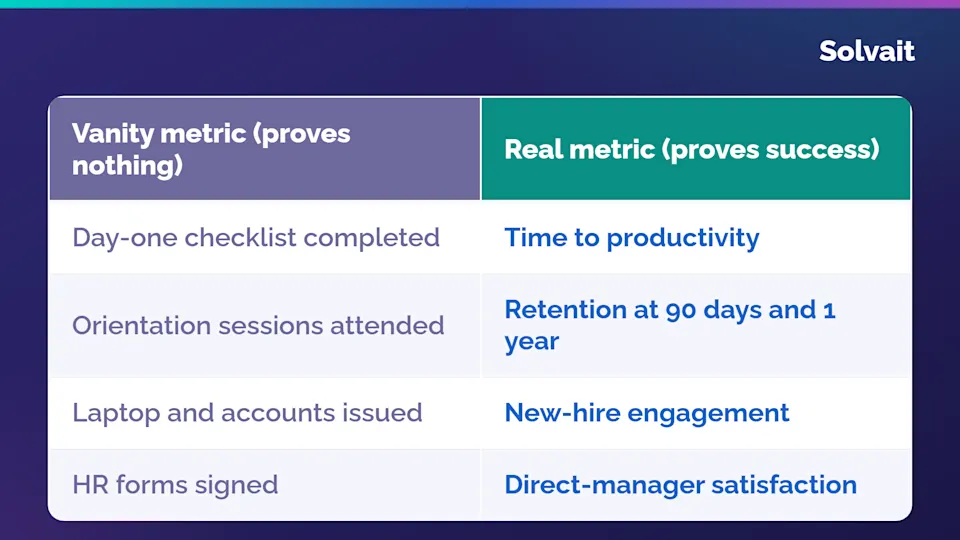
Vanity metric (proves nothing) | Real metric (proves success) |
|---|---|
Day-one checklist completed | Time to productivity : days until the hire hits their role's targets |
Orientation sessions attended | Retention at 90 days and at one year , compared across hiring cohorts |
Laptop and accounts issued | New-hire engagement
(a short survey at 30, 60 and 90 days) |
HR forms signed | Direct manager satisfaction with the hire's readiness |
The four metrics connect to each other:
Time to productivity. SHRM defines it as the time a new hire takes to reach the required performance level. Set a clear target per role, then count the days until they hit it. Gallup's benchmark: a new employee takes around 12 months to reach peak performance, so every week you shave off that ramp is a direct gain.
Retention at 90 days and at one year. Don't look only at overall employee turnover. Compare hiring "cohorts" (people who started in the same period). If many leave from a single cohort, the cause is usually shared, and usually in the onboarding.
New hire engagement. A three question survey at 30, 60 and 90 days surfaces the problem while it is still fixable, not after the resignation. Gallup data shows employees who had exceptional onboarding are 2.6 times as likely to be extremely satisfied with their workplace.
Direct manager satisfaction. The manager is the one who sees real readiness. An active manager role in onboarding makes a hire 3.4 times as likely to call the experience successful, per Gallup. One question to the manager at 90 days says a lot.
How do you measure the first 90 days in practice, and where does the data come from?
Start where recruiting ended. Candidate data in your applicant tracking system (ATS) (the role, the hiring source, the CV match score) is the natural starting point, because it links the quality of the hire to its outcome 90 days later. When a person moves from "candidate" to "new hire" and their data does not move with them, every measurement starts from zero. This is where connecting hiring to onboarding in one platform pays off.
Then set the measurement rhythm on three clear gates:
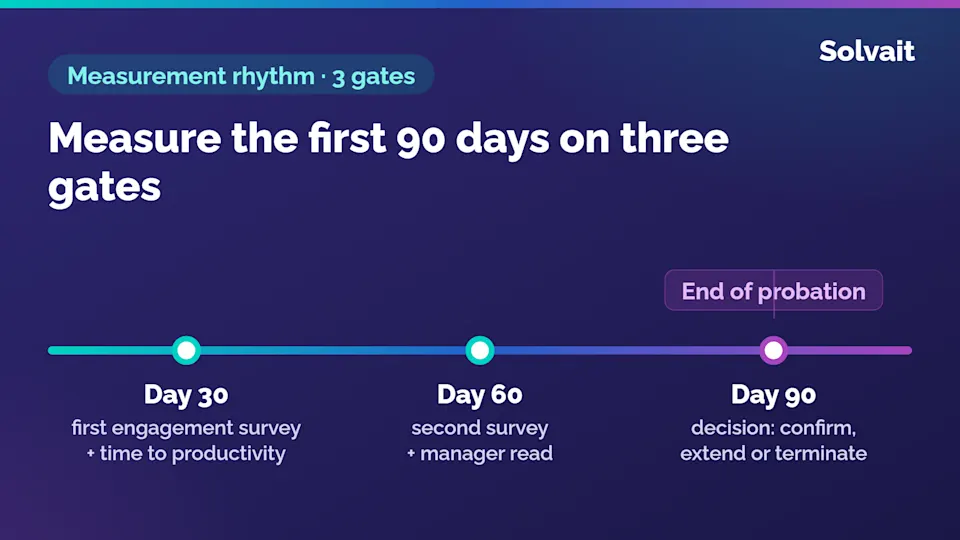
Day 30: first engagement survey, and a quick check of time to productivity against target. The point is to catch whoever is stalling early.
Day 60: second survey, and an initial read from the direct manager. This is where fixable gaps show up before they turn into a decision to leave.
Day 90: the decision. Did the hire hit their role's targets? What does the manager say? Because this day is also the legal end of probation, measuring here is not just a performance review. It is a compliance decision with a cost if its deadline passes.
What everyone gets wrong: relying on a monthly report that arrives too late. A late report tells you the hire left, not that they are about to. The value is in live tracking that warns before the deadline, not after.
Where Solvait fits
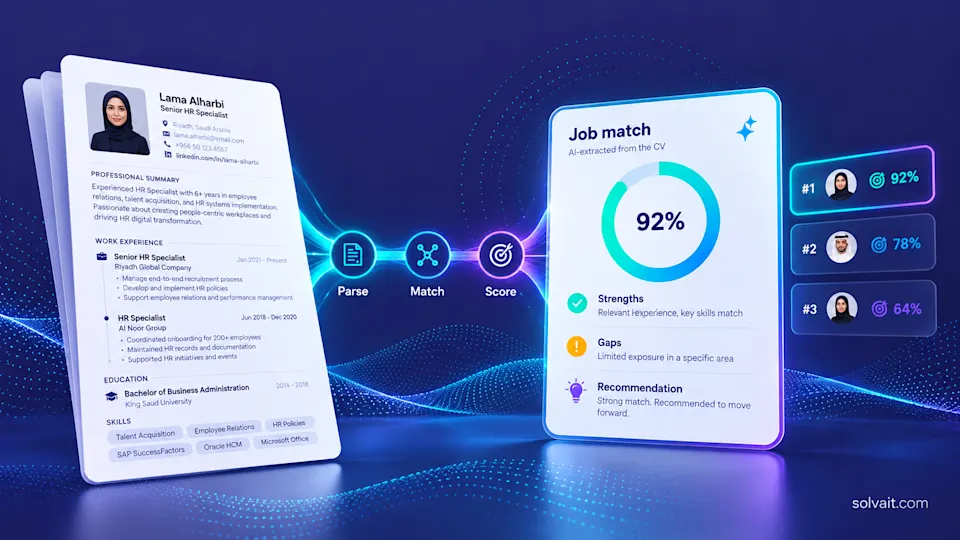
The path starts with Solvait Attract, the recruitment system that generates job descriptions, parses and scores CVs, and ranks candidates. When a candidate is hired, their data carries into onboarding instead of being lost, so you start from a known baseline, not a blank page.
Then Solvait Agentic AI HR takes over. "Agentic" means the platform does not wait to be asked. It tracks the dates and alerts. The Mutaba'aa compliance agent watches the approaching day 90 (the end of probation) and warns the manager before the deadline, with the options laid out: confirm, extend by written agreement, or terminate within the period. That is what turns onboarding measurement from a late report into live HR automation. The final call stays with management. The agent alerts and prepares; the human decides.Across the data of the 300+ enterprise clients Solvait serves as the agentic AI HR company, this kind of tracking turns onboarding from a hope into a process you can prove with numbers.Ready to see the first 90 days measured on your own company's data? Book a short demo with Solvait.
Frequently asked questions
How long should employee onboarding last?
Effective onboarding is an extended process, not a one day event. The first 90 days are the decisive window for the stay or leave decision and retention, and in Saudi Arabia that is the legal probation window. Reaching peak performance takes around 12 months per Gallup, so good measurement runs through the first year, with clear gates at 30, 60 and 90 days.
What is the most important onboarding metric?
No single metric is enough, but the strongest pair is time to productivity together with retention at 90 days. The first measures whether the hire became productive, the second whether they stayed. Together they tell you if onboarding did its job. Add new hire engagement and manager satisfaction to complete the picture.
What is the difference between vanity and real onboarding metrics?
Vanity metrics measure activity: checklist completed, sessions attended, forms signed. They prove something happened, not that it worked. Real metrics measure the outcome: productivity, retention, engagement, and manager satisfaction. Build your reporting on the second set, not the first.
How does AI help measure onboarding?
AI links recruiting data from the ATS to onboarding data, so measurement doesn't start from zero. Agentic AI then tracks sensitive dates like the end of day 90 (probation) and alerts the manager before the deadline, so the decision is made on time instead of being discovered in a late report.
Are the first 90 days the same as the probation period in Saudi labor law?
Yes. The probation period in Saudi labor law is 90 days, extendable to 180 by written agreement. That makes measuring the first 90 days a legal decision, not just an HR practice: if the period ends with no decision, the employee becomes permanent.
References
Gallup: 8 Practical Tips for Leaders for a Better Onboarding Process, 2021 (the 12% figure, 29% feel prepared, 2.6x satisfaction, 3.4x manager role, 12 months to peak performance).
SHRM: Onboarding: Measuring Success (definitions of onboarding metrics: time to productivity, cohort retention, new-hire surveys).
SHRM Foundation, Talya Bauer: Onboarding New Employees: Maximizing Success, 2010 (the 90-day window to prove oneself).
US Department of Labor (DOL): a bad hire costs at least 30% of first-year earnings, 2024 (cost floor).
GASTAT: Labour Market Statistics, Q1 2025 (scale of the Saudi workforce and Saudi unemployment at 6.3%).
See agentic HR in action
Solvait AI HR and its agents prepare Saudi labor-law work so HR can review it before anything is submitted.
Tags
Related Posts
CV ATS Score: Why the AI Ranked This Candidate
A CV ATS score gives every candidate a match number plus the reason behind it, so you walk into the selection meeting with a ranking you can defend.
Oct 27, 2026

Applicant Tracking System (ATS): Employer's Guide
An applicant tracking system reads and ranks CVs before a recruiter sees them. Here's how an ATS works from the employer's side .
Oct 21, 2026

AI CV Screening: How It Ranks Arabic and English CVs
How AI CV screening reads Arabic and English CVs, scores each applicant with strengths and gaps, and what Saudi recruiters should still decide themselves.
Sep 17, 2026