
Holding Company Payroll in Saudi Arabia: One Calendar Across Subsidiaries
A holding company does not have one payroll problem. It has one per subsidiary. Each entity has its own commercial registration, its own Mudad account, its own Wage Protection System (WPS) file to upload, and its own GOSI contributions to settle. When cutoff dates differ from one subsidiary to the next, month-end turns into a manual race across scattered spreadsheets.
The fix is not one giant pay run that merges everything into a single file. The Wage Protection System will not accept that, because every commercial registration uploads its own file. The fix is one calendar that every subsidiary runs to: a shared cutoff, approvals with clear roles, per-entity Mudad and WPS files generated from the same source, and an automated check before filing. That is the difference between a group that closes payroll in two days and one that chases variances to the last minute.
Key takeaways
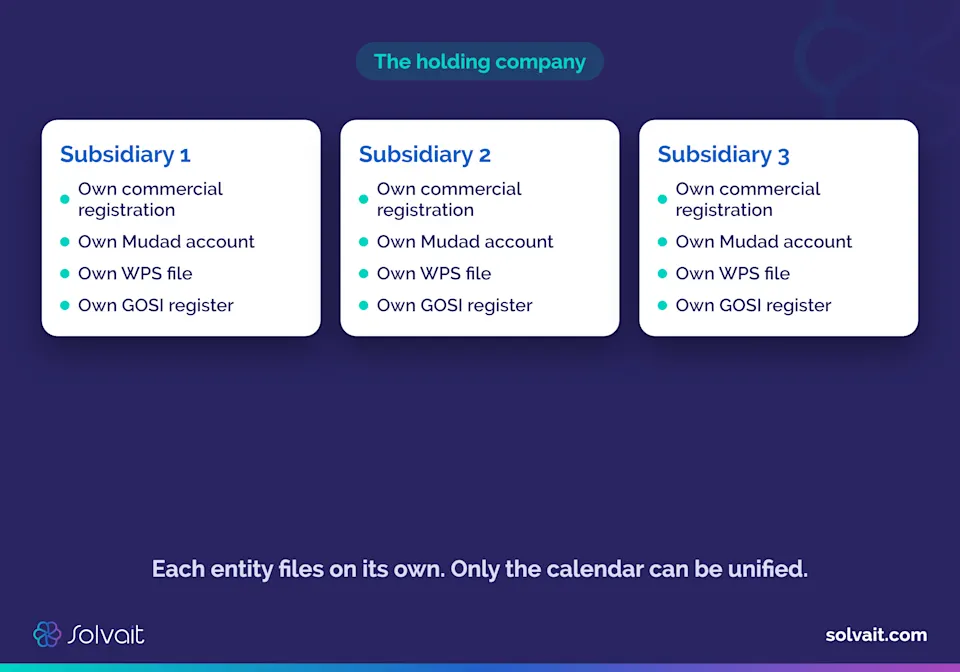
Holding company payroll in Saudi subsidiaries is run entity by entity, not in one batch. Each subsidiary has its own CR, Mudad account, WPS file, and GOSI register.
A shared calendar is the answer, not merging. One cutoff and clear approval roles, while each entity's file stays separate as the system requires.
Time genuinely got tighter. The Ministry of Human Resources cut the WPS upload window on Mudad from 60 days to 30 days, effective 1 March 2025.
Accuracy is not optional. Roughly one in five payrolls contains an error, per EY, and every error costs time, money, and sometimes regulatory exposure.
Agentic AI checks before you file. A payroll agent reviews each entity and flags variances before the file goes up, and leaves the decision to a named person.
Why does holding-company payroll break down across subsidiaries?
Because each subsidiary, in the eyes of the system, is a full company. It is not a branch in one ledger. That distinction is the root of the complexity.
In Saudi Arabia, running payroll ties each entity separately to three authorities:
Mudad: the state payroll management platform. Every establishment with its own commercial registration needs its own Mudad account to prepare payroll and upload WPS files.
Wage Protection System (WPS): it compares what you actually paid against what is recorded in the labor contracts. A separate file is uploaded per establishment, never one combined file for the group.
GOSI (social insurance): contributions are calculated and settled at the entity level, on each register.
On top of that, the calculation base itself is no longer uniform. Under the new Social Insurance Law in force since 3 July 2024, new joiners enter on a contribution schedule that rises gradually by half a point a year, while anyone who contributed earlier stays on their previous rate. In a group that employs thousands across several entities, that means two tiers inside a single payroll register, and a wider chance of error on every employee payslip.
The familiar result: one Excel sheet per subsidiary, a payroll officer stitching them together by hand, and a close date that shifts from company to company. And with the WPS upload window cut to 30 days, the margin for error is narrower than it was.
Item | At group level | At each subsidiary |
|---|---|---|
Commercial registration | One owning entity | Separate CR per subsidiary |
Mudad account | No single shared account | Own account per establishment |
WPS file | No one file for the group | Separate monthly file per entity |
GOSI contributions | Settled at entity level | Own register and contribution |
Cutoff date | Should be shared | Often different, and that is the flaw |
Look at the last row. Everything else is fixed by the system and you cannot change it. The cutoff date is the one thing you own. And it is exactly what slips out of most groups' hands.
How does one shared payroll calendar across subsidiaries work?
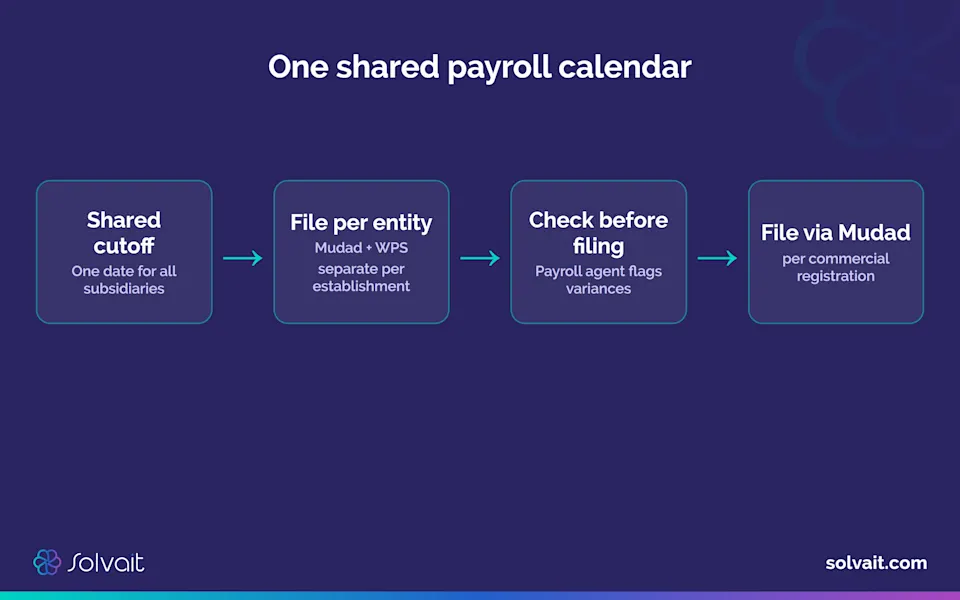
The idea is simple: unify what you own, keep separate what the system mandates. You do not merge files. You unify the rhythm they are produced in.
A group's shared payroll calendar rests on four parts:
A shared cutoff. One date on which every subsidiary closes attendance, changes, and allowances. No different "month end" per company.
Clear approval roles. Each subsidiary's finance manager signs off on their entity, and the group controller sees the full picture before filing. Approval by name, not by email.
One source, one file per entity. From the same platform, a Mudad and WPS file is generated for each establishment with its own data. One source, separate outputs.
Entity level GOSI reconciliation. Contributions are calculated per register, with the new joiner and legacy tiers separated automatically.
The practical gap is large. In the fragmented model, every payroll officer starts from scratch, each file is filed in its own moment, and errors are usually found after filing. In the unified model, everyone starts from one calendar, and entities are reviewed side by side before anything is uploaded.
This is where payroll software built for groups, not for a single company, earns its place. Software that sees every entity in one dashboard, generates each entity's file, and keeps an audit trail of every change saves days of manual work. And if you want a quick check for a single entity, Solvait's salary calculator gives you a first read in a minute.To be fair about it. For a single entity, the Mudad portal plus a simple spreadsheet can be enough to file the monthly file. Regional payroll systems such as Qoyod and ZenHR do that single-establishment job well. The problem starts with the second and third entity, when the mismatch in cutoff dates becomes the real risk. That is exactly where a group grade platform matters, not a single-company payroll tool.
Where does agentic AI fit before filing?
Manual review across entities does not scale with headcount. One person cannot compare ten payroll registers line by line inside a 30-day window. This is where agentic AI comes in.The difference between an assistant and an agent matters here. An assistant suggests. An agent runs the full check and shows its result with a log. On the Solvait platform, the Rawatib payroll agent reviews each entity before filing. It compares net pay against the prior month, flags an unexplained jump in an allowance or a deduction, and verifies that the WPS file matches the recorded contracts. Whatever it finds, it raises to you before it reaches Mudad.
The Mutaba'aa compliance agent completes the picture. It watches GOSI, Qiwa, and Mudad deadlines and alerts you before a delay becomes a fine. This is what a Saudi labor law compliance platform means when it works at group scale: continuous monitoring per entity, not a late monthly review.One honest point. The agent flags and suggests, but it does not file on your behalf. The decision stays with a named person. That is the correct design. Payroll data validation software earns its value when it gives you confidence before you press "submit", not when it acts without you.
What are the common mistakes in group payroll?
Three mistakes repeat in almost every group:
Unifying the file instead of the calendar. Trying to upload one WPS file for the group. The system rejects it, because each CR uploads its own. Unify the date, not the file.
Ignoring the new-joiner tier. Applying one contribution rate to everyone after the 2024 change. The register looks right, and the gap shows up at reconciliation.
Finding errors after filing. Waiting for an employee complaint to catch a mistake. With a 30-day window, correcting after upload is harder and costlier. The check comes before filing, not after it.
Group payroll with Solvait
Solvait is the agentic AI HR company. The Solvait Agentic AI HR platform runs the full HR lifecycle and connects your entities in one dashboard, while each establishment's file stays separate as the system requires. It generates Mudad and WPS files per entity, calculates GOSI across both tiers, and keeps an audit trail of every change.
On top of it, two agents work under human oversight: Rawatib checks each entity before filing, and Mutaba'aa monitors compliance across Qiwa, Mudad, and GOSI. You make the call, the AI does the checking.
The results Solvait publishes for its clients: up to 50% savings in operations time, readiness within 30 days, more than 300 enterprise clients, and full compliance readiness for Saudi requirements. See how Solvait's agentic AI HR platform runs payroll across your entities from one place.Holding company payroll is solved with one calendar and a check before every filing.
Book a demo with Solvait to see how your group closes payroll in two days, not in a month end race.
FAQ
Can I upload one WPS file for all subsidiaries?
No. Each commercial registration uploads its own WPS file through the establishment's own Mudad account. There is no combined file for the group. What you can unify is the payroll calendar and approvals, so that every file is generated from one source on the same date.
How long is the WPS upload window in Saudi Arabia?
The Ministry of Human Resources and Social Development cut the allowed window for uploading the Wage Protection System file on Mudad from 60 days to 30 days, effective 1 March 2025. That leaves less time to verify across entities and raises the value of an automated check before filing.
What is the difference between merging payroll and unifying the payroll calendar?
Merging tries to combine entities into one file, which the system rejects. Unifying keeps each entity's file separate but puts every subsidiary on one shared cutoff and clear approval roles. Unifying is possible and useful. Merging is not possible under the regulations.
How do GOSI contributions differ between employees in a group?
Since 3 July 2024, new joiners enter on a gradually rising contribution schedule, while anyone who contributed earlier stays on their previous rate. That means two tiers inside a single register, and your payroll software should separate them automatically.
Does the AI file payroll on my behalf?
No. Solvait's Rawatib agent reviews each entity, flags variances, and presents them to you, but the filing decision stays with a named human. The AI does the checking, and you make the call.
References
EY : How much are payroll errors costing your business?, 2022 (payroll error rate and regulatory impact)
ADP : Improving payroll data accuracy across multiple countries, 2024 (payroll accuracy across multiple entities)
McKinsey : How finance teams are putting AI to work today, 2025 (finance-team time savings with AI)
Ministry of Human Resources and Social Development (via Deloitte Middle East) : Update on Wage Protection System file uploading period, 2025 (30-day window)
GOSI : New Social Insurance Law comes into force, 2024 (new-joiner contribution schedule)
Solvait : Agentic AI HR platform, 2026 (Solvait figures: 300+ clients, 50% time savings, 30-day setup)
See agentic HR in action
Solvait AI HR and its agents prepare Saudi labor-law work so HR can review it before anything is submitted.
Tags
Related Posts
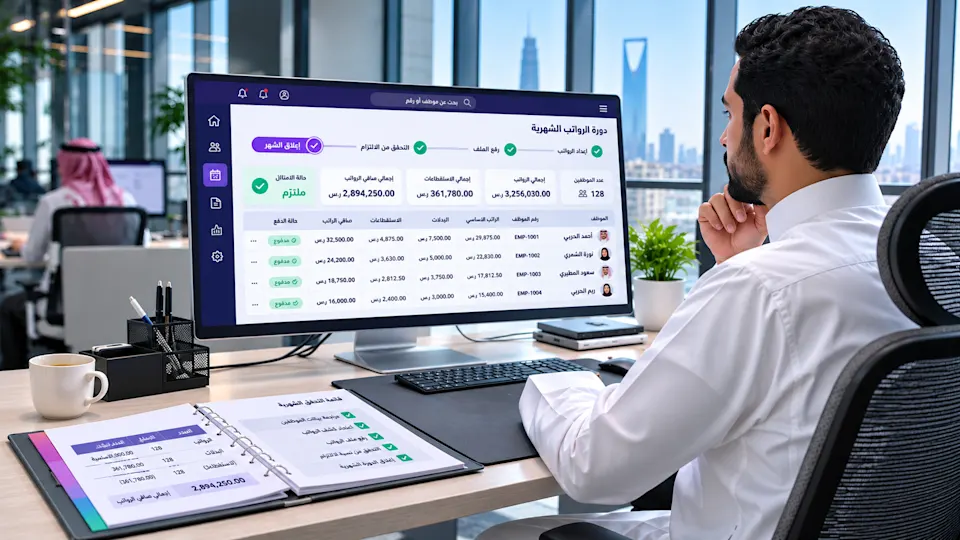
Wage Protection System & Mudad: Saudi Payroll File
Mudad and the Wage Protection System in Saudi Arabia share one payroll file. Why WPS flags it, and how to pass compliance.
Nov 16, 2026

GOSI Automation Saudi Arabia: Calculate, File & Audit
Calculate, submit and audit GOSI contributions in Saudi Arabia accurately, without a dedicated compliance specialist, using agentic payroll automation.
Aug 24, 2026
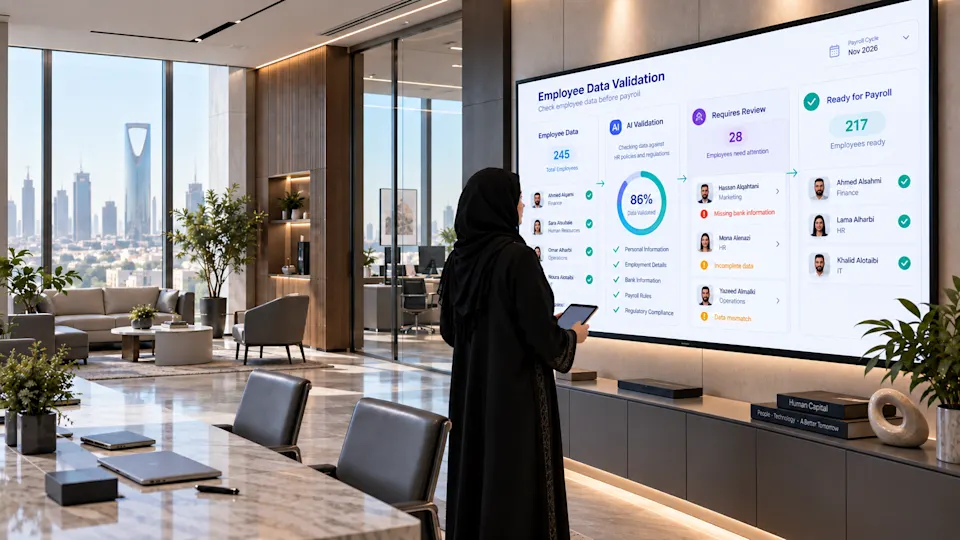
AI Employee Data Validation Before Payroll
Solvait's AI Employee Data Validation scans employee data before payroll, and validates the payout itself before payday.
Nov 10, 2026