
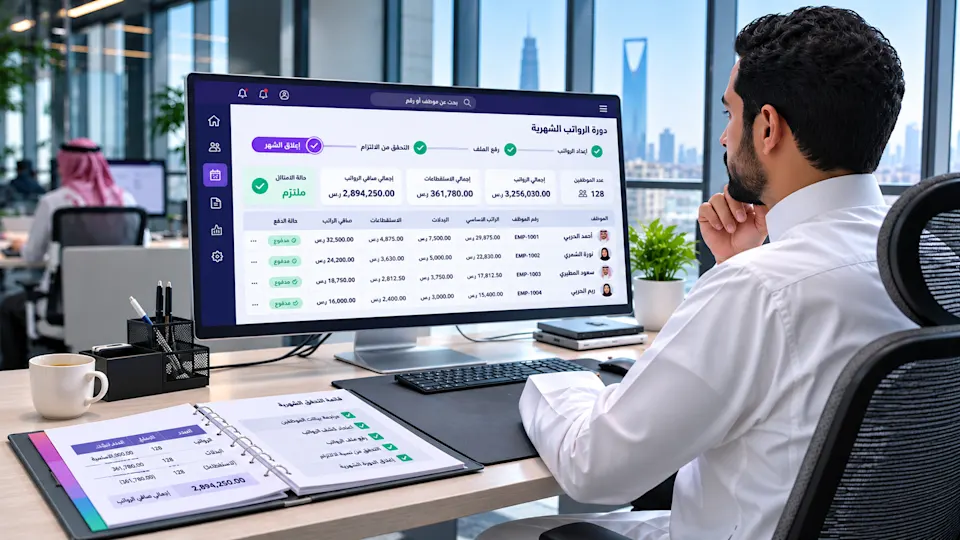
Mudad and WPS: One Monthly Payroll File Without Last-Day Panic
The Wage Protection System (WPS) is a Saudi government mechanism that verifies every employee was paid the agreed wage on time, by matching what the company actually paid against what is recorded with the authorities. Mudad is the platform most establishments use to upload the monthly payroll file so it reaches the banks and the Wage Protection System. In one line: Mudad is the door, and WPS is the auditor. Every payroll team knows the problem, and it looks simple on the surface. The file itself is just a list of names and wages. But any small gap between the salary in your system and the salary recorded in the General Organization for Social Insurance (GOSI) or in a Qiwa contract can get the file rejected, or drop your compliance rate. Worse, that gap is usually discovered on the last day, when there is no time left to fix it calmly.
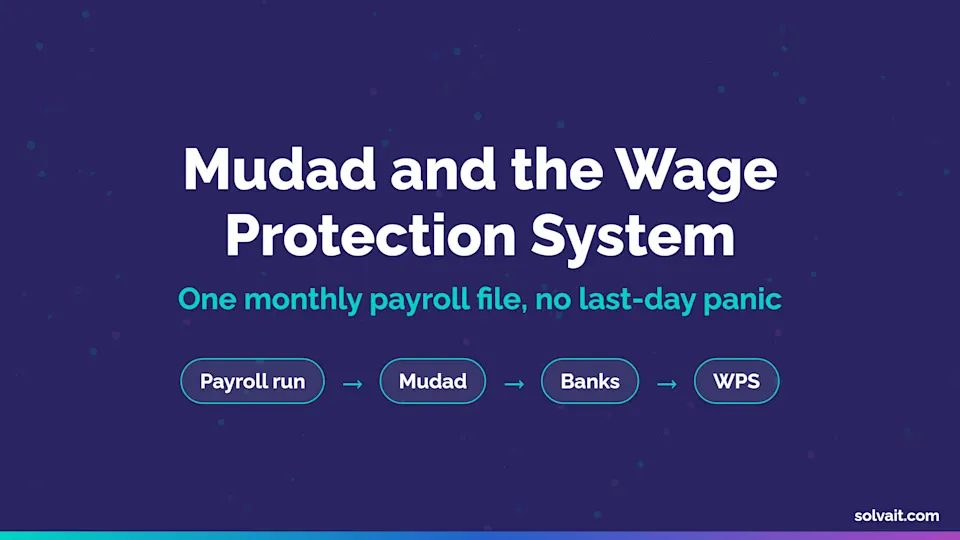
This article explains how the file flows from Mudad to the Wage Protection System, which mismatches stop the file or lower your compliance rate, and how to close every month with one checklist instead of a last-minute scramble.
Key takeaways
Mudad is the channel for uploading the monthly payroll file; the Wage Protection System is the auditor that matches what was actually paid against official records.
WPS subscription through Mudad is mandatory for every private sector establishment regardless of size, since the end of 2020.
Most file rejections or compliance rate drops come from a gap between the salary in your system and the salary recorded in GOSI or a Qiwa contract.
A falling compliance rate exposes the establishment to per worker fines and to suspension of Qiwa and Muqeem services, which stops visas and work permit renewals.
An agentic AI pre-submission check catches the mismatches before the file is uploaded, turning payroll close from a last day race into a calm review.
What is the difference between Mudad and WPS, and how does the payroll file flow?
The two names appear together every month, so they get confused. Each plays a different role.
Mudad is a platform from the Ministry of Human Resources and Social Development for payroll and establishment services. Through it, an establishment prepares the payroll run and uploads the monthly wage file. The platform is linked directly to GOSI records and to Qiwa contracts, and it is the practical channel the file passes through on its way to the banks.
The Wage Protection System (WPS) is a government program that checks whether the establishment paid wages in full and on time. It does not upload the file. It compares what reached employees' accounts against what is recorded officially, then gives the establishment a monthly compliance rate.
The distinction is simpler than it sounds: Mudad uploads, WPS audits. The monthly file travels through four steps in order:
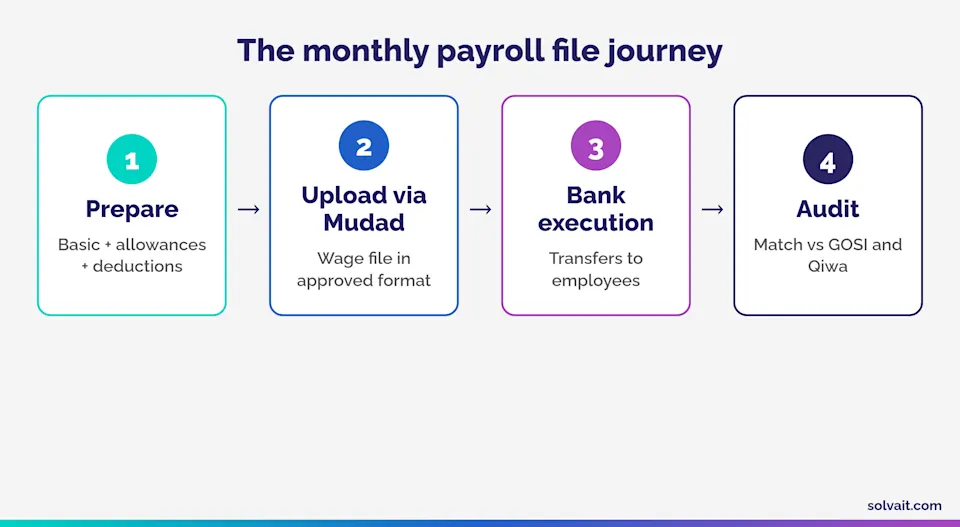
Prepare: the payroll team builds the month's run (basic salary, allowances, deductions, advances).
Upload via Mudad: the run is turned into a wage file in the approved format and uploaded.
Bank execution: transfers are sent to employees' accounts through the banks.
Audit: WPS matches the amounts paid against GOSI and Qiwa records and updates the compliance rate.
The table below summarizes the difference:
Item | Mudad platform | Wage Protection System (WPS) |
|---|---|---|
Authority | Ministry of Human Resources and Social Development | Ministry of Human Resources and Social Development |
Role | Channel to upload and manage the payroll file | Auditor that measures wage payment compliance |
What it holds or measures | Employee, salary, and allowance data | Match of paid vs recorded, and the compliance rate |
Where you track it | The Mudad platform | The compliance rate shown to the establishment |
Who feels the result | The payroll team | The whole establishment (Qiwa, Muqeem, Nitaqat) |
The volume on this path is large. The Ministry of Human Resources and Social Development reported that establishments registered on Mudad passed one million, roughly 94% of private sector establishments during 2025 (MHRSD, 2025). And because about three in four private sector workers in Saudi Arabia are non-Saudi (GASTAT, 2025), the accuracy of every line in the wage file touches tens of millions of salaries each month.
Why does the payroll file get rejected or the compliance rate drop on the last day?
The file is not rejected because it is complex. It is rejected because it is sensitive to any gap. The most common gap is a mismatch between a number in your system and a number held by an authority. The usual culprits:
Salary gap: the basic salary or allowance in your system differs from what is recorded in GOSI.
Missing Qiwa contract: a new hire with no documented contract, or an expired contract not renewed.
Wrong bank details: an incorrect IBAN or an inactive account, so the transfer bounces.
Joiners and leavers: someone who left is still in the file, or a new hire has not been added.
Late upload: the file is uploaded after the allowed window (that window was shortened in 2025, so confirm the current deadline on Mudad).
These gaps are not a theoretical cost. EY estimated the fully loaded cost of a single payroll error at about USD 291 once correction time, rework, and employee communication are counted (EY, 2022). At the establishment level, a falling compliance rate exposes it to fines calculated per worker and to suspension of Qiwa and Muqeem services, which stops visa issuance and work permit renewals and affects its Nitaqat standing. (Fines, thresholds, and timelines vary and are updated; check Mudad and the ministry for current figures.)
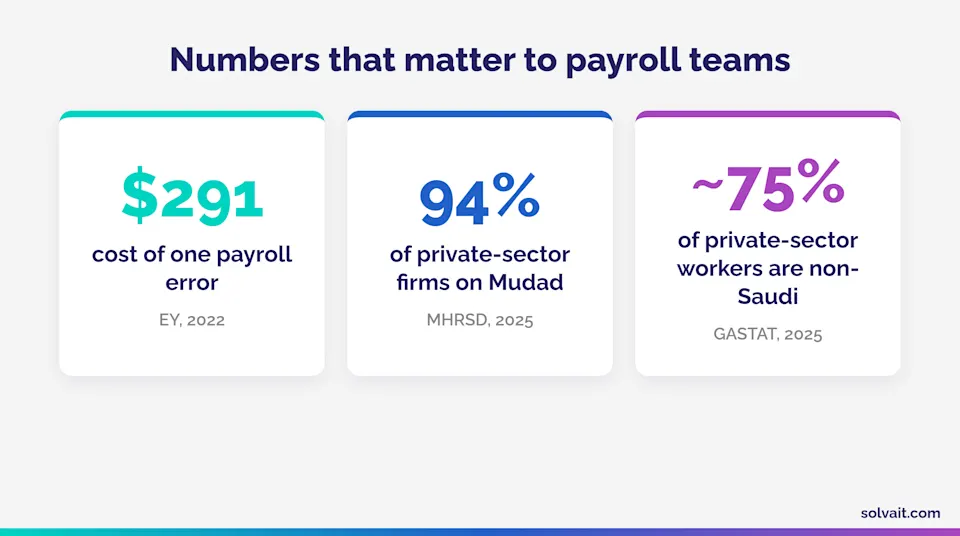
The root problem is that manual matching happens too late. The file is built first, then the gap surfaces at or after upload. The American Payroll Association put the manual processing error rate at roughly 1.2% of operations, a small share that turns into a crisis when it appears on the last day.This is where an agentic AI pre-submission check changes the order. Instead of matching after the build, a compliance agent reviews every line before upload: it compares the salary against the GOSI record, confirms a live Qiwa contract exists, and flags the suspect cases (salary gap, missing contract, wrong IBAN, a leaver not removed), holding them for human review before they reach the file. The AI does the checking; your team makes the call. And since 75% of Middle East workers said they used AI in their work over the past year (PwC, 2025), this kind of review feels familiar rather than foreign.
Last-day panic | Agentic pre-check | |
|---|---|---|
When gaps are found | After the file is built, or at upload | Before upload, line by line |
Who matches against GOSI and Qiwa | A person, manually, under time pressure | An agent, matching everyone automatically |
Usual outcome | A rejected file and a threatened rate | A clean file and a calm review |
How do you close the monthly payroll file without errors? A pre-upload checklist
This is a practical list a payroll team can run every month before pressing "upload". The goal is to enter the file clean, not to fix it after a rejection.
Match the numbers: confirm each employee's basic salary and allowances match what is recorded in GOSI.
Check the contracts: every employee in the file has a documented, active Qiwa contract.
Reconcile movement: anyone who joined this month is added, anyone who left is removed.
Verify bank details: a correct IBAN and an active account for every employee.
Approve deductions: review advances, absences, and penalties before final sign off.
Upload early: submit on Mudad well before the allowed deadline, not on the last day.
Follow up after upload: watch the compliance rate and resolve any pending case at once.
Steps 1 to 5 are exactly what a compliance agent can check automatically, freeing your team for the decision instead of the manual reconciliation.
How Solvait helps you close payroll without the panic
Solvait is the agentic AI HR company. Its Solvait Agentic AI HR platform runs the full payroll cycle, connects to your existing systems, and adds AI agents that do the routine work under human oversight.
Mutaba'aa (Compliance agent): watches the match against GOSI, Qiwa, Mudad, Nitaqat, and the Labour Law, and catches gaps before they reach the wage file.
Rawatib (Payroll agent): builds the payroll run and prepares the WPS file in the approved format, cutting the manual build.
You can size the gaps quickly with Solvait's free salary calculator and see the payroll and compliance platform inside the suite. If your team also tracks contract and residency timing, Qiwa Contract vs Iqama Expiry: Two Clocks is a natural companion to this one.
Solvait serves more than 300 enterprises, with a 100% compliance rate for its clients and ISO 27001:2022 certification. Learn more about Solvait Agentic AI HR.
Ready to see the difference on your own file? Book a demo with Solvait and let the compliance agent review a real payroll cycle with you.
Frequently asked questions
Is WPS subscription through Mudad mandatory for every company?
Yes. Subscription to the Wage Protection System through Mudad is mandatory for every private-sector establishment in Saudi Arabia regardless of size, since the end of 2020, including establishments with a single employee. The establishment uploads the monthly wage file, and the system measures how fully and promptly it paid wages.
What is the difference between Mudad and WPS?
Mudad is the channel through which payroll files are managed and uploaded, and it is linked to GOSI records and Qiwa contracts. The Wage Protection System is the government mechanism that verifies wages were paid in full and on time, by matching what was paid against what is recorded. In short, Mudad uploads and WPS audits.
Why does the payroll file get rejected or the compliance rate drop?
The most common cause is a gap between the salary in your system and the salary recorded in GOSI or a Qiwa contract. Other causes include a wrong IBAN or inactive account, a leaver still in the file, a new hire not yet added, or uploading the file after the allowed window.
What happens if the establishment's compliance rate falls?
The establishment faces fines calculated per worker and suspension of Qiwa and Muqeem services, which stops visa issuance and work-permit renewals and affects its Nitaqat standing. Fines, thresholds, and timelines vary and are updated regularly, so check the Mudad platform and the Ministry of Human Resources and Social Development for current figures.
References
EY: The cost of payroll errors, 2022 (fully loaded cost of a single payroll error, about USD 291).
Ministry of Human Resources and Social Development: Wage Protection program, 2025 (over one million establishments, 94% of the private sector on Mudad).
Mudad: Mudad platform, 2026 (wage-file upload and matching against GOSI and Qiwa).
GOSI: gosi.gov.sa, 2026 (the recorded-wage reference the file is matched against).
GASTAT: Labour market statistics, 2025 (share of non-Saudi workers in the private sector).
PwC: Workforce Hopes and Fears 2025, 2025 (75% of Middle East workers used AI in their work).
Solvait: solvait.com (300+ enterprises, 100% compliance rate, ISO 27001).
See agentic HR in action
Solvait AI HR and its agents prepare Saudi labor-law work so HR can review it before anything is submitted.
Tags
Related Posts

AI Employee Data Validation Before Payroll
Solvait's AI Employee Data Validation scans employee data before payroll, and validates the payout itself before payday.
Nov 10, 2026

Payroll Error Detection: AI Flags, Your Team Decides
AI powered payroll error detection flags salary gaps before you post, while your team makes the call. A practical Saudi pre-payroll guide.
Oct 25, 2026

GOSI Automation Saudi Arabia: Calculate, File & Audit
Calculate, submit and audit GOSI contributions in Saudi Arabia accurately, without a dedicated compliance specialist, using agentic payroll automation.
Aug 24, 2026