

Saudization Hiring Quality: Scorecards That Protect Nitaqat Green
Saudization hiring quality means choosing the Saudi hire who stays and performs, not just filling a seat so the number looks good this month. The direct answer: build a weighted hiring scorecard before you open the role, score every candidate against the same number, and count a hire as a win only if it survives 12 months. A hire who leaves after four months does not protect your band. It costs you twice.
The green band in Nitaqat is not a box you fill with anyone. Your color decides work visas, permit renewals, and job-title changes, and a Saudi employee whose contract is not documented on Qiwa does not count at all. So the rule is not "hire fast". It is "hire the person who stays".
Key takeaways
Saudization hiring quality is measured by who stays and performs after 12 months, not by this month's headcount.
A fast hire who leaves early drops your Nitaqat number and makes you pay to recruit all over again.
A weighted hiring scorecard gives every candidate the same score on the same criteria, so fewer decisions run on gut feel.
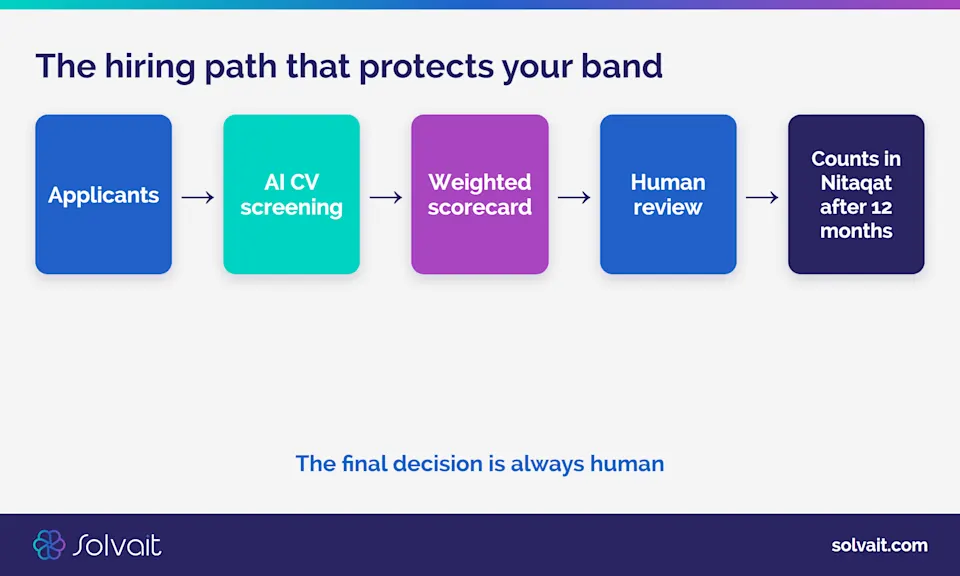
AI CV screening speeds and standardizes the shortlist, but it is never the final call. A human makes the decision.
Count a Saudi hire toward Saudization only after the contract is documented on Qiwa and a clear retention window has passed.
Why does filling Nitaqat green with any fast hire backfire?
As a Nitaqat review date nears, many teams rush to hire so the Saudization rate climbs. The instinct is understandable, but it builds a fragile number. A Saudi hired in a hurry with no real fit for the role leaves within months, your number slips back to where it was, and a fresh recruiting cycle begins.
The cost is not symbolic. A widely cited estimate puts the cost of a bad hire at around 30% of the employee's first-year salary, across advertising, manager time, and wasted training. And yet few companies actually measure hiring quality. SHRM data shows that organizations tracking quality of hire are still a minority.
There is a Saudi dimension that raises the stakes. Unemployment among Saudi nationals fell to 7.2% in Q4 2025, and among Saudi women to 10.3% (General Authority for Statistics). The market is tightening, and good Saudi talent is wanted by everyone. A company that treats Saudization as a number to fill will lose those people to a company that treats it as a real career path.
The point is simple. Speed alone is the enemy of a stable green band. What protects it is the quality of the choice.
How do you build a hiring scorecard that protects the green band?
A hiring scorecard is a table of weighted criteria. You give each candidate a score from 1 to 5 on every criterion, then combine the scores by weight into one comparable number. Its value is that it moves the decision from impression to a fixed standard, and it makes everyone on the panel measure the same thing.
Build it in six steps:
Write the role criteria before you post the job, not after you meet the first candidate.
Give each criterion a weight that reflects its real importance to the role (total 100%).
Define what a 1 means and what a 5 means for each criterion, so two raters don't disagree on the meaning.
Score every candidate on the same scorecard, with a short note justifying each score.
Set a decision threshold in advance (for example: 3.5 and above hires, 2.5 to 3.5 gets a second interview, below that is a no).
Review the scorecard after six months: are the highest-scoring candidates actually the best performers who stayed? Adjust the weights accordingly.
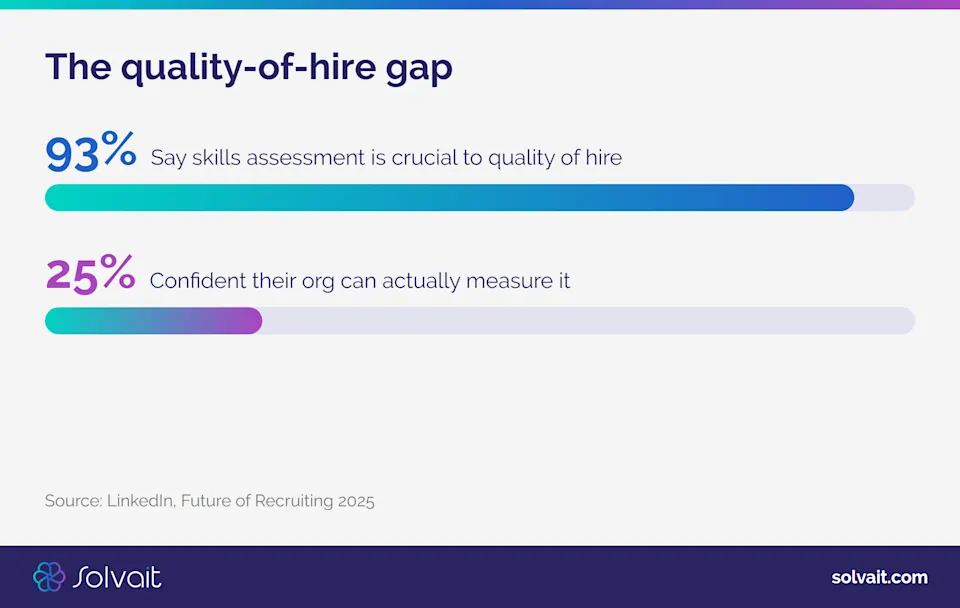
The most important criterion is the one measured by retention. A hire who stays 12 months and performs is the only hire that protects your band. Per LinkedIn's Future of Recruiting 2025, 93% of talent acquisition professionals say accurately assessing a candidate's skills is crucial to quality of hire, yet only about 25% are confident their organization can actually measure it. The scorecard closes that gap.
Here is a ready scorecard you can copy today:
Criterion | Weight | What you score (1 weak, 5 excellent) |
|---|---|---|
Role fit and core skills | 30% | Do they have the actual skills, not just the certificate? |
Likelihood of staying 12 months | 20% | Stability of past track record and clarity of motivation |
Learning and growth potential | 15% | Speed of picking up a new skill and openness to develop |
Team fit (not sameness) | 15% | Working and communication style, not one identical background |
Readiness to start | 10% | Complete paperwork and a near start date |
Saudization value | 10% | A real career path that builds lasting Saudi capability |
The golden rule: do not count the hire on signing day. Count it after the contract is documented on Qiwa and an agreed retention window has passed. The number that survives is the only one that helps at a Nitaqat review.
And separate two roles that often get confused: who decides the hire (owns the call) and who is consulted (opinion only). Confusing them drowns the decision in views that carry no responsibility for the outcome.
How does AI raise screening quality without lowering the bar?
Manual screening of hundreds of CVs does not hold up. This is where AI CV screening comes in: the system reads the CV, extracts skills and experience, matches them against the role criteria, and ranks candidates. This is what many people are after when they search for a "smart recruitment agent" or "cv analysis": a tool that screens fast and fairly.
The direction is clear. AI adoption in HR rose from 26% in 2024 to 43% in 2025 (SHRM). And employers in Saudi Arabia expect technology to perform 45% of tasks by 2030, against 34% globally (World Economic Forum, 2025). Repetitive, rule-based screening is among the first things to automate.
But beware a common illusion: the tool is not automatically fair. In Warden AI's 2025 audit, 15% of the screening tools reviewed failed to clear fairness thresholds between groups. A tool tuned to bad criteria will simply screen faster toward a bad decision. Value comes when you design the scorecard and criteria first, then let the system screen against them, with the final call staying human.
So let AI raise screening quality on three conditions: it matches candidates against the same criteria in your scorecard, it explains the reason for each ranking rather than giving a vague number, and the top candidate passes a human review before an offer. The goal is to widen your screening capacity, not to replace your judgment.
What are the common mistakes in measuring Saudization hiring quality?
Counting the hire on signing day: the number rises, then collapses when the employee leaves early. Count retention, not signatures.
Criteria with no weights: when every criterion is equal, impression wins. Weight what actually matters to the role.
Confusing speed with quality: "we filled the role in a week" is no win if the hire leaves in a month.
Full reliance on the tool: AI screens, but it carries no responsibility. The decision is human.
Saudization as a number, not a path: build a career path for Saudis and you keep them; fill a box and you lose them.
Where Solvait fits
Solvait is the agentic AI HR company, and it handles Saudization hiring quality on two practical levels:
Solvait Attract is the recruitment system that writes job descriptions in Arabic and English, parses and ranks CVs against the role criteria, and runs stage-driven candidate communication. It gives you the fast, consistent shortlist you build your scorecard on top of.
Solvait Agentic AI HR is the full platform that ties recruiting to compliance, where the
Mutaba'aa agent monitors Saudization metrics and Qiwa contract documentation, so your Nitaqat number is built on documented hires that last.
The result is concrete: Solvait clients see up to 50% time savings and go live within 30 days, with more than 300 clients across Saudi Arabia and the Gulf.Start with the simplest step today: prepare one standard scorecard for your open role, and let the recruitment system screen CVs against its criteria before the first interview.
Ready for hiring that protects your band instead of shaking it? Book a demo with Solvait.
Frequently asked questions
What is Saudization hiring quality?
It is choosing the Saudi hire who stays and performs, measured by retention and performance after the hire rather than by headcount. A hire who leaves early does not protect the green band, because your Nitaqat number slips back and the cost of hiring repeats.
How do you build a hiring scorecard?
Write the role criteria before posting the job, give each criterion a weight totaling 100%, define what a 1 and a 5 mean, score every candidate on the same scorecard, then set a decision threshold in advance. Review the scorecard after six months and adjust the weights by who actually stayed and performed.
Does AI CV screening replace the interview?
No. AI CV screening speeds and standardizes the shortlist and ranks candidates, but it does not make the final decision. A tool tuned to bad criteria screens fast toward a bad decision, so the top candidate stays under human review before an offer.
When does a Saudi hire count toward Saudization?
It counts after the contract is documented on the Qiwa platform, not on signing alone. To protect a stable green band, measure hire quality by whether the employee stays an agreed period, because an early departure drops the number again.
How does a bad hire affect Nitaqat?
A bad hire who leaves early returns the Saudization rate to where it was and costs you a fresh recruiting cycle with its time and load. Because your Nitaqat color sets work visas and permits, an unstable number puts those privileges at risk of swinging.
References
General Authority for Statistics: Saudi unemployment Q4 2025, 2026 (Saudi nationals 7.2%, Saudi women 10.3%).
LinkedIn: The Future of Recruiting 2025, 2025 (93% say skills assessment is crucial to quality of hire; only 25% confident they can measure it).
SHRM: The Cost of a Bad Hire, 2024 (bad-hire cost and the rarity of measuring quality of hire).
World Economic Forum: Future of Jobs Report 2025, 2025 (45% of tasks by technology in Saudi Arabia vs 34% globally by 2030).
Warden AI: The State of AI Bias in Talent Acquisition 2025, 2025 (15% of audited screening tools failed fairness thresholds).
Qiwa platform: Qiwa, 2026 (documenting Saudi employee contracts so they count toward Nitaqat).
See agentic HR in action
Solvait AI HR and its agents prepare Saudi labor-law work so HR can review it before anything is submitted.
Tags
Related Posts
Org Structure Design for Saudization Goals | Solvait
Design a high performance org structure that hits your Saudization goals. A practical guide to spans, layers, and workforce analytics for Saudi teams.
Aug 26, 2026

Hit Nitaqat Without Losing Quality
How to meet 2026 Saudization quotas and keep hiring quality high, with profession level rates, and a pipeline that survives six months.
Jul 31, 2026

Nitaqat 2026: The Green Zone Guide for Saudi HR
The 2026 Nitaqat phase raised the ratios, removed the Yellow band, and tied Saudization to Qiwa contracts. A practical guide to protecting your band.
Jul 26, 2026