
How Saudi Energy made learning something employees come back to
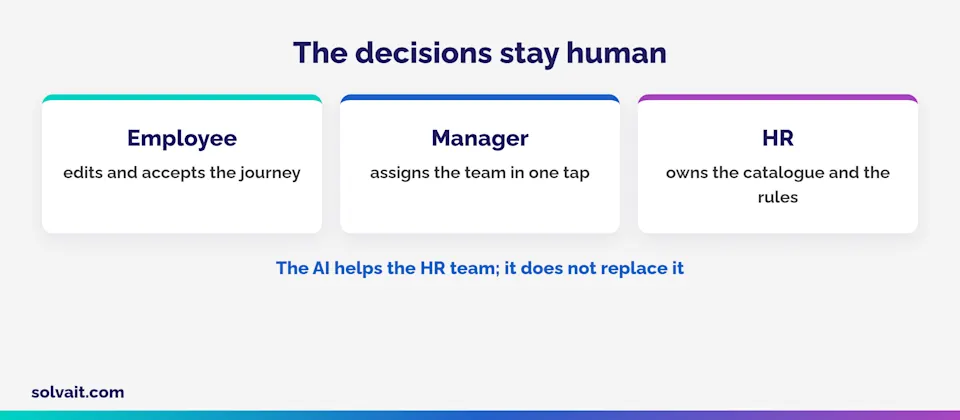
Saudi Energy made learning a habit its people come back to the moment it stopped asking them to open a heavy system and started meeting them where they already are. Solvait kept the HR system of record exactly where it was and built We Learn 2.0 on top of it: a mobile first learning app with an agentic AI learning companion called Sahar that turns each employee's goal into a full learning journey drawn from the company's own catalogue. And the decisions stayed human at every step. The employee edits and accepts the journey, the manager assigns, and the HR team owns the catalogue and the rules.
Key takeaways
The system of record stayed in place, with the layer employees actually touch built above it. No rip-and-replace, no risk to years of data.
Sahar, an agentic AI learning companion, reads the employee's goal and builds a full learning journey from the company's courses.
The app is mobile first, so it reaches field crews, not only people at a desk.
People keep the decisions: the employee edits and accepts, the manager assigns in one tap, and HR sees the whole picture.
Why wasn't learning reaching employees at Saudi Energy?
Learning at Saudi Energy lived inside its HR system of record. The system did its job well: it kept the records. But employees rarely opened it.
Course completion stayed flat, and staff saw training as a compliance task, not a way to grow. Years of configuration, new training and new campaigns had not moved it.
Replacing the system was never on the table. It held years of HR data, and the company didn't want that risk.
A large share of its people also work in the field, away from a desk, so a portal designed for the desktop was never going to reach them.
What changed with We Learn 2.0?
Solvait kept the system of record exactly where it was and built We Learn 2.0, the layer employees actually touch, above it.
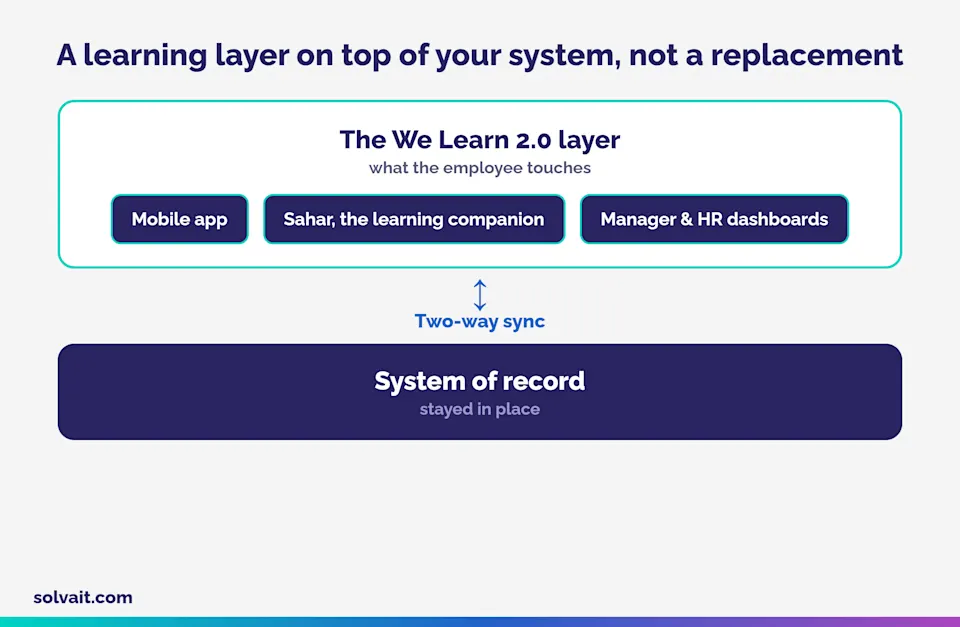
Layer | What it gives |
|---|---|
A mobile app in Saudi Energy's brand | Field crews, engineers and managers each see what is relevant to their role |
Sahar, the AI learning companion | Turns an employee's goal into a personal learning journey from the company's courses |
Employee control | Reorder or remove courses, save the journey, and track progress to a certificate |
Manager view | Shows team progress, and the manager assigns a course in one tap |
HR dashboards | Compliance and learning dashboards replace manual reports |
Two way sync | Learning history stays in one place with the system of record |
Sahar's name is the Arabic word for the hour before dawn. An employee writes a goal in Arabic or English, for example "I want to become a project manager", and Sahar builds a personal learning journey of courses from the company's own catalogue.
Why do we call Sahar agentic AI, and where do people stay in control?
An ordinary learning assistant answers questions about courses. Sahar does the work: she reads the goal, takes the employee's role and history into account, and prepares the whole journey.
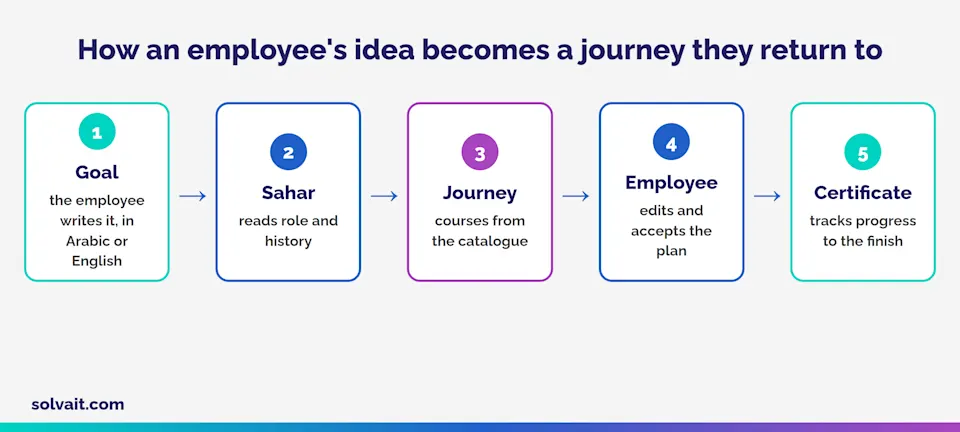
People keep every decision. The employee edits and accepts the plan, the manager assigns, and HR owns the catalogue and the rules. The AI helps the HR team; it doesn't replace it.
That difference matters for any company weighing AI for HR. You are not handing learning to a machine. You are giving your team a companion that takes the dull work off their plate and leaves the decision with whoever owns it.
How do we measure the impact?
The measures come from Saudi Energy's own figures. Until the company approves those figures, this section uses no numbers and no quote.
What we track is clear, though: course completion before and after, active learners per month, and the share of journeys started on mobile. Those measures tell you, in plain numbers, whether employees have actually come back to learning.
What can other HR teams take from this?
Don't rip out the system of record. Build the experience above it, and keep your data and your peace of mind.
Start from the employee's goal, not the course list. Let the AI do the planning work.
Design for the field before the desk. If it doesn't work on a phone, a large part of the workforce never sees it.
Keep the decisions human. The employee, the manager and HR each keep their own call.
If your team runs on an HR system you trust and don't want to give up, the idea that worked here applies to you: an agentic AI layer that sits above your system, connects to it, and leaves the decision with you. You can learn more about agentic AI for HR from Solvait.
Want to see how agentic AI could work for your HR team?
Book a demo and we will show you what a learning layer like We Learn 2.0 looks like on top of your current system.
Solvait has built HR systems for companies in Saudi Arabia and the GCC since 2010, with 300+ clients. Solvait is the agentic AI HR company.
FAQ
What is We Learn 2.0?
The learning platform Solvait built for Saudi Energy: a phone app in the company's brand, with an AI learning companion called Sahar and dashboards for managers and HR.
Was the existing HR system replaced?
No. The system of record stayed where it was, and the platform sits above it with two-way sync, so learning history stays in one place.
Who decides on the learning journey?
The employee. Sahar proposes the whole journey; the employee edits and accepts it, the manager assigns, and HR owns the catalogue.
Who is Sahar?
An agentic AI learning companion inside the platform. She reads the employee's goal, takes their role and history into account, and prepares a full learning journey from the company's courses.
Does the app reach field employees?
Yes. The app is mobile first, so it reaches field crews and engineers, not only people at a desk.
See agentic HR in action
Solvait AI HR and its agents prepare Saudi labor-law work so HR can review it before anything is submitted.
Tags
Related Posts
Agentic HR vs Automation vs Chatbots: A Plain Guide
Agentic HR is not automation and not a chatbot. A plain language guide to the difference, the four AI HR agents in Solvait AI HR, and when you need each.
Oct 20, 2026
Agentic AI for HR Compliance in Saudi Arabia
Mutaba'aa is an agentic AI for HR that watches your Saudi deadlines across GOSI, Qiwa, Mudad and the Wage Protection System.
Oct 14, 2026

AI Payroll Error Detection: Catch Gaps Before You Post
How AI payroll error detection flags pay discrepancies before posting by comparing expected vs found and holding the wrong line.
Oct 11, 2026