

Leave Approval Routing: Who Approves When the Manager Is Away
Leave approval routing is defining in advance who holds the authority to approve a leave request in every case, including when the line manager is away, so the request never stalls. The direct answer: when the manager is out, a pre-named delegate approves the request; if none exists, it escalates to the next-level manager, and HR is the final safety net. The point is not a specific person, but a written rule and a clear delegation of authority set up before anyone travels.
Under Saudi labor law, an employee is entitled to annual leave of no less than 21 days, rising to 30 days after five years, and the employer may set the timing according to work requirements (Article 109). So approval is a high frequency decision, and any stall means an employee waiting and leave pay that may be delayed. The fix is to design the route, not to wait for the manager to return.
Key takeaways
When the manager is away, leave is approved by a pre-named delegate, then the next-level manager, then HR.
Leave approval routing is a written rule plus delegation of authority, set up before the absence, not after.
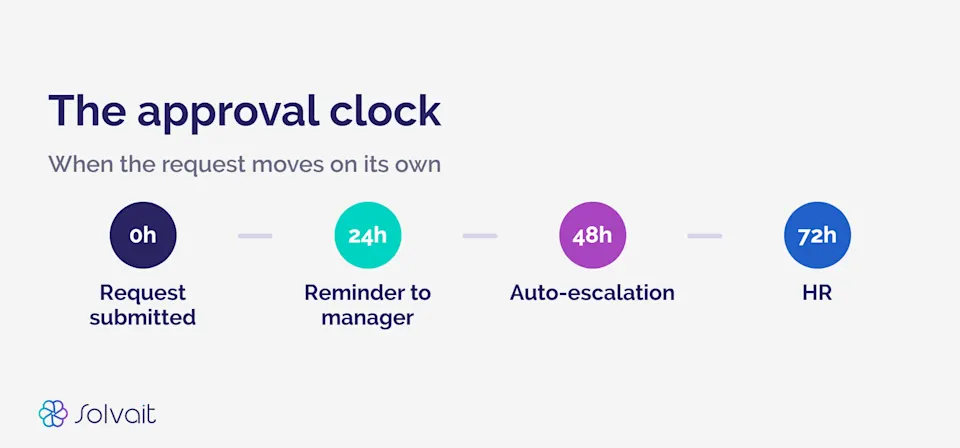
A time threshold for escalation (for example 48 hours) stops requests from sitting idle.
An HR self-service portal runs the routing and delegation automatically, with a full record of every approval.
Accurate approval updates the balance instantly, so the leave balance at end of service is correct at settlement.
Who approves leave when the manager is away?
When the line manager is out, a leave request should never sit waiting for their return. The principle is simple: every approval authority has a pre-defined backup. This is delegation of authority, and it protects the employee and the employer at once. Because the employer sets leave timing according to work requirements under Article 109, approval authority must stay live at all times, not pause because one person traveled. The difference between an organized company and a chaotic one is having this rule in place before it is needed. The table below sums up who approves in the most common absence cases:
Scenario | Who approves | The rule |
|---|---|---|
Manager traveling, delegate pre-set | The delegate (deputy) | Delegation activates automatically from the travel date |
Sudden absence, no delegate | Next-level manager | Immediate escalation after a short time threshold |
Manager on long leave | The delegate for the whole period | Delegate is named before the leave starts |
No delegate defined at all | HR | Final safety net, with the case logged to fix the rule |
The golden rule: never leave the "delegate" field empty for any manager. An empty field today is a stalled request tomorrow. How do you build an approval route that never stalls? A good route is a clear chain in which every party knows its role, and authority passes automatically at any break. Build it on five ordered links:
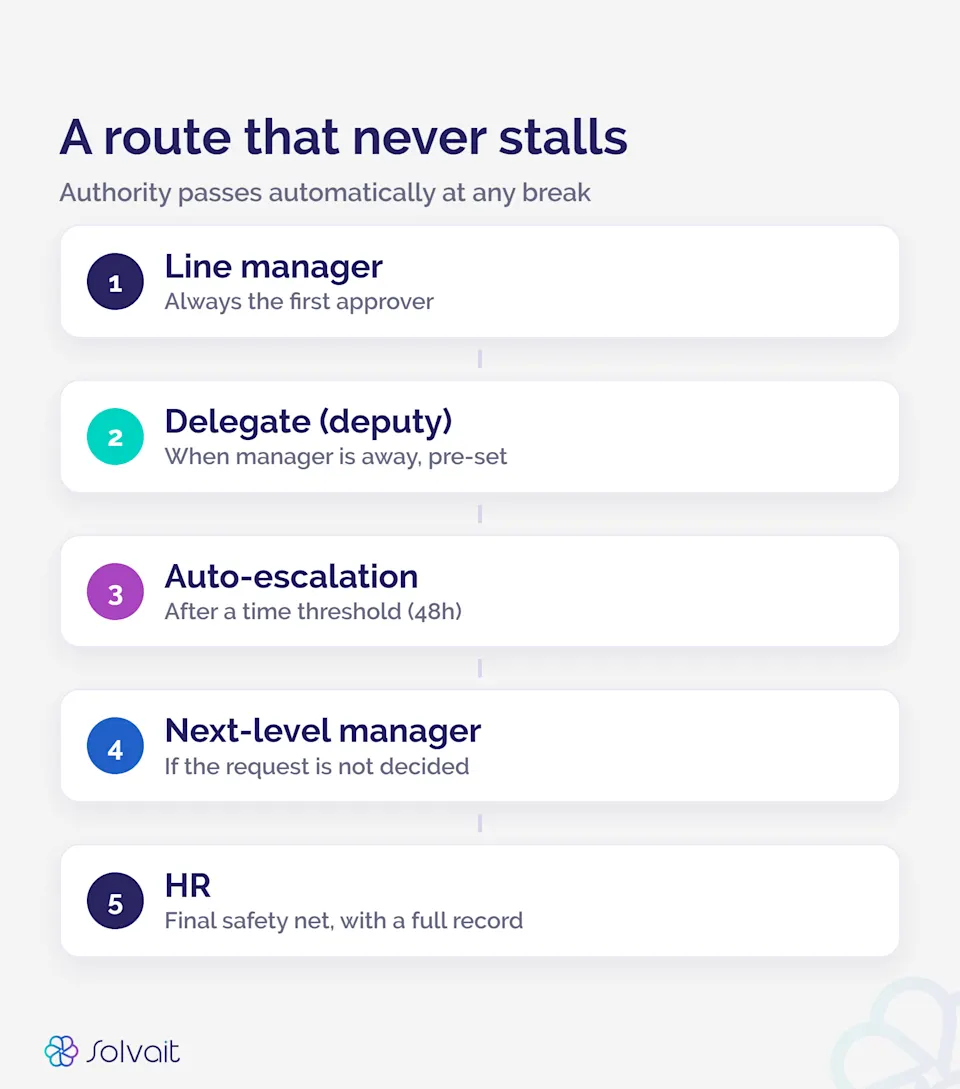
The line manager is always the first approver.
Name a delegate (deputy) for every manager in advance, not when the need arises.
Activate delegation automatically when the manager is away (leave or travel), not manually.
Set a time threshold for escalation to the next level manager if the request is not decided within it.
Make HR the final safety net, with a full record of every step.
The most important element is the time threshold. Without it, a request "waits for the manager" indefinitely. With a clear threshold, the request moves on its own. The timeline below is a practical example:
And separate two roles that are often confused: who approves (holds the decision) and who is notified (knows only). Confusing them creates requests waiting on someone who has no authority to approve in the first place.
How do you automate routing with a self-service portal and an agent?
Manual routing over chat and email collapses at the first absence. The fix is to let the route live inside an HR self service portal: the employee submits the request, it routes itself to the correct approver, it escalates automatically on delay, and all of it is logged.
This is not a luxury in Saudi Arabia. The Qiwa platform passed 14.5 million registered users in the first half of 2025 and topped the government's Digital Maturity Index for 2024. When official labor transactions are this digital, an internal paper based route becomes the slowest link in the company.
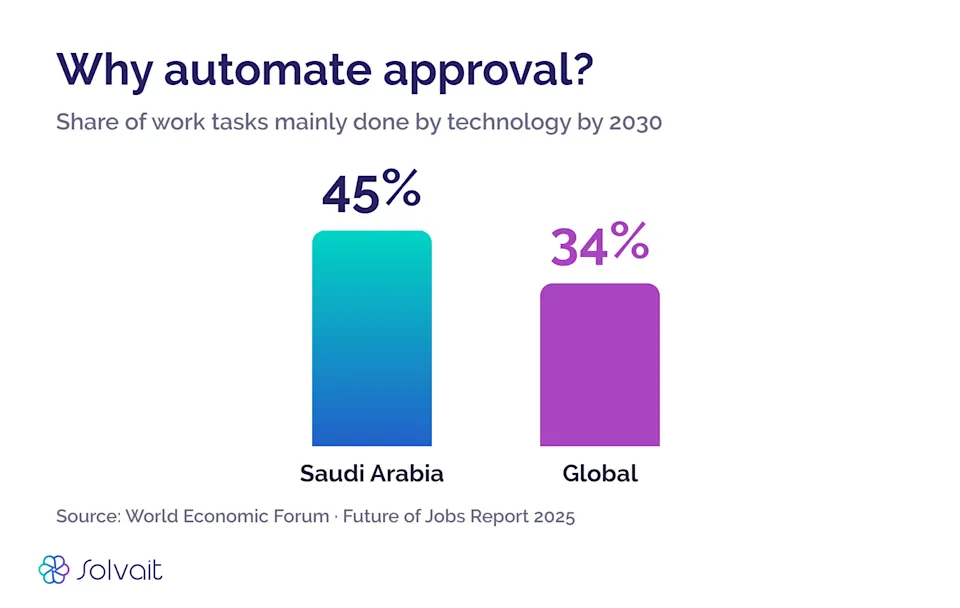
The numbers confirm the direction. Employers in Saudi Arabia expect technology to mainly perform 45% of work tasks by 2030, against 34% globally (World Economic Forum, 2025). Leave approval, with its repeatable, clear rules, is among the first things automated.
But the tool alone is not enough. Gartner reports that 88% of HR leaders say their organizations have not yet realized significant business value from AI tools (2025). The reason is usually that the tool was bolted onto a route that was never designed. Value comes when you design the routing and delegation rule first, then let the tool run it.
One last practical benefit: automated approval updates the balance in real time. The leave balance stays correct throughout service, and the leave balance at end of service is right when you compute final dues, with no disputes.
What are the common mistakes in leave approval routing?
Empty delegate field: a manager with no named deputy means requests freeze at the first trip.
Verbal delegation with no record: "so and so approves for me" is not enough; no trace, no accountability.
No time threshold: with no response deadline, requests sit open indefinitely.
Confusing approver with notified: sending the request to someone who has no decision authority.
Not updating the balance: an approval that does not reflect instantly on the balance confuses settlement and end-of-service dues.
Where Solvait fits
Solvait is the agentic AI HR company, and it handles this route in three layers:
HR Assistant is an AI assistant that executes, not just suggests: it submits the leave request, routes it to the rightapprover, escalates it on delay, and answers the employee's balance directly.
Everything's App is the mobile self-service app for leave, excuses, and approvals, so a manager or their delegateapproves from anywhere.
Solvait AI HR is the full platform that ties routing, delegation, and escalation to labor-law rules, with the Mutaba'aa agent monitoring compliance and keeping a full record of every approval.
The result is concrete: Solvait clients see up to 50% time savings and go live within 30 days, with more than 300 clients across Saudi Arabia and the Gulf.Start with the simplest step today: switch on routing and delegation in your self service portal so no leave request stalls when a manager is away.
Ready for an approval route that never stalls? Book a demo with Solvait.
Frequently asked questions
Who approves leave when the manager is away in Saudi Arabia?
A pre-named delegate (deputy) for that manager approves it. If no delegate exists, the request escalates automatically to the next level manager, and HR remains the final safety net. The key is a written delegation rule that is active before the manager's absence, not after it.
Can the employer set the timing of annual leave?
Yes. Under Article 109 of the Saudi labor law, an employee is entitled to no less than 21 days of annual leave (30 days after five years), and the employer may set the timing according to work requirements. This is exactly why approval authority must stay live and delegated at all times.
What is the difference between who approves leave and who is notified?
The approver holds the authority to accept or reject. A notified person is shown the request for information only, with no authority. Confusing the two roles is a common cause of stalled requests, because they wait on someone who cannot actually approve.
How do you stop a leave request from stalling?
Set a time threshold for escalation: if the request is not decided within a set period (for example 48 hours), the system escalates it automatically to the next approver. That time rule, inside a self-service portal, is what turns the route from waiting for the manager into automatic movement.
How does leave approval affect end-of-service balance?
Every approval must deduct from the balance immediately. If the update is late or manual, the balance drifts, and the dispute surfaces at settlement. Automated routing updates the balance the moment of approval, so the leave balance at end of service stays accurate and auditable.
References
Ministry of Human Resources and Social Development: Annual leave in the labor law (Article 109), 2024 (leave entitlement and the authority to set its timing).
World Economic Forum: Future of Jobs Report 2025, 2025 (45% of tasks in Saudi Arabia vs 34% globally by 2030).
Gartner: HR leaders and value from AI tools, 2025 (88% have not yet realized significant value).
Qiwa platform: Qiwa passes 14.5M registered users in H1 2025, 2025 (digitization of labor transactions in Saudi Arabia).
Solvait: Official Solvait site, 2026 (50% time savings, 30-day setup, 300+ clients).
See agentic HR in action
Solvait AI HR and its agents prepare Saudi labor-law work so HR can review it before anything is submitted.
Tags
Related Posts

Agentic HR vs Automation vs Chatbots: A Plain Guide
Agentic HR is not automation and not a chatbot. A plain language guide to the difference, the four AI HR agents in Solvait AI HR, and when you need each.
Oct 20, 2026

Vision 2030 Is Rewriting the Saudi HR Stack
Vision 2030 changed Saudi Arabia's labour market and compliance faster than legacy systems can keep up. Why Saudi CHROs have to rethink the HR stack now.
Sep 21, 2026

AI Employee Data Validation Before Payroll
Solvait's AI Employee Data Validation scans employee data before payroll, and validates the payout itself before payday.
Nov 10, 2026